DeepSeek V4.1 Flash API Pricing: 552B Guide
DeepSeek V4.1 Flash was released on September 10, 2026 with open weights and the official API model name deepseek-flash. It accepts text and image input, generates text, and uses a new asymmetric design: a 552B backbone with about 8B active parameters per token during input processing and about 16B during output generation. See the official DeepSeek release note.
For developers, the update matters in three practical areas: stronger agent-task performance, lower long-context cache cost, and routing changes behind old model names. The most important migration item is deepseek-v4-pro: DeepSeek announced that after 12:00 on September 14, 2026 Beijing time, this route would temporarily point to V4.1 Flash until a future V4.1 Pro release.
The images below use DeepSeek's official release assets. Benchmark numbers are vendor-published and have not been independently retested by this site.
DeepSeek V4.1 Flash key specifications
| Item | Published information |
|---|---|
| Release date | September 10, 2026 |
| Official API model name | deepseek-flash |
| Model type | Native multimodal MoE: text/image input, text output |
| Backbone size | 552B parameters |
| Active parameters | 8B for input / 16B for output |
| Core architecture | Causal Encoder-Decoder, or CED |
| Context window | 1M tokens |
| Maximum API output | 384K tokens |
| Global KV Cache | 890 bytes/token, about one quarter of the previous V4 Flash |
| Weight and repository license | MIT |
The parameter and architecture claims should be checked against the official model card. Context length, output limit, and API features should be checked against the official pricing and model specification page. Some summaries round the model to 550B; this article uses DeepSeek's official 552B wording.
If you want to call the model through this site, first check the live model pricing page. DeepSeek's direct API launch and third-party gateway availability are separate things; configure the actual model ID shown in the current catalog, and treat this site's catalog, response, and ledger as authoritative for gateway billing.
What do 552B, 8B, and 16B mean?
MoE models do not activate every parameter for every generated token. 552B describes the model backbone. 8B and 16B describe the active compute scale per token in different phases. They are not interchangeable "model sizes."
DeepSeek V4.1 Flash uses a 40-layer CED backbone: 20 causal encoder layers and 20 decoder layers. According to the model card, the decoder's global KV Cache is projected from the encoder's final hidden state rather than generated independently by every decoder layer. This allows input processing and output generation to use different compute scales.
For repository analysis, long-document reading, and multi-turn tool use, this design mainly reduces the burden of processing large inputs repeatedly. It does not mean quality can be judged only by the active-parameter number, and it does not mean self-hosting only needs to load 8B parameters.
Agent benchmarks: V4.1 Flash versus V4 Pro
The table below mirrors the official model-card comparison. The delta column is an absolute score difference, not a percentage change.
| Benchmark | V4 Pro | V4.1 Flash | Delta |
|---|---|---|---|
| DeepSWE v1.1 | 62.7 | 74.2 | +11.5 |
| Terminal-Bench 3.0 | 11.8 | 30.0 | +18.2 |
| AutomationBench | 43.2 | 54.8 | +11.6 |
| CyberGym | 83.3 | 88.1 | +4.8 |
| GPQA Diamond | 92.4 | 90.9 | −1.5 |
The first four results suggest a clear improvement for coding, terminal, and automation workloads. GPQA Diamond remains slightly below V4 Pro, so the accurate summary is stronger agent capability, not universal superiority across every benchmark. See the official evaluation table and settings.
Runtime also matters. The official Instruct comparison uses high reasoning intensity with temperature=1.0 and top_p=0.95. The reported DeepSWE v1.1 score of 74.2 corresponds to the mini-SWE environment; the same model reports 72.6 under DSH Minimal. Model version, task set, agent framework, and reasoning budget all affect the result.
For model selection, test three representative tasks from your own workload: a code fix with existing tests, a terminal task requiring multiple commands, and a document or screenshot task. Completion rate, elapsed time, and final bill are more useful than one leaderboard number.
API pricing: CNY 1 input and CNY 4 output per million tokens off peak
The official price took effect at 12:00 on September 10, 2026 Beijing time. The following table shows DeepSeek's direct API RMB price in CNY per million tokens, not this site's gateway price. Source: official pricing page.
| Billing item | Off-peak | Peak |
|---|---|---|
| Input: cache hit | ¥0.02 | ¥0.04 |
| Input: cache miss | ¥1.00 | ¥2.00 |
| Output | ¥4.00 | ¥8.00 |
Peak hours are Monday to Friday, 09:00–12:00 and 14:00–18:00 Beijing time. All other hours are off-peak, including weekends. Use these explicit windows rather than inferring Chinese holiday make-up days.
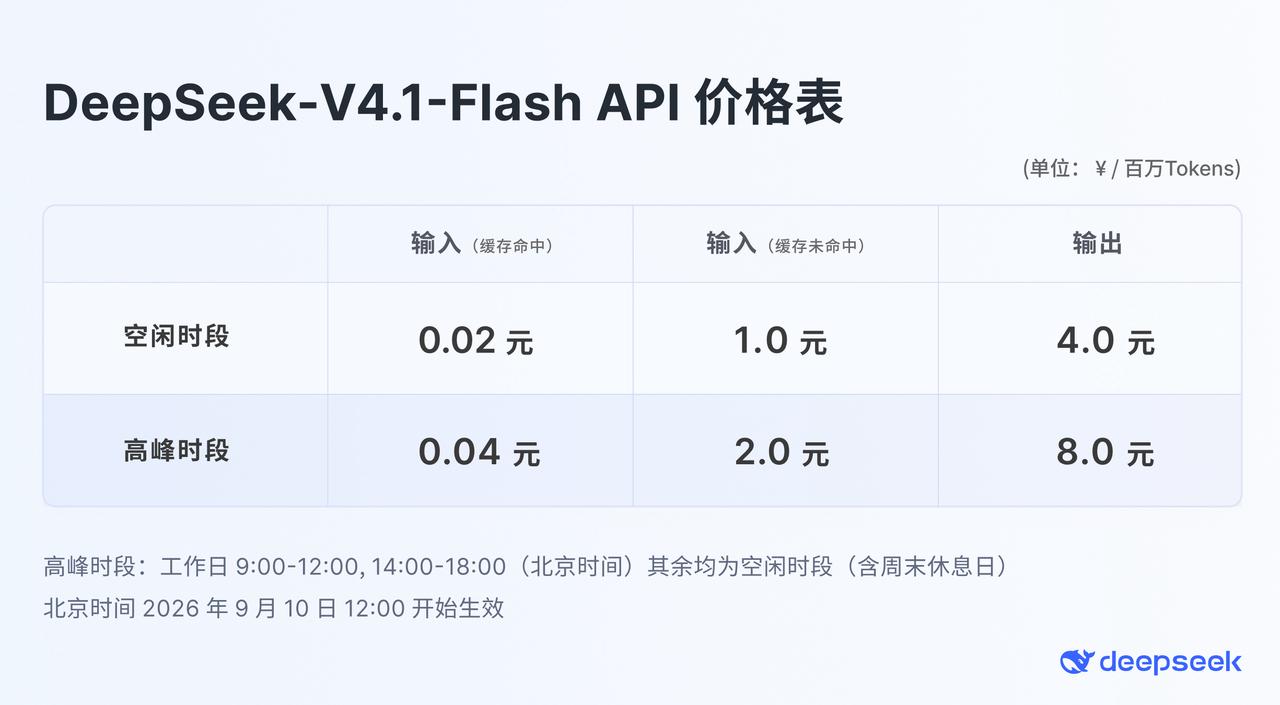
Image source: DeepSeek official release. The original image is unchanged. Prices may change, and third-party providers bill independently.
A reproducible agent-billing example
Assume a batch of tasks uses 8 million cache-hit input tokens, 2 million cache-miss input tokens, and 0.5 million output tokens, all in the same billing tier:
Total cost = cache-hit input millions × cache-hit price
           + cache-miss input millions × cache-miss price
           + output millions × output price

Off-peak: 8 × 0.02 + 2 × 1 + 0.5 × 4 = CNY 4.16
Peak:     8 × 0.04 + 2 × 2 + 0.5 × 8 = CNY 8.32
The cache-hit and cache-miss input prices differ by 50×, but the whole task is not automatically 50× cheaper. In this example, cache-hit input costs only CNY 0.16 off peak, while cache-miss input and output cost CNY 2 each. Optimizing an agent means watching cache reuse, tool-loop length, output volume, and retry behavior.
Why the smaller KV Cache matters for long sessions
KV Cache stores intermediate context computation. For agents that repeatedly read the same repository, system instructions, and conversation history, stable prefix reuse can avoid duplicate work. DeepSeek says V4.1 Flash compresses the global KV Cache to 890 bytes per token, about one quarter of V4 Flash. See the architecture section of the official model card.
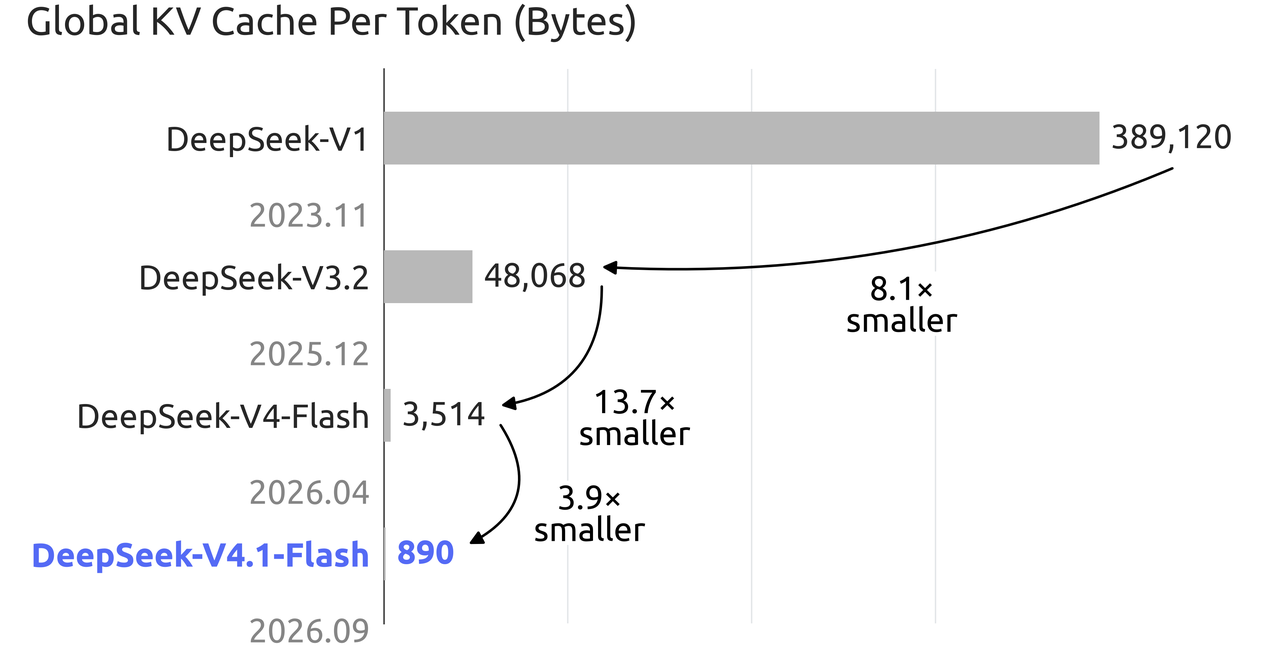
Image source: DeepSeek official release. The chart compares global KV Cache per token, not total deployment memory.
Keep the storage terms separate: DeepSeek says cache-related HBM demand falls to about 1/4 and SSD demand to about 1/8. That statement is about cache resources, not total model weights, full runtime memory, or every deployment-cluster requirement.
For API users, keep reusable reference prefixes stable. Avoid adding changing timestamps, random IDs, or reordered tool lists to the prefix on every turn. Then inspect actual usage fields to confirm cache hits; "the content looks similar" is not proof of a cache hit.
How to call the DeepSeek V4.1 Flash API
New integrations should use the official model name deepseek-flash. The example below uses DeepSeek's direct Chat Completions endpoint. Set DEEPSEEK_API_KEY in your terminal before running it. This sample has not been validated as a paid call through this site.
curl https://api.deepseek.com/chat/completions \
  -H "Authorization: Bearer ${DEEPSEEK_API_KEY}" \
  -H "Content-Type: application/json" \
  -d '{
    "model": "deepseek-flash",
    "messages": [
      {
        "role": "user",
        "content": "List implementation steps, edge cases, and acceptance checks for a Markdown batch-renaming tool."
      }
    ],
    "thinking": {"type": "enabled"},
    "reasoning_effort": "high",
    "max_tokens": 2048,
    "stream": false
  }'
The response should be JSON, with the answer text in choices[0].message.content. During validation, check the HTTP status, content, and usage fields; do not only check whether the request was sent. See DeepSeek's first-call guide.
Native vision means image understanding, not image generation. For screenshots, add image content blocks according to the official vision guide. A successful text request does not replace separate checks for image input, tool use, and streaming.
If you call through a third-party gateway, verify the Base URL, model ID, authentication method, and supported protocol together. Replacing only the official host URL is not enough to guarantee identical features or billing.
Do old model names still work?
| Current model name | Official handling |
|---|---|
deepseek-flash |
Recommended new name; calls V4.1 Flash |
deepseek-v4-flash |
Old model is offline; name remains temporarily compatible and routes to V4.1 Flash |
deepseek-v4-flash-vision-exp |
Old model is offline; name remains temporarily compatible and routes to V4.1 Flash |
deepseek-v4-pro |
After 12:00 on 2026-09-14 Beijing time, and until a future V4.1 Pro launch, routes to V4.1 Flash and uses the new Flash price |
This is the official DeepSeek API arrangement. Third-party gateways may use different aliases or migration windows. Keeping an old name does not lock the old model, and it is not a rollback plan to old weights.
A safe migration sequence is: export current model names and key request samples; test the new name with text, image, tool, and cache-usage cases; then update client defaults, task templates, and billing checks. For reproducible tasks, record call date, provider, and response metadata rather than only the legacy alias.
What changed in DeepSeek Harness v0.1.5?
The model performs reasoning; Harness connects files, commands, and tools so model output can become executable work. With this model release, DeepSeek Harness was updated to v0.1.5 and adapted for standard mode, programmatic tool calling (PTC), and minimal mode.
According to the release material, the new version supports image and PDF uploads, workspace file trees, artifact previews, improved long-session recovery and navigation, stronger parent-child agent communication, queued messages, and task intervention. Experimental Agent Teams can divide work through a shared task list, but they are disabled by default and should be budgeted for extra token usage when enabled.
On a system with Node.js installed, start it from the official repository:
npx @deepseek-ai/dsh web
After launch, enter a DeepSeek API key in the web UI, select a workspace, and submit a task. This command fetches the package available at runtime; it does not pin v0.1.5. Record the actual package version if you need reproducibility.
Start with a small, auditable task:
Read the current workspace documentation and create a Markdown getting-started guide.
Include startup commands, required configuration, and one minimal validation step.
Only add docs/getting-started-draft.md. Do not change business code.
After finishing, verify whether referenced paths exist and list anything you could not confirm.
The expected output is a real Markdown file, not just a chat message saying "done." Check that the file exists, paths are correct, and startup commands have a source before expanding the workflow. More client setup notes are available in this site's tutorials.
Can you self-host it on an ordinary PC?
No. You cannot infer "8B-class hardware is enough" from the fact that input processing activates about 8B parameters. The V4.1 Flash backbone is still 552B, and real deployment depends on weight precision, runtime support, cache, concurrency, and storage.
The model weights use the MIT license. Start with the official model repository and technical report. The release mentions large-scale deployment cooperation for teams with roughly 2,000 GPUs and storage-cluster resources; that is a cooperation condition, not a published minimum hardware requirement.
For teams whose main goal is application delivery, agent execution, or business validation, using the API first is usually the faster way to get quality and cost data before evaluating self-hosting.
FAQ
Is DeepSeek V4.1 Flash 550B or 552B?
DeepSeek's release page and model card use 552B for the backbone parameter count. 550B is a rounded summary used by some secondary articles.
What is the API model ID?
DeepSeek recommends deepseek-flash. Do not invent deepseek-v4.1-flash from the display name; a third-party alias does not make it the official API name.
Does CNY 0.02 buy one million arbitrary tokens?
No. CNY 0.02 per million tokens applies only to off-peak cache-hit input. Cache-miss input, output, and peak hours use different prices.
Does V4.1 Flash support vision and image generation?
It supports text and image input and generates text, so it is suitable for screenshot understanding and chart analysis. The model card does not define it as an image-generation model.
Is V4 Pro already fully offline?
As of the article date, September 10, 2026, DeepSeek had announced the September 14 12:00 routing change; it should not be written as already completed before that time. The two older Flash models were already offline, with names temporarily kept compatible.
Does this site bill by DeepSeek's peak/off-peak table?
Do not assume that. The table above describes DeepSeek's direct API. This site's model IDs, availability, and billing should be checked on the live pricing page and in the actual ledger. After confirming the target model, start with a small test from the buy page.
Bottom line: validate task cost before migrating configuration
DeepSeek V4.1 Flash combines native vision, asymmetric compute, and a more compact context cache. For agents with long input and repeated tool calls, it is worth validating on real tasks. For existing API applications, the urgent work is to confirm old-alias routing and the September 14 V4 Pro transition window.
The practical sequence is: confirm the model ID → test your own tasks → check cache and output billing → update configuration. That is how a model release becomes a measurable application upgrade.
Sources
- DeepSeek V4.1 Flash official release: release date, 552B structure, price effective time, and migration plan.
- DeepSeek V4.1 Flash model card: CED architecture, evaluation table, test settings, KV Cache, and MIT license.
- DeepSeek models and pricing: RMB peak/off-peak prices, context, and output limits.
- DeepSeek first-call guide: current model ID, request sample, and compatibility notes.
- DeepSeek vision guide: image-input capability and format.
- DeepSeek Harness repository: startup method and developer-preview status.
- Additional release material: WeChat article 1, WeChat article 2.
Sources checked on September 10, 2026. This article is a release interpretation and integration guide, not an independent benchmark.