DeepSeek-V4-Flash-Vision-Exp API Guide 2026
DeepSeek launched its first official multimodal API model, deepseek-v4-flash-vision-exp, on August 21, 2026. It adds image understanding to the text, reasoning, and agent capabilities of DeepSeek V4 Flash, with a 1M-token context window, up to 384K output tokens, and a maximum charge of 384 input tokens per image at the direct V4 Flash API price.
The exp suffix means experimental. The route is callable on DeepSeek's official API, but it should not be described as a long-term stable release. This guide separates DeepSeek's official specifications and vendor benchmarks, third-party examples, and this gateway's public route state. When checked on August 22, 2026, this gateway's public pricing catalog did not yet list the new ID, so this article does not guess a gateway multiplier.
Check the live route first: confirm that
deepseek-v4-flash-vision-expappears in model pricing before opening a small balance from the API purchase page. Availability and billing records remain authoritative at request time.
DeepSeek-V4-Flash-Vision-Exp key stats
| Item | Officially published information |
|---|---|
| Release date | August 21, 2026 |
| Exact model ID | deepseek-v4-flash-vision-exp |
| Release status | Experimental multimodal API model |
| Context window | 1M tokens |
| Maximum output | 384K tokens |
| Image token use | Dimension-based; no more than 384 tokens per image |
| Maximum images per request | 600 |
| Input methods | Text + image via base64, external URL, or Files API file_id |
| API formats | Chat Completions, Anthropic Messages, and Responses API |
| Tool calls | Supported |
| Thinking modes | Thinking and non-thinking; thinking is the default |
| FIM completion | Not supported |
| Official concurrency limit | 2,500 |
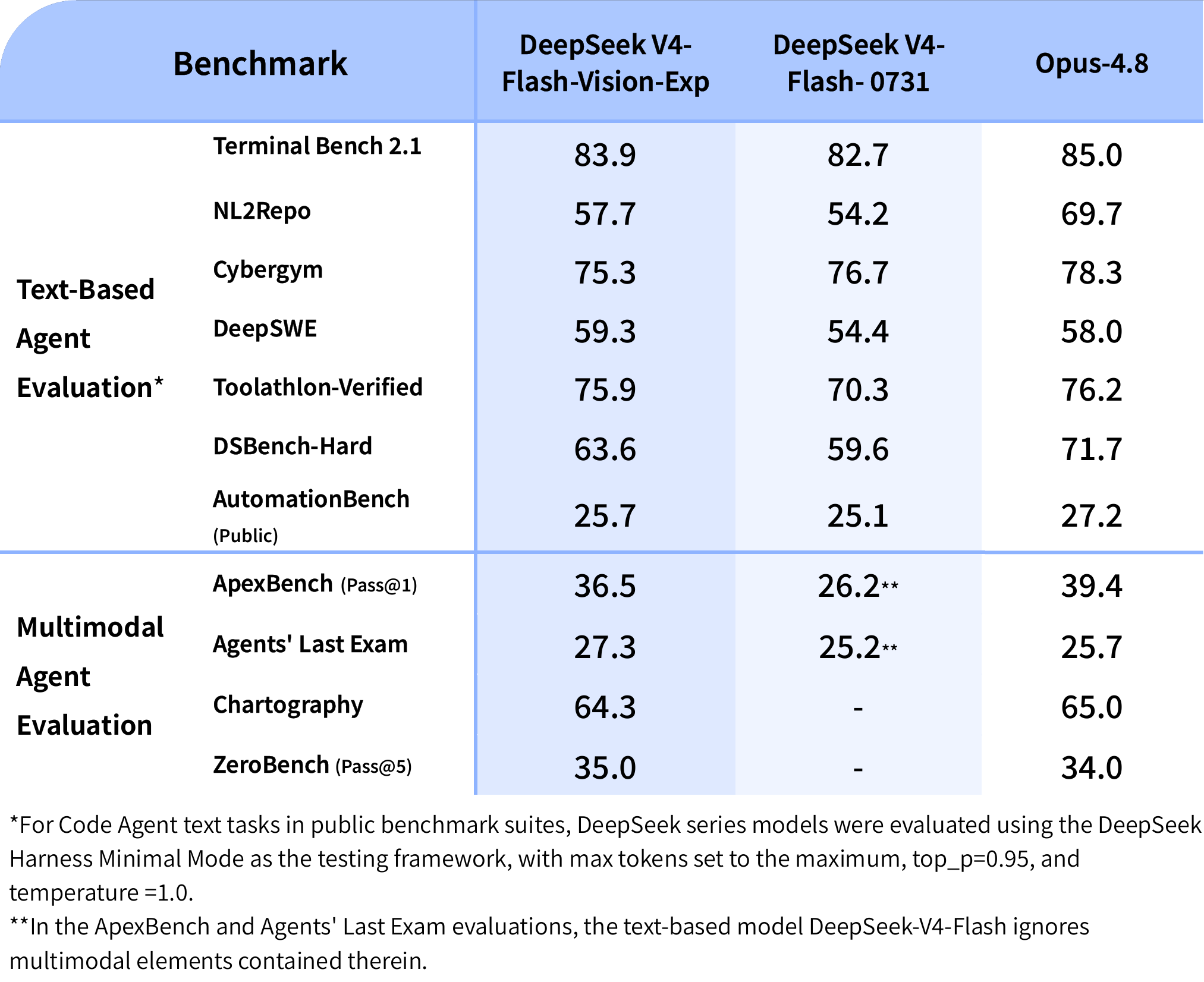
Source: DeepSeek's August 21, 2026 release. These are vendor-published evaluations, not independent tests by this site.
Benchmark analysis: close to Opus-4.8 is not the same as winning every test
DeepSeek says V4-Flash-Vision-Exp makes a major leap over V4 Flash on multimodal agent benchmarks and brings overall performance close to Opus-4.8. The published table supports that positioning, but the individual results show a mixed comparison rather than a clean sweep.
| Benchmark | Vision-Exp | V4-Flash-0731 | Opus-4.8 |
|---|---|---|---|
| Terminal Bench 2.1 | 83.9 | 82.7 | 85.0 |
| NL2Repo | 57.7 | 54.2 | 69.7 |
| Cybergym | 75.3 | 76.7 | 78.3 |
| DeepSWE | 59.3 | 54.4 | 58.0 |
| Toolathlon-Verified | 75.9 | 70.3 | 76.2 |
| DSBench-Hard | 63.6 | 59.6 | 71.7 |
| AutomationBench (Public) | 25.7 | 25.1 | 27.2 |
| ApexBench (Pass@1) | 36.5 | 26.2 | 39.4 |
| Agents' Last Exam | 27.3 | 25.2 | 25.7 |
| Chartography | 64.3 | — | 65.0 |
| ZeroBench (Pass@5) | 35.0 | — | 34.0 |
Vision-Exp is above the pictured Opus-4.8 result on DeepSWE, Agents' Last Exam, and ZeroBench, while it remains behind on Terminal Bench, NL2Repo, and DSBench-Hard. It scores higher than V4-Flash-0731 on eight of the nine directly comparable rows, with Cybergym as the exception.
Evaluation conditions matter. DeepSeek ran the public text-based Code Agent tasks with DeepSeek Harness Minimal Mode, maximum output tokens, top_p=0.95, and temperature=1.0. On ApexBench and Agents' Last Exam, the text-only V4 Flash model ignores multimodal elements, so those rows are not an equal comparison between two vision models.
What does a 384-token image actually cost?
DeepSeek resizes and tiles an image based on its dimensions, then bills the result as input tokens. The maximum is 384 tokens per image. Multiple images are counted independently; there is no shared 384-token ceiling for the whole request.
The direct API lists Vision-Exp at the same price as V4 Flash:
| Direct DeepSeek API | Off-peak | Peak |
|---|---|---|
| Cache-hit input / 1M tokens | $0.007 | $0.014 |
| Cache-miss input / 1M tokens | $0.22 | $0.44 |
| Output / 1M tokens | $0.66 | $1.32 |
Using the conservative case where every image reaches 384 tokens and is billed as cache-miss input, 1,000 images cost about $0.0845 off-peak or $0.169 peak for the image input alone. This excludes text input, model output, tool loops, and retries.
DeepSeek's Chinese pricing page lists the regional CNY rates as CNY 1.50/M off-peak and CNY 3.00/M peak for cache-miss input. Under the same maximum-image assumption, 1,000 images cost about CNY 0.576 or CNY 1.152 in image input. The USD and CNY tables are regional official prices, not a live foreign-exchange conversion.
The supplied Chinese report compared these costs with other vision APIs and described a 25x to 50x difference. This article does not repeat that ratio because the competing models, image-token rules, time tiers, and output charges were not verified under one consistent methodology.
Verify with a real ledger: if the model appears in this gateway's live catalog, top up an existing key with a small amount and test one non-sensitive image. Record image tokens, text tokens, output tokens, latency, and the actual charge.
Three image input methods
1. Inline base64
Encode a JPEG, PNG, GIF, or WebP as a data URL. This works for small or private temporary images. The inline request body is limited to 48 MiB, with a 32 MiB maximum for one image.
2. External URL
Provide a publicly downloadable HTTP(S) image. DeepSeek limits one URL image to 32 MiB and requires the download to finish within 60 seconds. Avoid links that depend on cookies, private-network access, or short-lived signatures unless the exact route has been tested.
3. Files API file_id
Upload an image once and reuse its file_id across requests. The official Files API is free, accepts files up to 64 MiB, and supports an optional expiry between one hour and 30 days. It reduces repeated upload bandwidth for agents that revisit the same design, dashboard, or screenshot; image tokens are still billed when the model reads the file.
Chat Completions image request
This minimal example calls DeepSeek's direct OpenAI-compatible endpoint:
curl https://api.deepseek.com/chat/completions \
  -H "Authorization: Bearer YOUR_DEEPSEEK_API_KEY" \
  -H "Content-Type: application/json" \
  -d '{
    "model": "deepseek-v4-flash-vision-exp",
    "messages": [{
      "role": "user",
      "content": [
        {"type": "text", "text": "Inspect this page screenshot and list its main sections, colors, and responsive risks."},
        {"type": "image_url", "image_url": {"url": "https://example.com/page.png"}}
      ]
    }]
  }'
Chat Completions uses an array of text and image blocks. The Responses API carries images in input_image blocks, while Anthropic Messages can use the https://api.deepseek.com/anthropic endpoint. Do not copy a Chat request body unchanged into Responses or Messages because their content-block schemas differ.
For this gateway, first confirm that the exact model ID is present in the live catalog, then use the documented gateway base URL and authentication method. Official DeepSeek availability does not prove that every third-party gateway has already enabled image forwarding, Files API, every protocol, or billing.
Practical multimodal-agent workflows
The supplied Chinese material describes two examples: rebuilding a website from a screenshot and turning a broad business brief into a B2B presentation. These are third-party demonstrations, not independent tests by this site, but they illustrate useful workflow patterns.
Screenshot to HTML
The model must identify layout, hierarchy, colors, typography, spacing, and image placement before a coding tool generates HTML, CSS, and JavaScript. A real evaluation should compare visual diffs, 375px mobile behavior, keyboard focus, hover states, and reduced-motion behavior instead of judging only one final screenshot.
Reports, slides, and design review
Vision-Exp can read charts, OCR text, visual style, and page structure, then pass that evidence to document, presentation, or coding tools. Deliverable quality still depends on the agent framework, available tools, source assets, and acceptance process. Image understanding alone does not guarantee a client-ready slide deck.
Visual acceptance for agents
An agent can inspect screenshots after important browser or desktop actions and compare the observed state with an expected result. The image-token ceiling lowers input cost for repeated visual checks, but output and tool calls remain part of the total budget.
For workloads without images, first compare the DeepSeek V4 Flash Responses API guide. For harder text-only reasoning and coding, also review the DeepSeek-V4-Pro-0813 API guide. A new experimental vision route is not a reason to move every text-only request immediately.
Image understanding is not image generation
DeepSeek's documentation defines deepseek-v4-flash-vision-exp as a model that accepts text and images to describe pictures, read screenshot text, and analyze charts. It is not listed as an image-generation model.
If a generated website or slide deck contains imagery, those assets may come from the prompt, a stock source, drawing code, another image-generation tool, or files available to the agent. A visual final product does not prove that Vision-Exp generated its images.
Production evaluation checklist
- Use the exact ID
deepseek-v4-flash-vision-exp; do not invent a dated alias. - Confirm that the current provider or gateway catalog actually lists the ID.
- Test base64, URL, and Files API separately; third-party support may differ.
- Use a small image without secrets, personal data, private URLs, or customer information.
- Log image count, image tokens, text tokens, output tokens, latency, and billing.
- Build scored tests for OCR, charts, layout, and small text instead of accepting approximate answers.
- Keep permissions around tools, network access, file writes, deletion, deployment, and payments.
- Maintain a fallback to
deepseek-v4-flash,deepseek-v4-pro, or another vision model because this route is experimental.
Key takeaways
deepseek-v4-flash-vision-expis a live experimental multimodal DeepSeek API route, not an image generator.- It has a 1M-token context window, up to 384K output, and no more than 384 input tokens per image.
- It supports Chat Completions, Anthropic Messages, and Responses API, with images supplied by base64, URL, or Files API.
- DeepSeek says multimodal-agent performance is close to Opus-4.8; its table shows three wins and several losses in that comparison.
- The direct DeepSeek API matches V4 Flash pricing, while third-party route pricing and protocol coverage must be checked separately.
- The experimental label makes acceptance tests, budgets, and a fallback route important before production use.
Frequently asked questions
Is DeepSeek-V4-Flash-Vision-Exp officially available?
Yes. DeepSeek launched it on the official API platform on August 21, 2026. It is an experimental route, not a promise of long-term stable behavior.
What is the exact model ID?
Use deepseek-v4-flash-vision-exp. Keep the lowercase hyphenated API ID instead of the capitalized display name.
Does every image always use 384 tokens?
No. The actual count follows DeepSeek's resize and tiling rules. A single image uses no more than 384 tokens, and multiple images are counted separately.
Can Vision-Exp generate images?
DeepSeek documents image understanding, OCR, screenshot reading, and chart analysis, not native image generation. Images in a generated website or deck may come from other tools or supplied assets.
How much stronger is it than V4 Flash?
Vision-Exp is higher on eight of the nine directly comparable rows in DeepSeek's table and lower on Cybergym. Vendor benchmarks do not guarantee that every text or repository task improves.
Can I reuse an image with the Files API?
Yes. Upload it once and reference the returned file_id in later requests. File storage and upload are free, but the model still bills image tokens when it processes the image.
Can I use it with Codex?
DeepSeek confirms Responses API image support, but image transport through Codex depends on the client version, content-block format, and gateway. Test plain text, image input, and tool-result images separately.
What is this gateway's Vision-Exp multiplier?
When checked on August 22, 2026, this gateway's public pricing catalog did not list the ID. Do not infer that it matches the existing deepseek-v4-flash route; consult live model pricing.
Primary sources
- DeepSeek: V4 Flash Vision Exp release: release date, model ID, multimodal positioning, vendor benchmarks, API formats, and Harness 0.1.1
- DeepSeek Vision guide: image methods, token calculation, formats, sizes, and request limits
- DeepSeek models and pricing: 1M context, 384K output, time-tiered direct pricing, 2,500 concurrency, and features
- DeepSeek Files API: uploads,
file_id, size limits, and expiry controls - DeepSeek official X announcement: original launch announcement