Xiaomi MiMo-V2.6 Pro and Flash: Open-Weight Ranking, Pricing, and CodeMidas
MiMo-V2.6 brings two multimodal models improved through large-scale RL while retaining the prior generation's official API pricing. Pro targets complex, long-horizon work; Flash is the sensible first baseline for frequent office, coding, and batch tasks. Both list a 1M context, 128K maximum output, text/image/audio/video input, and text output. Pro specs, Flash specs
At launch, Xiaomi reported MiMo-V2.6-Pro first among open-weight models on Artificial Analysis's composite intelligence index, at 46. The AA page also showed 46 on September 22, 2026. That is not proof that it wins every real task; this is an analysis of official material and the CodeMidas paper, not an independent benchmark. AA model page, release notes
Pro versus Flash
| Item | MiMo-V2.6-Pro | MiMo-V2.6-Flash |
|---|---|---|
| API ID | mimo-v2.6-pro |
mimo-v2.6-flash |
| Official positioning | Complex workflows, long reasoning, professional tasks | High-volume work and cost control |
| Input/output | Text, image, audio, video in; text out | Text, image, audio, video in; text out |
| Context/max output | 1M / 128K tokens | 1M / 128K tokens |
| First tasks to test | Cross-file changes, multi-step research, complex plans | Extraction, summaries, routine coding, batch office work |
Start with Flash to establish a cost/quality baseline, then send its failures to Pro. For costly mistakes, compare accepted deliverables rather than model labels. “Flash” does not guarantee lower latency on every network, client, or output length. This site routes only these two IDs; Xiaomi also offers UltraSpeed, but it is not available through this site.
What AA 46 means—and does not mean
AA's composite index is useful for narrowing candidates, not for deciding which model can modify your repository, operate browser tools, retry safely, or produce an acceptable deliverable. Its model page groups comparisons by model class and notes further parameter-size grouping for open-weight models. Therefore, a group-level No. 1 cannot be expanded into “better than every closed model.” Recheck the current AA page and methodology.
For developers, 46 is a reason to evaluate Pro. Migration should follow real acceptance: tests pass for code, source cells remain traceable for data, and every research citation opens.
Coding and agent benchmarks: do not merge two DeepSWE series
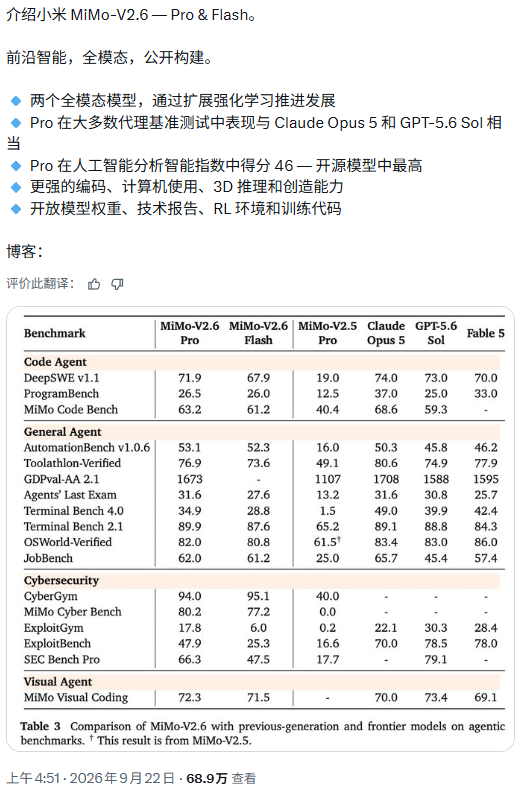
Launch-material screenshot, not this site's independent comparison.
| Launch-table metric | Pro | Flash | What it indicates |
|---|---|---|---|
| DeepSWE v1.1 | 71.9 | 67.9 | Software-engineering fixes |
| ProgramBench | 26.5 | 26.0 | Complete program construction |
| Terminal Bench 2.1 | 89.9 | 87.6 | Terminal tasks and tool use |
| MiMo Visual Coding | 72.3 | 71.5 | Programming with visual input |
The close gaps can justify trying Flash first; they do not show that production performance is interchangeable, especially in multi-turn work where an early error compounds. Separately, Xiaomi's Live RL process reports DeepSWE v1.1 moving from 58.4 to 72.6 for Pro and 48.8 to 65.7 for Flash. These are not the same numbers as the launch table; the material does not fully explain checkpoint and evaluation-setting differences, so they must not be fused into one ranking. Live RL disclosure
What did the $3.47M Live RL disclosure cover?
Xiaomi disclosed roughly $2.62M for Pro and $0.85M for Flash—about $3.47M total—in under six days, with 30 steps for each. It is the disclosed cost of this RL round, not total R&D, pretraining, data, or infrastructure cost. Training disclosure
The supplied material describes higher sample and token throughput per update, mixed coding/general-agent/vision/cybersecurity tasks and environments, and more compute for evaluation and rewards. Flash costing less in this round does not prove better business ROI; purchase decisions should use cost per accepted task.
CodeMidas: executable RL tasks from existing code
Xiaomi's CodeMidas paper addresses how to keep producing programming tasks with dependable graders without relying only on issues or commits. Starting from a working implementation, the system describes behavior, removes the core code the model must reconstruct, and retains a reasonable interface, repository structure, and dependencies. The original implementation is retained separately to produce expected outputs and validate submissions.
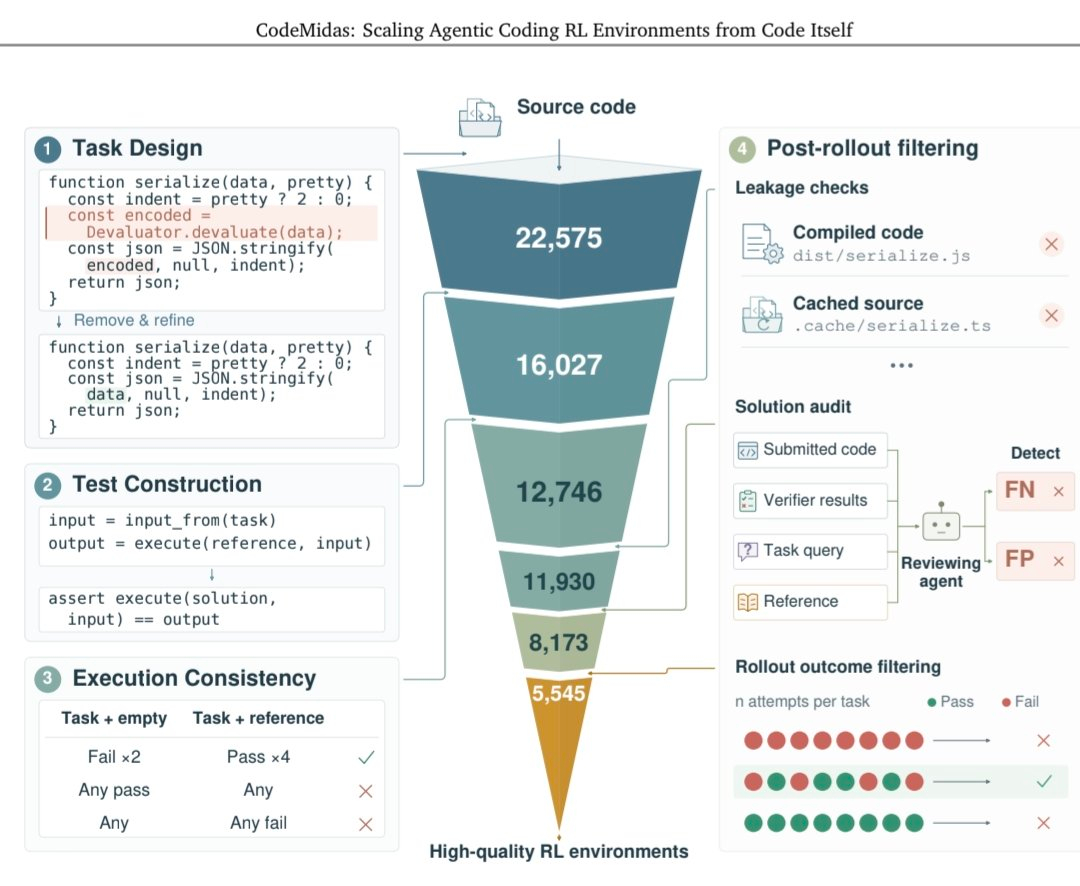
CodeMidas workflow; see Figure 1 and methods. The process also checks that environments run, compiled artifacts or caches do not leak answers, and graders do not misjudge. A reference implementation defines behavior, not the only valid internal implementation.
The paper reports 5,545 tasks from 3,185 repositories across 23 languages. Its main training experiments use MiMo-V2.5, so neither their results nor their task count can be treated as V2.6 results or added to the launch release's separate RL-environment numbers. The engineering lesson is to prepare executable acceptance conditions; “looks roughly right” cannot separate a solution from a workaround or an incomplete test.
API prices: official cache rates versus this site's multipliers
Xiaomi says V2.6 retains V2.5 API pricing. As checked on September 22, 2026, official real-time RMB pricing is per million tokens, not per request. Pro pricing, Flash pricing
| Official direct API | Cached input | Uncached input | Output |
|---|---|---|---|
| MiMo-V2.6-Pro | ¥0.025 | ¥3 | ¥6 |
| MiMo-V2.6-Flash | ¥0.02 | ¥1 | ¥2 |
Xiaomi's Batch API documentation lists separate offline batch-inference prices. That is for work without an immediate response, not merely concurrent ordinary requests, and does not mean this site exposes the same batch interface.
This site's public pricing snapshot on September 22, 2026 uses a different multiplier basis:
| Site model ID | Public multiplier | Public reference price per million tokens |
|---|---|---|
mimo-v2.6-pro |
4× | ¥1.6 |
mimo-v2.6-flash |
2× | ¥0.8 |
Source: public pricing document. Do not mix these rows with official cache/input/output columns. Before purchasing or scaling, check live model pricing and the actual configuration and bill.
Why cache hits matter for long-task cost
For official direct real-time rates, with token volumes in millions:
cost = cached-input volume × cache price + uncached-input volume × input price + output volume × output price
For Pro, 1M input tokens at 90% cache hits plus 0.1M output costs 0.9 × 0.025 + 0.1 × 3 + 0.1 × 6 = ¥0.9225; with no cache hits it costs 1 × 3 + 0.1 × 6 = ¥3.6. This is a calculation example, not a measured bill, and cannot estimate multiplier billing here. Third-party records mentioning “95.7% cache-hit rate” or “about ¥9 for five tasks” are context-specific and unreproduced; record hits, retries, reasoning output, and delivered quality yourself.
Test real work with five repeatable tasks
Third-party experience material covered 3D modeling, frontend design, real issues, office data, and long-horizon research. The following are test designs, not results achieved by this site.
| Task | Inputs | Acceptance focus |
|---|---|---|
| 3D modeling | Sourced dimensions, references, delivery format | Correct proportions, openable asset, render-review fixes |
| Frontend | Brand constraints, hierarchy, mobile requirements | Runnable responsive page, functioning buttons, compliant visual design |
| Repository fix | Fixed revision, issue, reproduction | Original failure gone; regression tests pass; no unrelated changes |
| Office data | Original page/sheet, fields, expected rows | Every row traceable; omissions detectable; corrections recorded |
| Long research | Specific question, time range, permitted sources | Citations open; facts separated from inferences; gaps declared |
Give Pro and Flash the same task, tool permissions, and acceptance standard; track first-pass rate, total time, human correction time, and final cost. total call cost ÷ accepted tasks is more useful than token price alone. MiMo Desktop can be an evaluation entry point, but its system prompts, tools, and context management mean a success there is not automatically a result for every API integration.
MiMo-V2.6 Pro / Flash API example
Both site IDs are lowercase. Verify a simple text response first, then add image and tool calls. API_KEY comes from your environment:
curl "https://api.llm-token.cn/v1/chat/completions" \
  -H "Authorization: Bearer $API_KEY" \
  -H "Content-Type: application/json" \
  -d '{"model":"mimo-v2.6-flash","messages":[{"role":"user","content":"List three executable acceptance criteria for a CSV import feature, including encoding, nulls, and duplicate rows."}],"stream":false}'
To compare Pro, change only model to mimo-v2.6-pro; retain the input and record returned model name, usage, and billing. Audio, video, and tool parameters follow the chosen service's API documentation: a model capability does not mean a client already implements its input format. See the Pro guide, Flash guide, purchase, and top-up.
FAQ
Is MiMo-V2.6-Pro really the strongest open model?
Only in the launch-time AA composite-index framing: 46 points. It does not establish superiority in every repository, research task, language, or client, and leaderboard versions and dates matter.
Can Flash replace Pro?
Evaluate Flash first for summaries, extraction, and routine coding. Compare Pro for multi-step dependencies, complex reasoning, or costly rework. Close launch-table scores do not prove universal interchangeability.
Does multimodal mean it directly outputs images, audio, or video?
No. Both official output modalities here are text. Web, 3D, or video examples usually involve generated code and external tools.
What was open-sourced?
The release lists Pro/Flash weights, a technical report, and supporting RL research resources. Check the MiMo-V2.6 collection for exact resources; licenses, dependencies, and compute still matter, and open weights do not mean ordinary hardware can reproduce training.
How does CodeMidas relate to this launch?
It is related research on constructing executable, gradeable programming RL tasks from existing functionality. Its MiMo-V2.5 experiments and V2.6 launch scores must be cited separately.
How should I read official cache pricing versus site pricing?
Xiaomi bills cached input, normal input, and output separately; this site's public material uses platform multipliers. Confirm Base URL, key, provider, current price, and bill before comparing rates.
Sources and verification
This editor's analysis was checked on September 22, 2026 and does not claim an executed model head-to-head. Images are the CodeMidas workflow and launch screenshot; unlinked third-party experience notes were used only to design evaluation questions, not as first-person claims.
- MiMo-V2.6 release notes
- Pro and Flash official pages
- Artificial Analysis model page
- CodeMidas paper and full text
- Site public pricing document; live settings: model pricing
Further reading: Qwen3.8-Omni-Flash multimodal agent guide.