Tencent Marvis vs ChatGPT / Claude: Which One Feels More Like a Real Assistant for Enterprise Office Work?
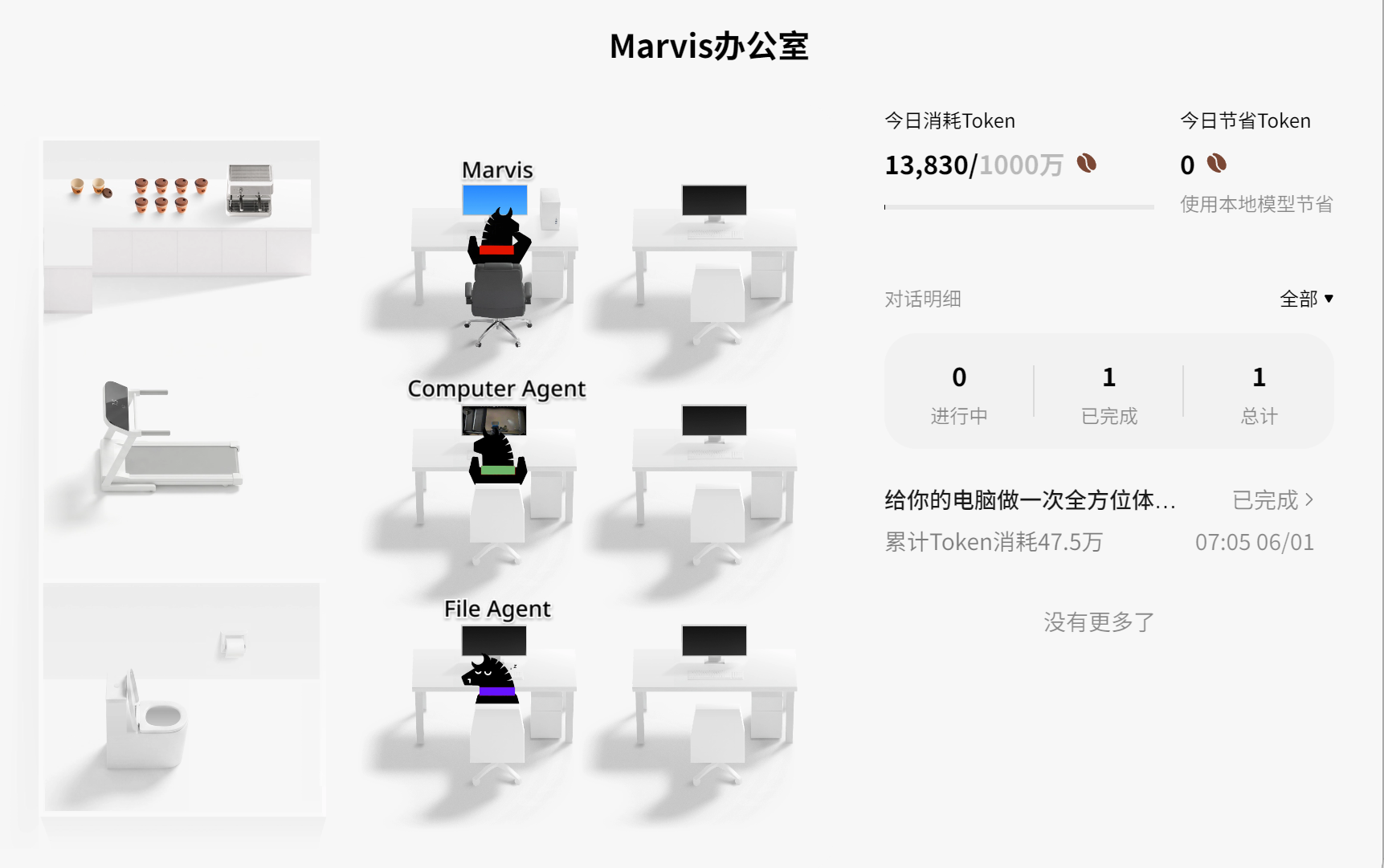
If you ask me what the biggest difference is between Marvis and ChatGPT or Claude, my answer is not really about which model is smarter.
It is this:
Which one is actually closer to landing in real enterprise office workflows.
For this comparison, I went through several public hands-on articles and focused on very concrete office tasks:
- writing weekly reports
- organizing meeting notes
- reviewing contracts
- doing data analysis
- finding files
- operating a computer
- handling PC tasks remotely from a phone
After reading them side by side, my take is pretty clear:
If your goal is the strongest general chat experience or the best long-context writing, ChatGPT and Claude still each have their own edge. But if your goal is to plug AI into the computer, local files, and enterprise office workflows, Marvis is taking a different path that feels much more like a system-level assistant.
The short verdict
- As of June 29, 2026, the core difference between
MarvisandChatGPT/Claude, based on public hands-on coverage, is not "who sounds more human." It is this:- Marvis puts much more weight on system-level execution and local file access
- ChatGPT is stronger in ecosystem breadth, plugins, and general chat experience
- Claude is stronger in long-document understanding and complex writing
- If what you care about most is:
- local mode
- privacy
- Word / Excel / file / desktop tasks
- remote PC control from a phone
then the product shape of
Marvisis much closer to enterprise office deployment.
- If what you care about most is:
- a richer plugin ecosystem
- a more mature general-purpose chat ecosystem
- ultra-long-context writing
then
ChatGPTandClaudestill have their own clear strengths.
Why enterprise office AI is not about "can it answer" but "can it take the task"
When many people compare AI tools, they still default to treating them as chat products:
- who responds faster
- whose wording sounds smoother
- who writes more naturally
But in real office workflows, the bottleneck usually is not the answer itself. It is things like:
- files live on the local computer
- data sits in spreadsheets
- contracts need to be exported into Word
- system settings need to be changed
- some tasks need to be handled remotely from a phone
- sensitive data cannot casually be sent to the cloud
In other words, the hardest part of enterprise office work is often not "no answer exists." It is this:
There is an operating system sitting between the answer and the action.
That is exactly why Marvis is worth watching. It is not just trying to be a smarter chat box. It is moving toward:
- local files
- system APIs
- remote control
- Word / Excel
- mode switching
- security confirmations
These are the parts much closer to real office work.
Comparison 1: Local mode and privacy boundaries put Marvis on a very different path from ChatGPT and Claude
In the public comparison article Marvis vs ChatGPT/Claude: A Real Comparison for Enterprise Office AI Deployment, the differences are stated very directly:
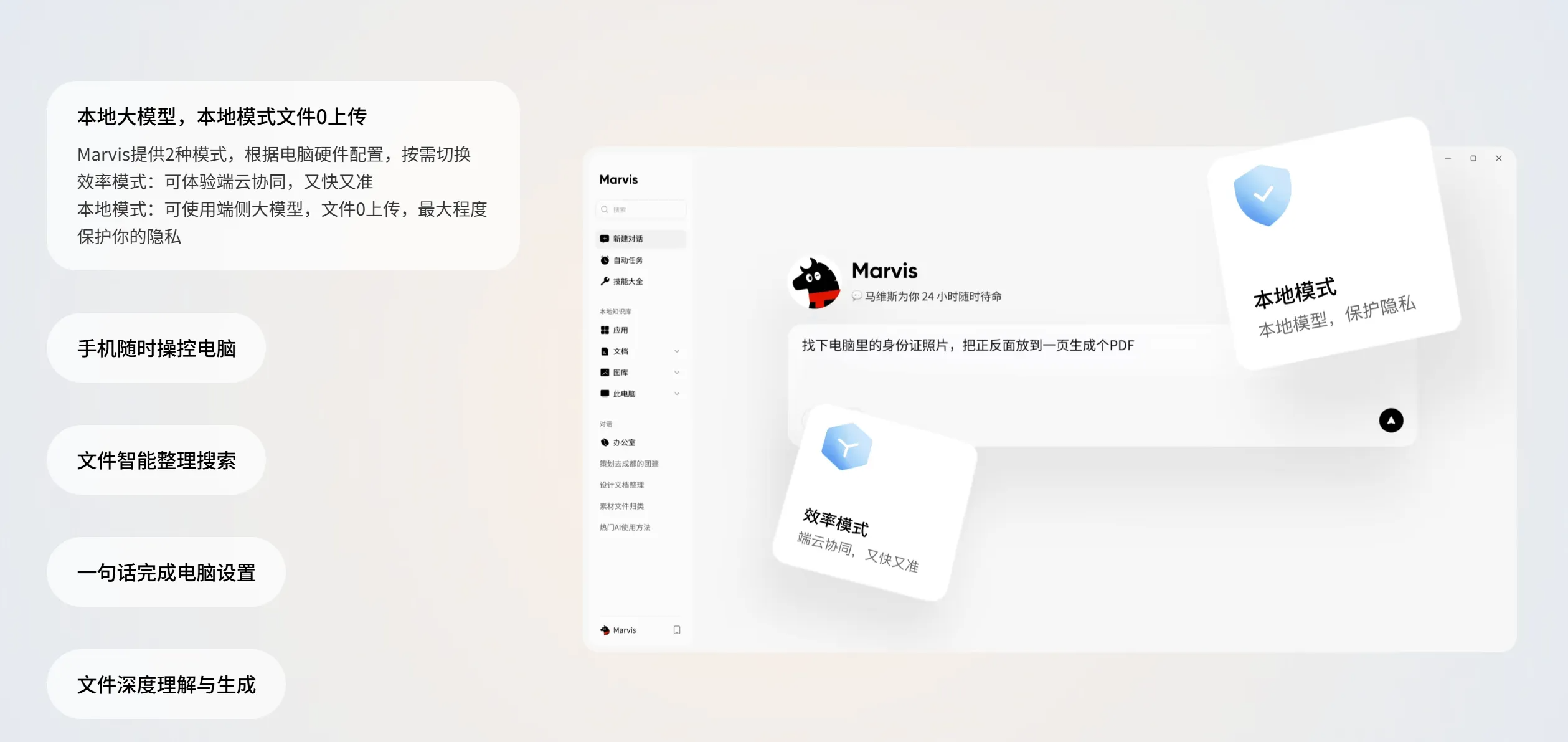
Marvis- the main strengths are desktop file operations, local mode, and privacy protection
ChatGPT- the main strengths are ecosystem maturity and plugin variety
Claude- the main strengths are long-text understanding and writing quality
To me, the key here is not the bullet list itself. It is that the article points out the most practical difference in enterprise usage:
Marvisoffers local mode- mainstream usage of
ChatGPTandClaudeis still much more cloud-oriented
The public material makes the contrast very clear:
Marvislocal mode:- data stays on the computer
- better suited to sensitive materials such as contracts, finance, and HR files
ChatGPT/Claude:- privacy boundary is not their strongest differentiator
- they depend more on cloud capability
That is why I think the comparison logic is completely different for an individual creator versus an enterprise office team.
An individual creator can start from output quality. Enterprise teams usually start from questions like:
- can the data stay local
- must files be uploaded
- is there a real mode switch
- are the security boundaries explicit
Comparison 2: In meeting notes, contract review, and data analysis, Marvis wins by sitting closer to the files, not by writing more
The public comparison article highlights several especially important office scenarios:
- meeting note organization
- contract review
- data analysis
- Word export
One conclusion from that piece is especially telling:
- for organizing meeting notes,
Marvislocal mode is recommended - for simple contract review,
Marvisis also favored - for data analysis,
Marvisis favored - for long-form document writing,
Claudeis favored
The logic behind that is actually quite reasonable.
Because in enterprise office work, these jobs are rarely just plain text:
- meeting notes often need to end up in
Word - contracts often exist as local files
- data analysis very often means
Excel - the output is not just "tell me the answer," but "give me a deliverable file"
So what companies ask for more often is not "write me a paragraph." It is:
Please use this file, this spreadsheet, and this local material to produce something I can actually hand off.
In that kind of workflow, the advantage of Marvis is not necessarily that its wording is prettier than Claude.
It is this:
It sits closer to the file and closer to the operating system.
Comparison 3: Phone-to-PC control is no longer a chat contest. It is a product-shape contest
This is the place where Marvis feels least like the same category of product as ChatGPT or Claude.
In the public hands-on pieces Inside Marvis: An AI Multi-Agent System That Can "Take Over" Your Computer and Tencent Marvis Hands-On: Once Your Phone Connects to the Computer, It Really Can Direct the PC to Work, the emphasis is not just on chatting. It is on things like:
- the phone showing the computer screen in real time
- connecting through the same account via QR scan or a dynamic code
- directly asking it to find files, compress files, send email, or send WeChat messages
- switching to a cloud assistant mode for lightweight tasks when the computer is offline
That means Marvis is not really competing with ChatGPT or Claude on who talks better. It is competing on something else:
Who can act more like a second operating entry point for the computer.
The public hands-on coverage also mentions several details worth calling out:
- no complicated remote desktop setup is required
- the phone side does not always require precise tapping
- tasks can be sent directly as text or voice
- important actions should still be manually confirmed
That means the problem being solved is not just "answer a question." It is:
When the person is away from the computer, can the task on that computer keep moving forward anyway?
In many enterprise scenarios, that is extremely valuable.
Comparison 4: System-level permissions and confirmation prompts make Marvis feel more enterprise-ready
When people hear that "AI can operate the computer," the first reaction is often:
- is that dangerous?
But one especially important signal in the public hands-on articles is that they do not frame this as unrestricted system control. They emphasize that:
- when a task involves critical system settings
- for example, registry changes or deleting system files
Marvisforces a second confirmation through a pop-up
That point matters a lot. A product that can actually enter enterprise use is not the one with the least boundaries. It is the one with:
broad capability, but clear boundaries.
From the public materials, Marvis at least appears to be moving in that direction:
- it can work with system settings
- it can handle files
- it can perform remote tasks
- but critical actions still require confirmation
That is much closer to enterprise security expectations than "give a strong model full freedom and hope for the best."
Comparison 5: Hardware cost and UX tradeoffs are real too. Marvis is not an automatic win
I do not want this article to read like "Marvis wins everything," because the public hands-on posts also mention some very real tradeoffs.
For example:
- local mode is more demanding on hardware
- large-file processing can be slower
- understanding of highly specialized legal terms may still lag behind
Claude ChatGPTstill has the more mature plugin ecosystem today
The public comparison article also gives a very grounded recommendation:
- if privacy matters most,
Marvislocal mode is the unique choice - if you urgently need ecosystem integrations,
ChatGPTmay still be better for now - if you work with ultra-long documents and complex writing,
Claudestill has a very clear edge
That framing actually makes the comparison more credible. Enterprise office work is never one-size-fits-all. It is always:
- different tasks, different tools
- different risk levels, different modes
That is also the more realistic way I see this category:
It is not about one tool replacing the others. It is about which tool is best suited to which segment of the workflow.
From these public hands-on reports, what real difference do I see?
If you stitch these public pieces together, the core differences between Marvis and ChatGPT / Claude become fairly obvious:
Marvisleans more toward:- system-level capabilities
- local files
- on-device mode
- phone-to-PC remote control
- deep file handling
- system settings and optimization
ChatGPTleans more toward:- general conversation
- ecosystem and plugins
- a more mature external expansion path
Claudeleans more toward:- long-document understanding
- writing quality
- legal and other complex text-heavy tasks
So if your question is:
- "Which model writes better?"
then
Marvismay not be the answer.
But if your question is:
- "Which tool feels more like a system-level assistant that can actually take office work?"
then
Marvisclearly stands apart.
Which enterprise teams should try it first
Teams that should try it now
- teams that care deeply about privacy and local mode
- organizations that do not want contract, finance, or HR materials uploaded to the cloud
- office teams with lots of local files, Excel sheets, Word documents, and desktop tasks
- teams that need to handle computer tasks remotely from a phone
- organizations trying to push "chat AI" toward a "system-level execution" stage
Teams that can wait and watch
- teams whose main need is still just chat, writing, and summarization
- teams that depend more heavily on plugin ecosystems and third-party integrations
- teams that do not really need local files or system-level operations
- teams with generally weak hardware that still want to rely heavily on local mode
If you want to test it yourself, this is how I would do it
- Do not only test chat. Test real office tasks directly.
- The most useful scenarios to compare are usually:
- meeting note organization
- contract review
- Excel data analysis
- local file retrieval
- remote PC control from a phone
- Do not look only at output quality. Focus on:
- whether the data must go to the cloud
- whether local file handling feels smooth
- whether Word / Excel delivery is actually practical
- whether system-level tasks truly remove a layer of manual work
- If you are already piloting enterprise AI internally, it is also worth comparing:
- which scenarios fit
Marvis - which scenarios should still go to
ChatGPT - which scenarios are better handled by
Claude
- which scenarios fit
If what you care about more right now is how to plug Tencent models, GLM, Kimi, DeepSeek, StepFun, and others into your own agent workflow through one unified layer, you can start here:
My final judgment
If I had to summarize my view on Marvis vs ChatGPT / Claude in one sentence, it would be this:
What makes Marvis worth paying attention to is not that it is stronger in every dimension. It is that it shifts the competition from "who chats better" to "who can actually take on system-level tasks inside enterprise office workflows."
That matters more than a pure IQ contest between models. Because in many enterprise scenarios, the hardest part has never been generating a paragraph. It has been:
Getting AI genuinely close to local files, the operating system, desktop apps, and remote tasks, while still keeping privacy boundaries and confirmation gates in place.
If your core need is general writing, ecosystem breadth, and ultra-long text handling, ChatGPT and Claude are still very strong.
But if your core need is making AI feel more like a real assistant inside enterprise office work, then the Marvis path is genuinely worth a serious look.
References
- Marvis vs ChatGPT/Claude: A Real Comparison for Enterprise Office AI Deployment
- Inside Marvis: An AI Multi-Agent System That Can "Take Over" Your Computer
- I Used Tencent Marvis for One Day, Then Decided This Dark Horse Deserved a Permanent Spot on My Computer
- Tencent Marvis Hands-On: Once Your Phone Connects to the Computer, It Really Can Direct the PC to Work