DeepSeek V4.1 Flash 1017: 77% DeepSWE and API Guide
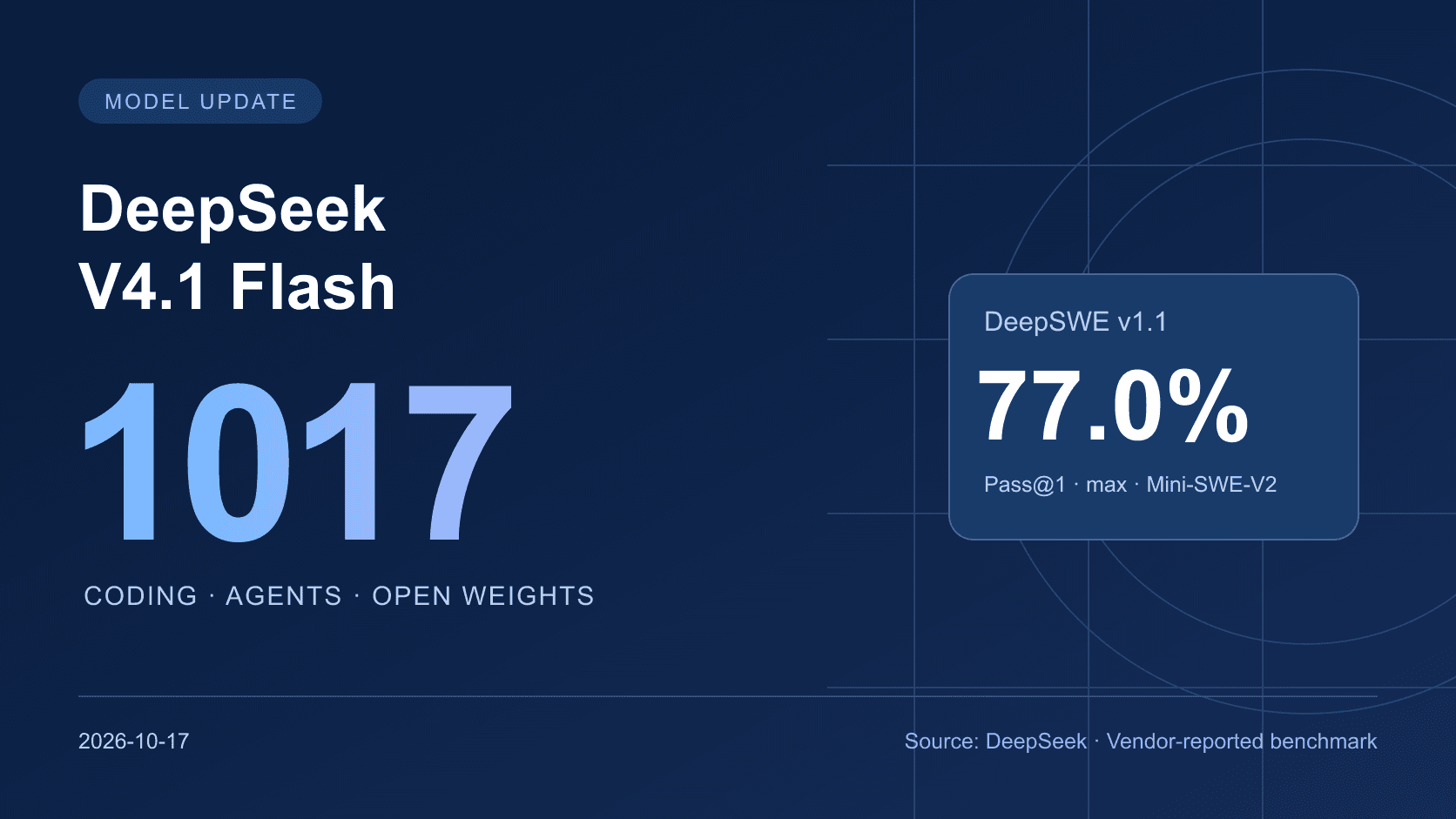
DeepSeek-V4.1-Flash-1017 is the V4.1 Flash update released on October 17, 2026. DeepSeek updated its website, app, and API together and released the model weights. In the official comparison, DeepSWE v1.1 rose from 74.2 to 77.0, with improvements across all 11 listed tests. The release also emphasizes shorter task completion times and shorter outputs. Official announcement
Keep two names separate: DeepSeek-V4.1-Flash-1017 identifies the model version; deepseek-flash is the model ID used by DeepSeek's own API. Our gateway has its own model IDs and endpoint configuration. For our rates, see the live model pricing page; this article does not list vendor rates.
Key figures and sources
- Release date: October 17, 2026. The website, app, and API were updated together. Announcement
- DeepSWE v1.1: 77.0 at max reasoning effort, up from 74.2—a gain of 2.8 percentage points. The official comparison uses Mini-SWE-V2. Official benchmark chart
- Terminal-Bench 4.0: 42.3, up from 31.2—a gain of 11.1 points. This test uses the Claude Code framework. Official benchmark chart
- ProgramBench: 29.1, up from 20.3—a gain of 8.8 points. Official benchmark chart
- Automation-Bench V1.0.6: 60.5, up from 54.8. Official benchmark chart
- Harness requirement: v0.2.1-rc.1 or later. This is DeepSeek's recommended upgrade for the new model. Announcement
These results come from DeepSeek's release materials; we have not independently rerun the benchmarks. Comparisons should retain the model version, test set, agent framework, and reasoning effort.
What changed in 1017? All 11 benchmarks compared
| Benchmark | Previous V4.1 Flash | V4.1 Flash 1017 |
|---|---|---|
| HLE (without tools) | 36.8 / 39.1* | 42.6 / 44.0* |
| Terminal-Bench 4.0 | 31.2 | 42.3 |
| DeepSWE v1.1 | 74.2 | 77.0 |
| ProgramBench | 20.3 | 29.1 |
| NL2Repo-Bench | 65.4 | 68.2 |
| Automation-Bench V1.0.6 | 54.8 | 60.5 |
| Agents’ Last Exam | 31.8 | 35.4 |
| Apex Bench v1.1 | 64.6 | 72.1 |
| Chartography (with tools) | 78.9 | 83.0 |
| BabyVision (with tools) | 89.6 | 92.5 |
| ZeroBench-main (with tools) | 49.0 | 51.0 |
* denotes the text-only subset of HLE. Terminal-Bench 4.0 uses Claude Code; DeepSWE uses Mini-SWE-V2; ZeroBench-main uses Pass@5. The table preserves the original scores: different tests do not all measure the same kind of pass rate.
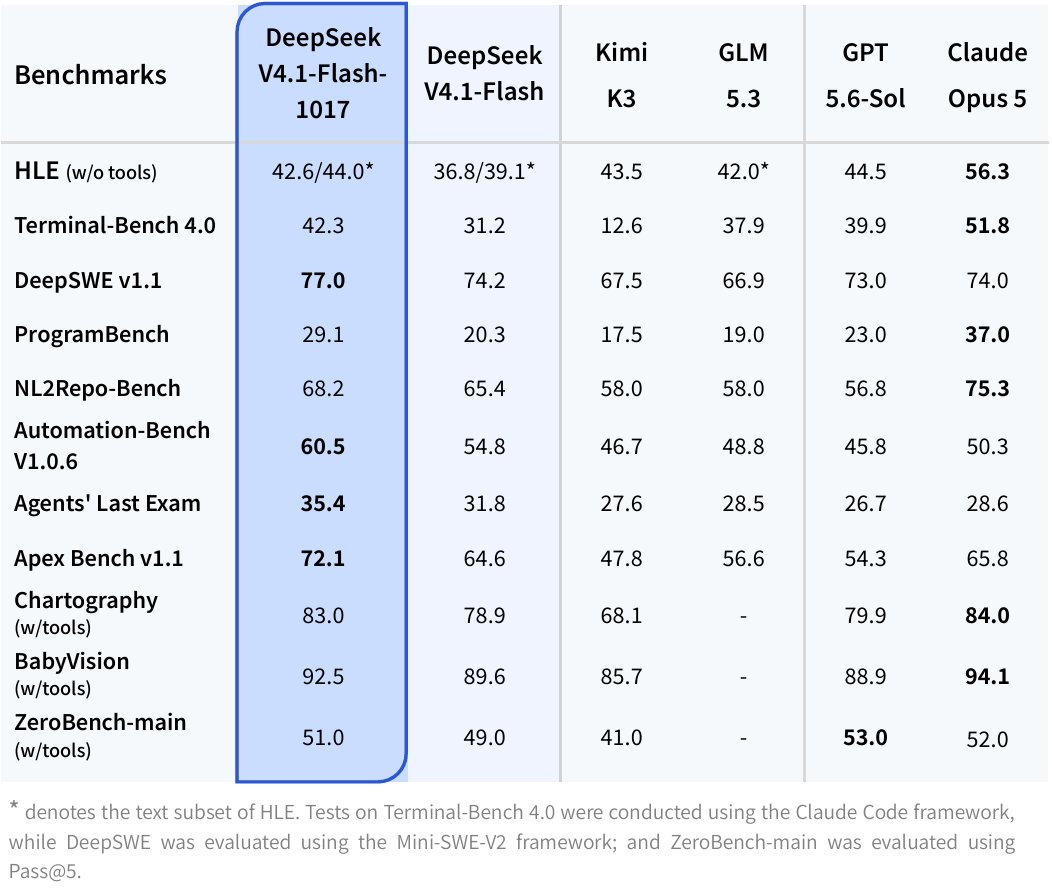
Chart: DeepSeek's official benchmark comparison.
Among the six model versions in this table, 1017 has the highest score on DeepSWE, Automation-Bench, Agents’ Last Exam, and Apex Bench. Claude Opus 5 still scores higher on HLE, Terminal-Bench, ProgramBench, and several other tests; GPT-5.6-Sol scores higher on ZeroBench-main. Choose by task type: leading on four tests is not the same as leading on every capability.
For existing codebases, DeepSWE is closer to bug-fixing work. For command-line tasks, the Terminal-Bench improvement is particularly relevant. Compare versions using the same repository, tests, and tool permissions, and record test outcomes, retries, total runtime, and output volume.
Building projects from scratch: self-feedback RL and Harness
DeepSeek says 1017 uses reinforcement learning based on self-feedback to strengthen end-to-end project development. After generating a first version, the model checks the result, identifies problems, and revises it. Official demonstrations include a 3D Forbidden City, a browser racing game, a Godot recreation of Portal 2, and 3D scenes spanning different historical periods. These are vendor demonstrations, not acceptance-test results for production projects. Examples and explanation
Training was optimized for environments including DeepSeek Harness, Tencent CodeBuddy, and WorkBuddy. Upgrade Harness to v0.2.1-rc.1 or later; the v0.1.5 release discussed in September's article is no longer the current recommendation.
With Node.js installed, launch the web interface using the official package:
npx @deepseek-ai/dsh@latest web
After launch, check that the installed version meets the requirement, enter the API key for the service you intend to use, and select a workspace. Start with a small, testable task in an isolated workspace before granting broader tool permissions. DeepSeek Harness repository
How does this relate to September's V4.1 Flash architecture?
The V4.1 Flash base model released in September uses native text-and-image multimodal MoE and a Causal Encoder-Decoder (CED) architecture. Its official model card lists 552B backbone parameters, with approximately 8B active per token during input prefill and 16B during decoding. The 550B figure used in some introductions is rounded. Total backbone parameters and active parameters are different measurements. V4.1 Flash model card
The base model also reduced global KV Cache per token from V4 Flash's 3514 bytes to 890 bytes. That measures the cache, not the memory needed to deploy the entire model. The 1017 release focuses on training, task performance, and execution efficiency; September's architecture changes should not be counted again as new October features. For background, see the V4.1 Flash architecture and integration guide.
API integration: distinguish version names, model IDs, and URLs
As of October 17, 2026, DeepSeek's official specifications explicitly map deepseek-flash to DeepSeek-V4.1-Flash-1017. Do not assume the release name itself is a valid API model ID. Official model version information
| Service | Full chat request URL | Model ID | API key issuer |
|---|---|---|---|
| Direct DeepSeek API | https://api.deepseek.com/v1/chat/completions |
deepseek-flash |
DeepSeek |
| Our gateway | https://api.llm-token.cn/v1/chat/completions |
Use deepseek-v4.1-flash as listed in our catalog |
贵数智能 |
An updated official alias does not mean every third-party channel has switched at the same time. On our pages, 1017 identifies the release discussed here. Before integration, check the available ID in the model catalog; contact support if you require a fixed version. Do not mix API keys between the two services or append a second /v1 to a Base URL that already includes it.
The following example shows our gateway's request format. Before running it, obtain a valid key and confirm the model ID in the catalog:
curl https://api.llm-token.cn/v1/chat/completions \
  -H "Authorization: Bearer $LLM_API_KEY" \
  -H "Content-Type: application/json" \
  -d '{
    "model": "deepseek-v4.1-flash",
    "messages": [
      {"role": "user", "content": "Review this repository and propose a testable bug-fix plan."}
    ],
    "stream": false
  }'
For a direct DeepSeek request, change the full URL to https://api.deepseek.com/v1/chat/completions, use a DeepSeek key, and set model to deepseek-flash. Read ordinary text output from choices[0].message.content; handle tool calls through your client's tool-execution workflow. API request format tutorial
Search and Fetch use separate tool URLs
DeepSeek also released its own Search and Fetch APIs. Search finds web pages by keyword; Fetch reads a specified page and returns its content as Markdown. Together they support agent workflows that search first and then read the sources.
| Function | Official DeepSeek POST URL |
|---|---|
| Search the web | https://api.deepseek.com/v1/tools/search |
| Fetch page content | https://api.deepseek.com/v1/tools/fetch |
Both use a DeepSeek key and are separate from the chat endpoint. Their availability at DeepSeek does not mean our gateway automatically proxies the same paths. Do not simply append /v1/tools/search or /v1/tools/fetch to our gateway address. See the official Search & Fetch documentation for request fields and limits.
Frequently asked questions
Are DeepSeek V4.1 Flash and V4.1 Flash 1017 two different API IDs?
No. V4.1 Flash is the model family, and 1017 identifies the October 17 update. DeepSeek currently serves it through deepseek-flash. Our gateway uses its own catalog ID; a display name alone does not establish which upstream snapshot is serving a request.
Do older DeepSeek API model names still work?
DeepSeek currently lists deepseek-v4-flash and deepseek-v4-flash-vision-exp as compatibility aliases served by 1017. Its current specifications still list deepseek-v4-pro separately as V4-Pro-0813. Do not treat September's transition arrangements as today's mapping. For our gateway, use the aliases in our own catalog. Current official model information
Where can I download the model weights?
Use the 1017 repository on Hugging Face or the 1017 repository on ModelScope. Before deployment, check that repository's version, license, inference-framework requirements, and hardware requirements. The 8B active-parameter figure is not an estimate of the resources needed for a full deployment.
Further reading
- DeepSeek V4.1 Flash architecture and integration guide
- Our model catalog and live pricing
- API URLs, request formats, and troubleshooting
- Official DeepSeek 1017 announcement
Updated October 17, 2026. This article explains release materials and integration documentation. For later changes to version mappings, consult the current documentation for the service you use.