GLM-5.3 API Guide 2026: 1M Context & 8x Pricing
GLM-5.3 launched on August 14, 2026 and is now available on this gateway under model ID glm-5.3, with a 1M-token context window. Its gateway billing matches GLM-5.2: one uniform 8x multiplier, approximately CNY 3.2 per million tokens. The gateway does not list a 37.5x rate for GLM-5.3.
Z.ai says GLM-5.3 uses the same base model as GLM-5.2 and derives its gains from post-training focused on complex coding, long-horizon agents, and emergent cyber capabilities. This guide keeps Z.ai's official capability and benchmark claims separate from this gateway's route and pricing data. The published scores are not independent tests by this site.
Validate with a small request first: check live model pricing or start from the API purchase page. Availability, output weighting, and the account ledger remain authoritative at request time.
GLM-5.3 key stats
| Item | Verified information |
|---|---|
| Official release | August 14, 2026 |
| API model ID | glm-5.3 |
| Context window | 1M tokens |
| Gateway multiplier | Uniform 8x, the same as glm-5.2 |
| Gateway reference rate | About CNY 3.2 per million tokens |
| Thinking parameter | thinking.type: "enabled" |
| Reasoning effort | low, high, or max; official default is max |
| Main focus | Complex coding, long-horizon agents, terminal work, and cyber research |
| Compatible formats | Gateway catalog lists OpenAI and Anthropic formats |
| Image input | Unconfirmed on this gateway; do not assume support |
Last verified on August 14, 2026. Recheck the live pricing page and model catalog before a production rollout.
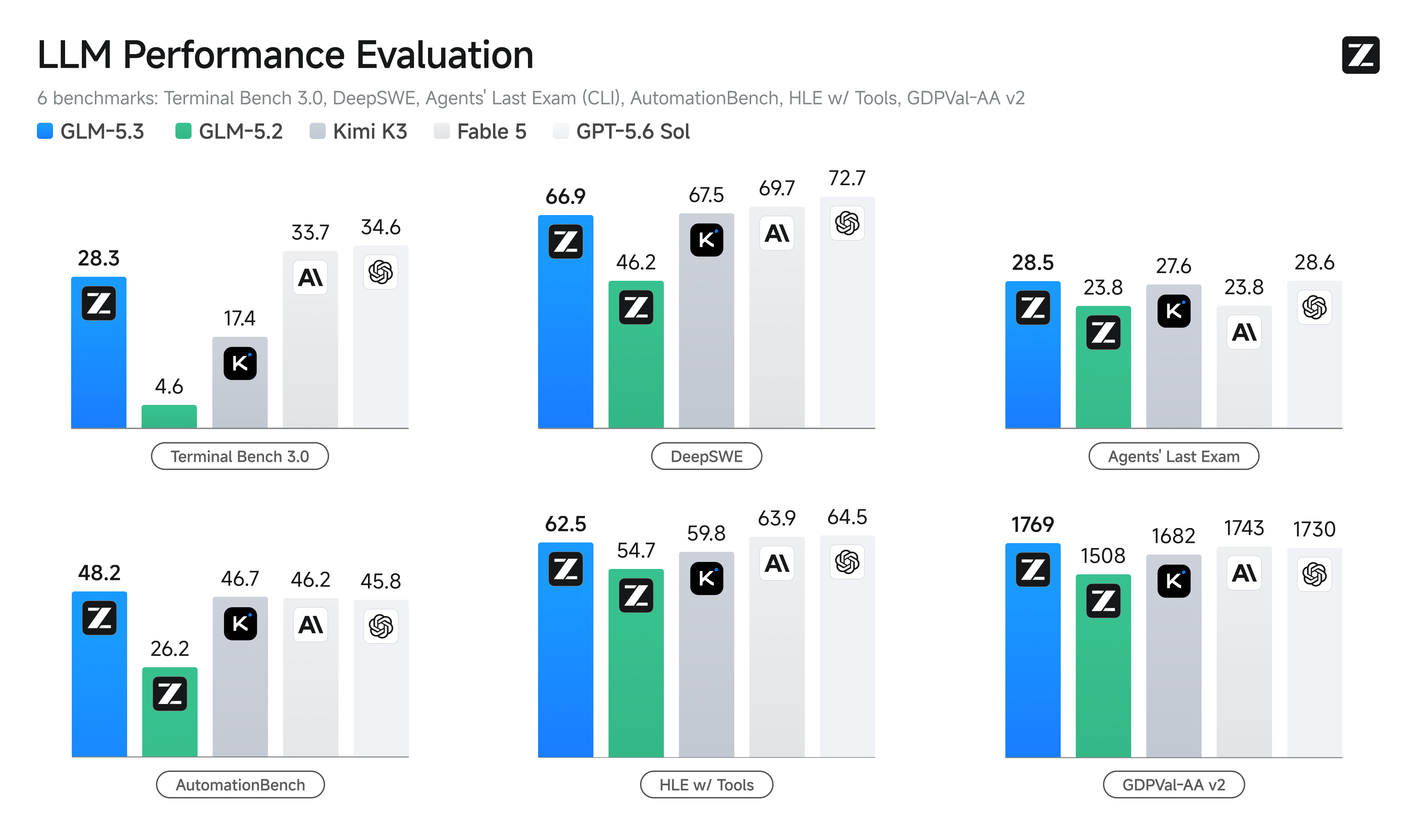
Source: Z.ai's official GLM-5.3 release. The figures are vendor-published evaluation results, not independent testing by this site.
What changed from GLM-5.2 to GLM-5.3?
GLM-5.3 is not a replacement built on a larger base model. According to Z.ai, it shares the same base as GLM-5.2 and gets its improvements from post-training. The important question is therefore how reliably the model completes difficult work, not only how large it is.
| Comparison | GLM-5.2 | GLM-5.3 |
|---|---|---|
| Base model | GLM-5.2 base | Same as GLM-5.2 |
| Main update | Existing general, coding, and agent capability | Stronger post-training for complex coding and long-horizon work |
| Context window | 1M tokens | 1M tokens |
| Gateway multiplier | 8x | 8x |
| Gateway reference rate | About CNY 3.2/M tokens | About CNY 3.2/M tokens |
| Thinking setup | Confirm on the active route | Thinking required; low/high/max effort |
If GLM-5.2 already runs reliably in production, a new version number alone is not a reason for an immediate full migration. Compare both on the same repositories, tool permissions, timeouts, reasoning effort, and acceptance commands with a small traffic slice.
How to read Z.ai's official benchmarks
Z.ai calls GLM-5.3 its strongest coding model intended for an open-weight release and published several substantial gains. At this article's verification time, the weights were still planned for roughly two weeks after launch rather than already available. The positioning is a vendor claim, not an independent conclusion. Selected release data includes:
| Vendor-published benchmark | GLM-5.2 | GLM-5.3 |
|---|---|---|
| Terminal Bench 3.0 | 4.6 | 28.3 |
| DeepSWE v1.1 | 46.2 | 66.9 |
| Agents' Last Exam | 23.8 | 28.5 |
| CyberGym | 77.2 | 84.5 |
| ExploitBench | 24.4 | 54.4 |
| ExploitGym 2h / 6h | 29 / 39 | 105 / 130 |
These figures come from Z.ai's release, not an independent rerun by this site. Harnesses, tool access, reasoning budgets, and benchmark versions may differ across models, so the deltas cannot be converted directly into a success rate for your repository. Z.ai also reports a 50% improvement over GLM-5.2 on its internal Code Bench. Treat that as evidence of the vendor's optimization direction, not a neutral leaderboard result.
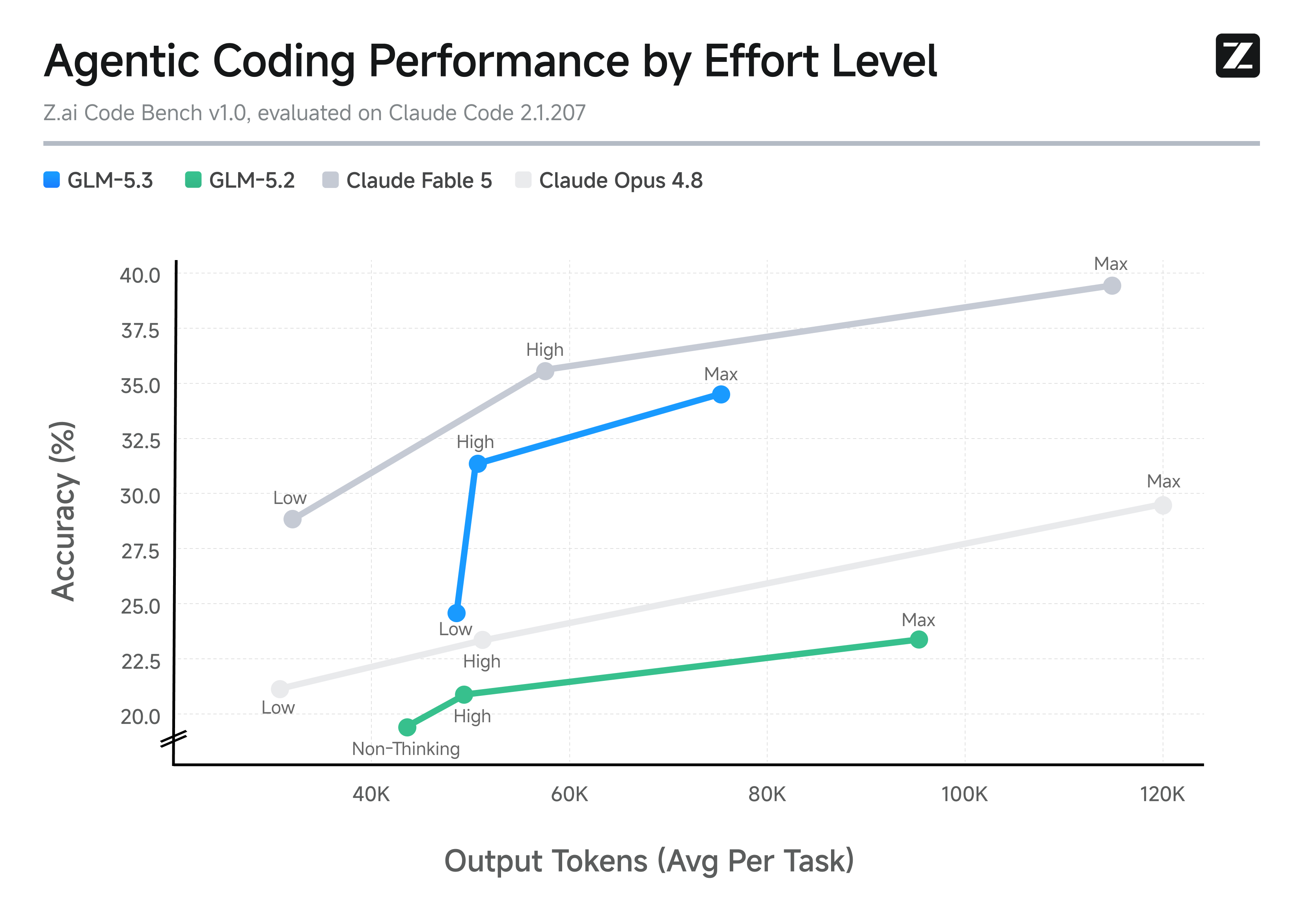
Z.ai's internal Code Bench chart. Add repository-level acceptance tests before selecting a production model.
What do "emergent cyber capabilities" mean?
Z.ai highlights GLM-5.3's ability to execute longer vulnerability-discovery and validation trajectories when given code, terminal access, and feedback. That can be useful for authorized security reviews, CTF environments, dependency-upgrade validation, and internal red-team work. It is not permission to test systems without authorization.
For security agents, restrict target domains, repositories, credentials, egress, and executable commands to an explicit scope. Keep human approval for data deletion, permission changes, production deployment, and external network actions. Stronger capability calls for a better sandbox, complete audit logs, and a reliable stop control.
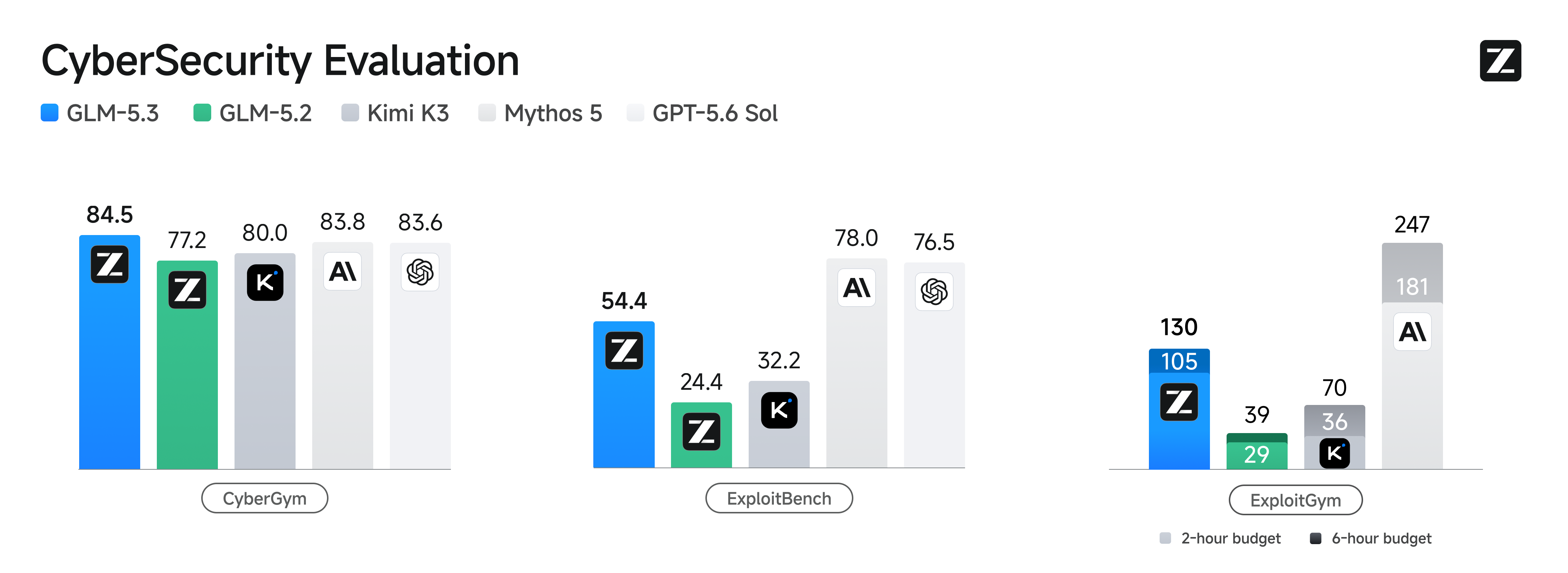
Z.ai's official cyber-capability chart. It describes vendor-published capability direction and is not a recommendation for unauthorized testing.
GLM-5.3 pricing: the same as GLM-5.2 here
This gateway currently assigns both glm-5.3 and glm-5.2 one uniform 8x multiplier, with a reference rate of approximately CNY 3.2 per million tokens. GLM-5.3 is not listed at 37.5x, and the multiplier does not change when the prompt becomes longer.
The 8x and CNY 3.2 figures are this gateway's billing terms, not Z.ai's direct-API list price. Completion weighting, account groups, cache treatment, promotions, or later rate changes may affect the final ledger. Start with a short, non-streaming request and record prompt tokens, completion tokens, and the actual charge.
Need a controlled cost check? Open a small balance from the API purchase page, or top up an existing key, then run one smoke request before increasing traffic.
How to call the GLM-5.3 API
Use the exact model ID glm-5.3. GLM-5.3 requires thinking to stay enabled. If an existing application sends thinking.type: "disabled", change it before switching models or the request will fail.
curl https://api.llm-token.cn/v1/chat/completions \
  -H "Authorization: Bearer YOUR_API_KEY" \
  -H "Content-Type: application/json" \
  -d '{
    "model": "glm-5.3",
    "messages": [
      {"role": "user", "content": "Analyze the failing tests in this repository. Explain the root cause before making changes."}
    ],
    "thinking": {"type": "enabled"},
    "reasoning_effort": "max"
  }'
reasoning_effort accepts low, high, or max, with max as the official default. Z.ai recommends max for coding, but production teams should still measure latency and token use. A practical router can use low for classification and small edits, then reserve high or max for difficult debugging, repository-level implementation, and security review.
The gateway catalog lists OpenAI- and Anthropic-compatible formats. When configuring Claude Code, OpenCode, ZCode, or another agent, test the base URL, model ID, tool calls, streaming, usage fields, and timeouts separately. A single successful text response is not a complete compatibility test.
Best GLM-5.3 coding-agent use cases
- Cross-file, cross-module repository implementation
- Long-running agents that inspect, edit, test, and repair
- Complex terminal, build, and dependency-conflict diagnosis
- Authorized vulnerability research, security regression, and CTF work
- 1M-context workflows over large repositories or document sets
- Multi-tool tasks that must plan, execute, and verify over a long trajectory
Classification, short summaries, template filling, and high-volume simple chat may be cheaper with lower effort or a lower-multiplier model. Compare routes in the model list, and contrast the 1M context and billing terms in the DeepSeek-V4-Pro-0813 guide.
Production evaluation checklist
- Copy
glm-5.3from the live model catalog instead of guessing a dated alias. - Remove or change
thinking.type: "disabled"in legacy payloads. - Measure acceptance rate, latency, and usage at
low,high, andmax. - Pin repository commit, task wording, tool permissions, and acceptance commands for comparisons.
- Cap tool calls, maximum output, per-call timeout, and total task budget.
- Log request ID, selected route, status, time to first token, total duration, usage, and accepted result.
- Keep human approval around file writes, deployment, payment, account permissions, and external-system actions.
- Maintain a fallback route for timeout, capacity, and upstream incidents.
Key takeaways
- The exact model ID is
glm-5.3, with a 1M-token context window. - On this gateway, GLM-5.3 matches GLM-5.2 at one 8x multiplier, about CNY 3.2 per million tokens.
- Thinking must stay enabled; GLM-5.3 accepts
low,high, andmaxreasoning effort and defaults tomax. - Z.ai's coding, agent, and cyber results are vendor-published evidence, not independent tests by this site.
- A 1M model window does not guarantee that every client can submit exactly 1M input tokens.
- Production selection should measure accepted tasks, token use, latency, and engineer rework on real workloads.
Frequently asked questions
Is GLM-5.3 officially released?
Yes. Z.ai released GLM-5.3 on August 14, 2026, and this gateway now lists the glm-5.3 route.
What is the GLM-5.3 context window?
The context window is 1M tokens. Usable input also depends on system instructions, tool transcripts, client limits, and reserved output.
What is the GLM-5.3 multiplier on this gateway?
It is one uniform 8x multiplier, the same as GLM-5.2, with a reference rate of about CNY 3.2 per million tokens. It is not 37.5x and is not tiered by context length.
Can I disable thinking for GLM-5.3?
No. The official release says thinking.type must be enabled; disabled is no longer supported. Correct legacy payloads before migrating.
Which reasoning_effort should I choose?
Start with low for simple work and test high or the officially recommended max for complex coding. Use your acceptance suite to balance quality, latency, and cost.
Can GLM-5.3 work with Claude Code or OpenCode?
Z.ai lists Claude Code, OpenCode, and ZCode as usage paths. This gateway exposes OpenAI- and Anthropic-compatible routes; validate messages, tools, streaming, timeouts, and billing on your exact client.
Are the GLM-5.3 open weights already available?
Not at this article's verification time. Z.ai said it planned to publish the weights about two weeks after launch, following additional safety work and hardening. Check the official repository for the actual release state.
Where can I buy or top up GLM-5.3 API access?
New users can start on the API purchase page. Existing key holders can use top-up.
Primary sources
- Z.ai: GLM-5.3: Frontier Coding with Emergent Cyber Capabilities: release date, shared base model, post-training, thinking parameters, coding and cyber evaluations, and planned weight release
- Z.ai: GLM-5.2: base-model and 1M-context background
- Gateway model guide: current route ID, 1M context, 8x multiplier, and compatible formats