Tencent WorkBuddy Presales Review: Client Discovery, Bid Proposals, Demo Scripts, ROI Models, and Competitive Intelligence
If you think WorkBuddy only helps a presales team polish a slide deck or rewrite a product intro, you are probably looking at the shallowest layer.
I went through several public case studies tied directly to client discovery, industry solution design, demo scripting, bid proposal generation, competitive analysis, ROI modeling, and SaaS intelligence briefs. After reading them together, the conclusion is fairly clear:
What makes WorkBuddy interesting in presales is not that it behaves like a chatbot. It is that it is starting to enter the parts of the workflow that actually consume expert hours: client research, proposal design, tender response, commercial justification, and reusable internal intelligence.
That matters because the hardest part of presales is often not product knowledge. It is everything around it:
- client materials are scattered across too many files
- demos need both technical depth and business framing
- bid responses follow rigid scoring logic but still have to be rebuilt every time
- competitive reviews cannot stop at feature lists, they need TCO and risk framing
- weekly intelligence briefs keep repeating the same search, filtering, and formatting work
That is why I think WorkBuddy is more convincing in presales than in generic "AI office" demos. Presales teams already live inside this pattern:
information extraction, structured output, multi-version delivery, and last-mile persuasion.
TL;DR
-
As of June 29, 2026, the strongest public
WorkBuddypresales signals map to at least four practical workflow lines:- client folder analysis and requirement summarization
- industry solution advisory, demo script design, and POC goal framing
- bid proposal and tender response generation
- competitive intelligence, procurement watch, and market briefing automation
-
The interesting part is not "AI sounds more human." It is that these public cases already include:
- multi-format file input
- scoring logic and procurement structure
- POC success criteria
- ROI spreadsheets and finance framing
- source-link traceability
- reusable custom Skills
-
If you work in:
- enterprise software presales
- solutions engineering
- bid and tender response
- B2B demo design
- competitive intelligence or industry consulting
then these cases are more useful than another broad AI productivity pitch.
Why presales teams are easy to win over with workflow AI
The real pain in presales is usually not "I do not know how to explain the product." It is more like this:
- the same deliverable needs too many revisions
- client context keeps breaking between handoffs
- technical language has to be translated into business language
- the input is never one clean document, it is a mix of Word, PDF, Excel, slides, and meeting notes
- the final delivery still has to look mature under time pressure
So the real question is not whether AI can answer a question. It is this:
Can AI connect fragmented presales tasks into a reusable delivery chain?
The best public WorkBuddy cases already move in that direction:
- scan a client folder
- extract constraints and business goals
- package the workflow into a reusable Skill
- generate demo talk tracks
- create competitive matrices
- build an ROI model
- export a usable Word or Markdown deliverable
That starts to feel less like a chat window and more like:
a repeatable digital presales desk
Case 1: Client discovery stops being "someone manually reads 42 files first"
The first public case worth studying is:
The Evolution of a Presales Worker's Lobster Life: From Late-Night Bid Writing to 23 Skills
What makes it useful is not the generic "efficiency improved" framing. It describes, quite concretely, where a presales day gets stuck:
- WeChat and client-group messages start exploding in the morning
- the inbox contains a 200-plus-page
RFP - lunch break gets consumed by a pending demo
- the weekly report is still waiting at night
- the next day starts with trying to remember what database a client was already using
The author eventually built a prospect-analyst Skill. The core workflow is not one question and one answer. It is to drop an entire client folder into WorkBuddy and let it process the context.
The public description says it supports:
pdf / docx / xlsx / pptx / txt / md- automatic extraction of industry, company size, current systems, key pain points, budget, and timeline
- enrichment with company registration details and latest developments
- a structured requirements analysis report as output
Three details make this look close to a real production workflow.
1.1 The input is a client directory, not a single document
The author describes:
15subfolders42files- mixed meeting notes, specs, and Excel sheets
That is exactly how presales context usually shows up. It is rarely clean, and almost never centralized.
1.2 The output is not a summary, it is a brief you can build a proposal from
The public output example already resembles a downstream presales brief, including:
- company profile
- core requirements
- technical constraints
- recommended solution direction
That matters. A one-time summary is nice. A structured brief that supports the next proposal step is much more valuable.
1.3 The public turnaround is three to five minutes
The author's public estimate is about 3 to 5 minutes for the full process.
That is different from saving a tiny step here and there. It means the "first time I inherit this client account" phase can be compressed in one shot.
For a presales or solutions team, the value is direct:
- fewer missed constraints
- less context rebuilding
- faster handoff to new team members
Case 2: The industry-solution angle is not just expertise, it is discovery design, demo design, and commercial framing
The second public case I would rank highly is:
WorkBuddy Solution Companion: Full Presales Scenario Control
The interesting part is that it does not just say "there are industry experts." It breaks many presales actions into reusable templates and structured scenario workflows.
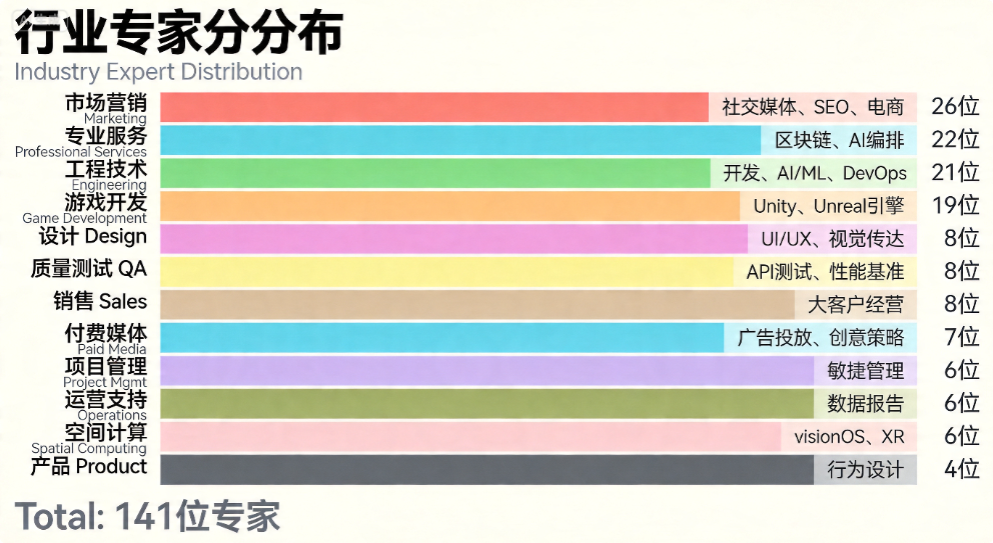
The public write-up is explicit about scale:
12industry domains140+industry experts- a mix of vertical AI roles, specialized knowledge bases, and complex tasks
What makes it relevant for overseas search users is what comes next.
2.1 Requirement discovery is framed around MTTR, P99, revenue loss, and compliance risk
Instead of generic discovery questions, the public example pushes a clear sequence:
- ask about stability challenges first
- then measure incident-resolution efficiency costs
- then quantify business impact
- then escalate the discussion to compliance risk
It explicitly names:
MTTRP99latency- revenue loss
- customer churn
That suggests WorkBuddy is not only helping somebody open a conversation. It is starting to formalize a technical discovery framework.
2.2 The demo script follows a 15-minute narrative, not a feature dump
The demo template in the public case looks like something a presales team could actually use with customers:
- minute
0-2: open with the customer's real business problem - minute
2-6: show end-to-end tracing from user side to database - minute
6-10: cover AI-assisted root cause analysis - minute
10-13: turn business value into numbers - minute
13-15: define thePOCsuccess criteria in advance
One detail stands out. The article says the golden rule is that the customer should start talking during minute 10-13.
That feels realistic, because effective demos are rarely about saying more. They are about getting the buyer to start using their own numbers.
2.3 The competitive analysis is not a feature table, it is closer to a Datadog or New Relic battlecard
Another strong section in the public case centers on customers comparing options such as Datadog and New Relic. The AI-generated output reportedly includes:
- a technical competitive matrix
- a
3-yearTCOcomparison - business-value dimensions
- a cost-versus-value quadrant
- response cards for competitive objections
That is much more useful than "write me a competitor comparison."
The hard part in enterprise competition is rarely listing features. It is translating:
- deployment flexibility
- localization or compliance value
- hybrid-cloud strengths
- industry-ready dashboards
into a customer-readable answer to:
why should we buy this now?
2.4 The ROI model reaches spreadsheet-level deliverables
The most production-like part may be the insurance-industry observability example, where the AI is asked to build a dynamic ROI model. The public case says the result includes:
7worksheets144formulas- blue cells that are directly editable
- automatic recalculation across linked metrics
- sensitivity analysis
That means WorkBuddy is not just writing explanatory text. It is already participating in:
- business-case preparation
- finance-oriented framing
- executive reporting support
Those are exactly the deliverables that help deals move forward but also consume senior presales time.
Case 3: Bid proposal work starts shifting from "copy the format by hand at midnight" to "teach the AI the flow"
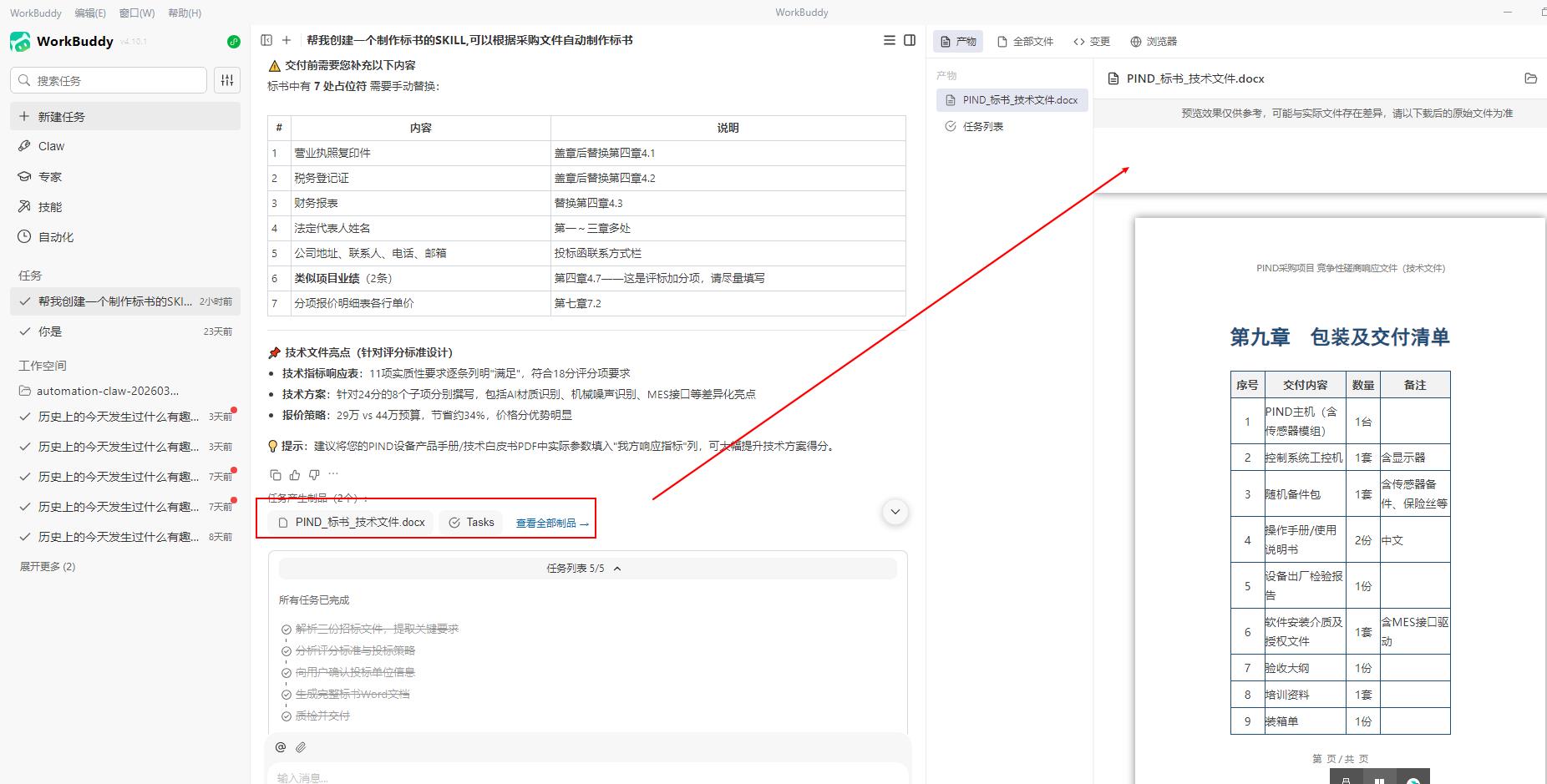
The third public case, Using WorkBuddy to Create a Bid Proposal Skill and Write Tender Responses Faster, hits one of the most painful presales jobs:
bid proposals are rarely intellectually hard, but they are long, repetitive, and easy to get wrong.
The public scenario is very concrete:
- the manager provides
3Word files - one procurement document
- one technical-requirements file
- one note on tender-response precautions
- the bid package still has to be produced the same day
The author created a bid-document-maker Skill and split the workflow into four stages:
- parse the procurement files
- define the response strategy
- generate the bid document
- run quality checks and optimization
The value here is not "AI can draft a document." It is the operational detail.
3.1 It identifies scoring points and substantive requirements, not just keywords
The public example says the AI did all of the following:
- parsed
3files - identified
11starred substantive technical requirements - mapped the response against the scoring standard
- produced a complete Word document
- added a quality-check report afterward
That is much closer to real tender work, where the biggest fear is usually not writer's block. It is:
- missing a mandatory clause
- failing to answer the scoring logic
- writing a long proposal that still does not earn points
3.2 It already tries to turn compliance into score-winning wording
One especially useful public detail is this:
- the scoring standard includes
18points for technical criteria and24points for solution quality - the AI adds differentiated wording for each technical indicator
The example given in public is straightforward:
- the procurement requirement says "forward-channel audio gain >=
60dB" - the AI adds wording such as "low-noise preamplifier design, gain up to
65dBtypical"
Why does that matter?
Because many bid teams do know how to meet the requirement. What they struggle with is turning:
we comply
into:
we comply in a way that is easier to score.
3.3 The deliverable is a nine-chapter package, not a half-finished draft
The public result is described as:
- a complete competitive-negotiation response document
9chapters- each technical indicator mapped against "procurement requirement" and "our response"
- solution sections covering overall architecture, metric implementation, security, reliability, quality management, deployment and commissioning, schedule, and after-sales service
That is already close to a handoff-ready document, not just a prompt output someone still has to rebuild from scratch.
3.4 The implementation pain points make it more believable, not less
One reason the case feels credible is that it includes the messy parts:
python-docxinstall timeouts- falling back to unpacking
docxas zipped XML to extract text - compatibility issues with a
docx v9API - image-based PDFs that cannot expose parameters cleanly
That is exactly what happens in real document workflows. It suggests WorkBuddy is not only giving ideas. It is touching the parsing and delivery chain.
Case 4: Presales is not only proposals, it is also continuous market and procurement watch
The fourth case belongs in the same set even though it is framed as market intelligence:
Is 198 RMB per Month Worth It? My Full Record of Using WorkBuddy to Automate a SaaS Observation Brief and Improve Efficiency 10x
This matters because many presales, solutions consulting, and industry-advisory teams already have to keep running:
- competitor monitoring
- policy tracking
- domestic-industry and localization watch
- procurement opportunity tracking
- AI and sector trend monitoring
The public workflow is detailed:
- search the last
24hours of SaaS, procurement, localization, and AI signals - remove duplicate newswire content
- auto-classify by topic
- summarize long reports
- generate a Markdown intelligence brief with a fixed template
- keep the original links
4.1 The real value is not scraping information, it is turning noise into a deliverable
The public case groups market information into four buckets:
- SaaS industry developments
- localization and domestic-industry movements
- procurement announcements
- AI developments
That structure is highly reusable for weekly presales syncs, internal briefings, and sector updates.
Most teams do not lack news. They lack an answer to:
which signals are worth putting into a proposal, a follow-up plan, or an internal decision?
4.2 The time claim is specific: from 16 hours per week to 1.5
The public numbers are:
- roughly
16hours per week before - about
1.5hours after automation
That is not a minor speed-up. It turns a recurring near-two-day task into less than one afternoon.
4.3 Source links are preserved on purpose
This part is important.
In presales, market intelligence, and procurement research, one of the biggest risks is hallucination or misreading. The public case explicitly requires the final report to:
- insert original source links
- generate timestamps and a short disclaimer
That is a healthy sign. It points toward a workflow that values traceability, not just speed.
What these public cases say about a real presales production workflow
If you read these cases together, WorkBuddy in presales already shows several consistent characteristics:
- the input is not one prompt, it is client folders, RFPs, technical requirements, meeting notes, and external articles
- the output is not a summary, it is a requirements brief, a demo script, a competitive matrix, an ROI model, a Word bid package, or a Markdown intelligence brief
- the middle layer is not generic generation, it is extraction, classification, scoring, quantification, writing back, and quality checking
- many actions are already tied to local files, spreadsheets, links, and document formats
- the results can be reused as dedicated Skills
That is why I think the most interesting part is not that WorkBuddy sounds smarter. It is that it starts turning a senior presales playbook from tacit knowledge into a workflow that can be called again.
Which teams should test this first
The best immediate fits look fairly obvious:
- enterprise software and cloud presales teams
- bid and tender response teams
- solutions consultants, industry consultants, and solution architects
- teams where product marketing and presales share competitive-intelligence work
- B2B groups that constantly monitor policy, procurement, and competitor signals
On the other hand, if your work barely involves:
- multi-document synthesis
- structured output
- material reuse across accounts
- competitive comparison
- finance-style business justification
then this specific WorkBuddy direction may feel less dramatic.
How I would test it in a real presales environment
Do not start by asking whether it can write polished copy. Pressure-test the real workflow instead:
- Take a real client folder and see whether it can produce a credible requirements brief in five minutes.
- Take a real demo flow and see whether it can translate technical explanations into business value the buyer will actually listen to.
- Take a real tender file and see whether it can identify scoring points and generate a structured bid response.
- Take a real competitive situation and see whether it can move the conversation from list-price comparison to
TCOandROI. - Take a week of actual market signals and see whether it can produce an intelligence brief your team would genuinely read.
If you are also evaluating model-access cost or multi-model routing for this kind of workflow, the practical next pages are:
Final verdict
If I had to summarize this set of WorkBuddy presales cases in one sentence, it would be this:
The important part is not that it saves a few minutes. It is that it is starting to combine client discovery, demo scripting, bid delivery, commercial justification, and competitive intelligence into a reusable digital presales workflow.
If that direction keeps maturing, the first visible change in presales teams is probably not "one fewer headcount." It is more likely to be:
- faster onboarding for new team members
- less senior time wasted on repetitive prep
- better reuse of account materials
- more standardized
POCand tender preparation - a shift from brute-force document assembly to higher-quality workflow design
That is why these public cases are worth watching.
Sources
- The Evolution of a Presales Worker's Lobster Life: From Late-Night Bid Writing to 23 Skills
- Using WorkBuddy to Create a Bid Proposal Skill and Write Tender Responses Faster
- WorkBuddy Solution Companion: Full Presales Scenario Control
- Is 198 RMB per Month Worth It? My Full Record of Using WorkBuddy to Automate a SaaS Observation Brief and Improve Efficiency 10x