Tencent WorkBuddy Consumer Shopping Case Study: Why SMZDM Shopping Assistant, Haina MCP, and Cross-Platform Price Comparison Are Moving Into AI Agent Workspaces
If your current mental model of WorkBuddy is still "Tencent built a desktop agent that can call tools," you are probably underrating what is happening on the consumer-shopping side.
I went through several public sources directly tied to shopping decisions, guided commerce, price comparison, and MCP-backed consumer data services. My conclusion is simple:
The most important thing about WorkBuddy in consumer shopping is not whether it can write a few buying-guide lines. It is that it is starting to connect real shopping data, product comparison, promo discovery, and a skills marketplace inside one AI Agent workspace.
Put the public signals together and this stops looking like "a chatbot that tells you what to buy." It starts looking more like this:
- users can install shopping-decision skills directly inside
WorkBuddy - conversations can return product information, side-by-side comparisons, prices, and promo clues
- an
MCP Server-level data service is supplying the backend continuously - the same capability is spreading into
Tencent Yuanbao, the wider agent ecosystem, and more endpoint surfaces
In other words, it increasingly looks like:
an AI Agent entry point that is beginning to take over the shopping-decision workflow.
The Short Version
- As of June 29, 2026, one of the clearest public
WorkBuddydeployments in consumer shopping is the addition of the SMZDM (Shenme Zhide Mai) Shopping Assistant to the Skills Market. - The value of this case is not just "it can recommend products." It packages product recommendations, performance summaries, reputation signals, cross-platform prices, and promo checks into an installable, callable skill.
- More importantly, this is not a one-off lightweight tool. It is backed by SMZDM's continuously exposed
HainaMCP Server data-service capability. - If you work in commerce content, buying guides, membership commerce, brand marketing, channel operations, or product intelligence, this WorkBuddy case is much more useful than a generic AI shopping demo.
Why Consumer Shopping Is Especially Well-Suited to Show Agent Value Early
A lot of people assume the consumer sector mainly needs:
- a smarter product search engine
- a stronger recommendation system
- a more human-like shopping assistant
All of that matters. But in real production environments, the bigger drag is usually:
- product information is scattered
- prices and promotions change too fast across platforms
- user questions are specific, but traditional search is too slow
- it is hard to connect buying-guide content, product cards, and comparison conclusions in one click
- ecommerce, content, media buying, and membership operations often do not live in one workspace
So the most annoying problem in consumer shopping is rarely "there is no information." It is:
there is too much information, too many entry points, and too much change, so the decision chain becomes fragmented.
That is exactly the kind of problem WorkBuddy + shopping-decision skills + MCP data services starts to address:
- package product and content capabilities into skills first
- let users call them directly inside an agent workspace
- connect multi-source consumer data behind the scenes
- deliver the result in a form that is easier to act on
That is why I think its value in consumer shopping is more practical than many models that only talk.
Signal 1: The Official X Page Already Frames Skills Market as an App Store for AI
From the public @WorkBuddy_AI profile on X, Tencent's positioning is already pretty clear: Skills Market is described as "the app store for your AI", with 100+ built-in skills and one-click install.
That wording matters.
If you only see WorkBuddy as a desktop chat box, the imagination for shopping use cases stays narrow. But if it is fundamentally an agent platform with:
- a skills marketplace
- an install mechanism
- industry-specific skills
- expert roles
- a desktop workspace
then shopping decisions stop being "something the model casually answers" and become a formal capability that can be inserted into a workflow.
For the consumer sector, that shift is important. The real risk is not one bad recommendation. It is:
failing to productize reliable data, content capability, and execution entry points into something repeatable.
Case 1: The SMZDM Shopping Assistant Is Not a Web Plugin Anymore. It Is an Installable WorkBuddy Skill
The second public signal worth paying attention to comes from partnership material published by SMZDM and Tencent Cloud.
According to the public write-up, SMZDM has officially launched the SMZDM Shopping Assistant inside Tencent WorkBuddy, and it is described as the first consumer shopping-decision service capability introduced into WorkBuddy.
The key point is not just that a partner got integrated. It is the way this capability appears inside the product:
- not as an external link
- not as a standalone webpage
- not as a plugin description page
- but as an addable skill inside the WorkBuddy Skills Market
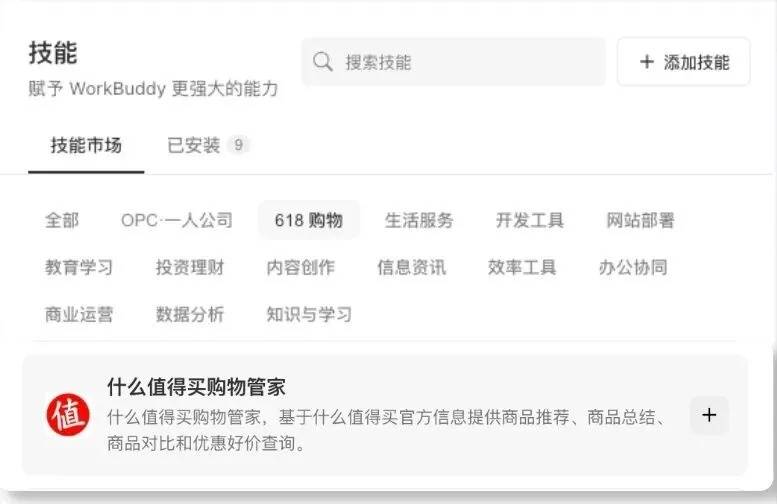
The public screenshot also shows several production-like details at a glance:
- the page is clearly labeled as a
Skills Market - the top bar includes search and add-skill entry points
- one category is explicitly
618 Shopping, referring to China's mid-year ecommerce festival - the same row also includes categories like
Daily Services,Developer Tools,Office Collaboration, andData Analysis - the SMZDM Shopping Assistant appears as a card that users can add directly
That means Tencent is not isolating shopping-decision capability as a side experiment. It is positioning it alongside office, analysis, developer, and collaboration capabilities as a standard capability block inside an AI workspace.
That matters, because it suggests Tencent is not treating the consumer sector as pure traffic play. It is pulling shopping decisions into the broader agent ecosystem.
Case 2: The Live Conversation Example Already Delivers Structured Product Research, Not Just a Buy Link
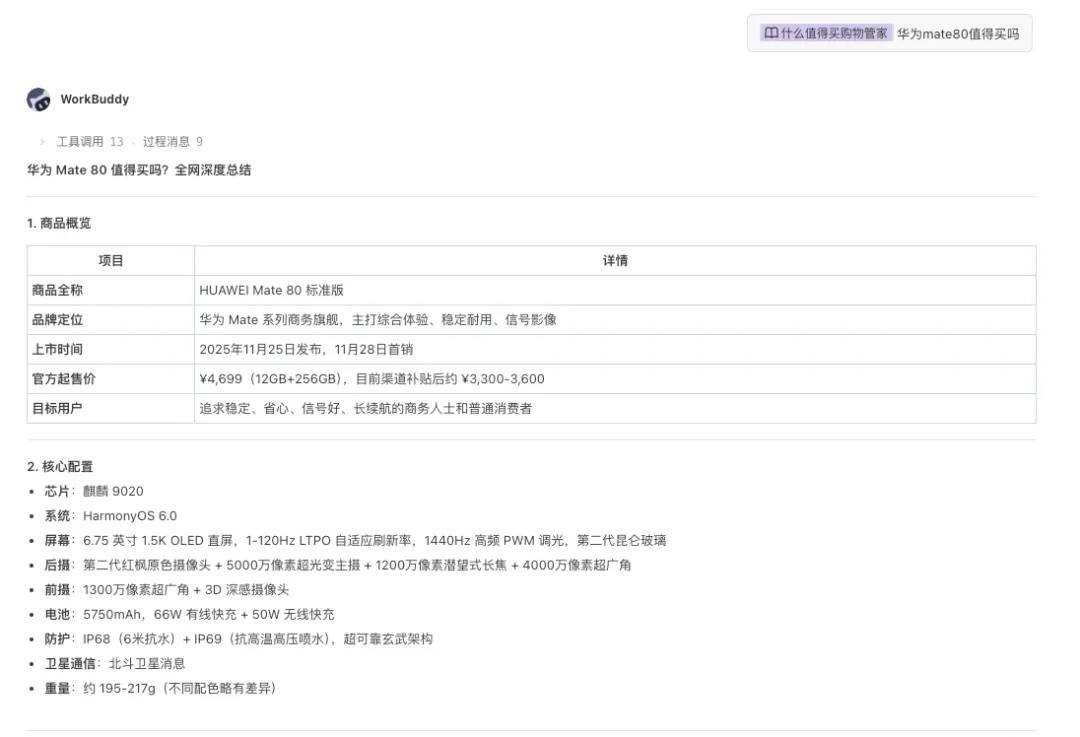
Another interesting detail in the public material is that it does not stop at a screenshot of "the skill is listed." It also shows the actual output from a real conversation.
The prompt in the screenshot is straightforward:
Is the Huawei Mate 80 worth buying?
And WorkBuddy does not respond with a vague yes-or-no line. It returns a structured summary that looks much closer to lightweight product research. The screenshot visibly includes:
- full product name
- brand positioning
- launch timing
- official suggested retail price
- target users
- chipset, OS, display, rear camera, front camera, and battery
- protection and satellite-communication capability
- weight
That is already different from the usual buying-guide page that simply lists a few specs. It is much closer to:
organizing consumer information, product positioning, and buying judgment into one readable conclusion block upfront.
From a shopping workflow perspective, that is valuable because what users often need first is not "show me search results." It is:
- summarize the important points first
- tell me whether this is even the right product for me first
- compare target users and use cases first
- then decide whether to keep checking price, reputation, and promos
If WorkBuddy can make that the default delivery layer, then its value to shopping is not "one more search entry." It is:
taking over the time-consuming organization work at the front half of the buying-decision chain.
Case 3: This Is Not Just a Clever Prompt Layer. The Haina MCP Server Is Supplying the Data
The part of this case I find most valuable is not the front-end UI. It is the infrastructure behind it.
The public partnership material makes it clear that the SMZDM Shopping Assistant is not a temporary shopping script. It comes from the broader Haina Shopping Assistant capability system that SMZDM launched in early 2026.
More importantly, the service is backed by a standardized Haina MCP Server.
Several public numbers sound much more like production infrastructure than marketing copy:
- already connected to 40+ major foundation-model products, AI agents, and smart endpoints
- 1.07 billion content outputs in Q1 2026
- 225.43% growth versus Q4 2025
- 180 million total queries processed across multiple domestic large-model partnerships in May 2026
- 500 million product cards generated
What do those numbers suggest?
They suggest this is not a shopping agent experiment that only recently became usable. It looks more like:
a backend service that already handles high-frequency calls, multiple integration surfaces, and large-scale content distribution.
That is especially important in shopping, because the biggest risks are:
- stale data
- summaries that do not stay updated
- skills that demo well but break under real traffic
- product cards, prices, and promotions that cannot be delivered consistently at scale
At minimum, the public information around the Haina MCP Server proves one thing:
this capability is already being treated as a large-scale data service, not just a demo.
Case 4: This Is No Longer a Single Partnership Story. It Is Moving Deeper Into Tencent's Agent Ecosystem
There is also a timeline in the public material that is worth paying attention to.
SMZDM and Tencent Cloud reached a strategic partnership as early as September 2024. The public milestones that followed include:
- SMZDM's consumer agent entering a branded agent zone inside
Tencent Yuanbao - in July 2025, the
HainaMCP Server landing onTencent Yuanqi, Tencent's agent-building platform - in November 2025, full access expanding across the desktop, WeChat, and app versions of
Tencent Yuanbao - by June 2026, the SMZDM Shopping Assistant formally entering
WorkBuddy
That timeline carries an important implication:
this is not just "one partner press release." It is a capability that has been landing progressively across multiple entry points in Tencent's agent ecosystem.
In that setup, WorkBuddy looks less like a one-off front end and more like:
- a desktop workspace entry point
- a skills-market entry point
- an install and invocation surface for shopping-decision services
- a day-to-day touchpoint inside the wider agent ecosystem
For the consumer sector, that matters because shopping services never live on a single page anyway. They spread across:
- desktop work
- the WeChat ecosystem
- app scenarios
- agent entry points
- content and guided-commerce task flows
If WorkBuddy can receive shopping-decision skills as one of its standard capability blocks, then its value is not "one more front end." It is:
the beginning of a more unified agent distribution layer for shopping services.
When I Put These Public Signals Together, the Production Shape Becomes Pretty Clear
If you look at the official WorkBuddy page, the X account, and the consumer-shopping partnership material together, several concrete production signals are already visible:
- there is a real skills marketplace, not just talk about ecosystem openness
- there are real capability cards, not just partner branding
- there are real conversation results, not just concept art
- there is a real consumer data service layer, not just model-generated summaries
- there are real query and content-output scale signals, not just a small pilot
- there is a real ecosystem timeline, not just a one-off event
That makes the workflow look a lot like a real shopping-agent capability chain:
- the skill gets listed
- the user installs it
- the conversation invokes it
- multi-source consumer data flows back in
- a structured shopping conclusion gets delivered
- the capability extends into Yuanbao, Yuanqi, and more endpoints
If you work on shopping content, member operations, brand guidance, cross-platform price comparison, or product intelligence, the core takeaway should be obvious:
the interesting part is not whether WorkBuddy can talk. It is that it is turning shopping-decision services into reusable, installable, and extensible agent capabilities.
My Take on This Case
Reddit-style, in one line:
This is not just "Tencent also made a shopping assistant."
I think the interesting part shows up on three levels.
1. It moves the consumer sector from content scenarios toward agent scenarios
Consumer services used to sit more often in:
- content recommendations
- shopping search
- ecommerce Q&A
- product cards
Now the direction is shifting toward:
- installable skills
- callable services
- extensible agent workspaces
That is a meaningful change in product form.
2. It shows that AI value in shopping is not only content generation. It is decision organization
What actually burns time is not "write me a recommendation paragraph." It is:
- normalizing product information
- matching products to user needs
- comparing prices across platforms
- filling in promo clues
- structuring the final conclusion
The most valuable thing in this WorkBuddy case is that it starts to take over those messy steps.
3. It has not proven it can cover every shopping task, but it already looks like a real production entry point
I would not claim that a few public numbers mean it has already won every consumer-shopping scenario. But based on the public material, it already has:
- a real skill form factor
- real interaction screenshots
- real service-scale signals
- a real ecosystem rollout timeline
That is more convincing than many agent products that only show benchmarks and vision slides.
If You Want to Bring This Kind of Capability Into Your Business, Evaluate It Like This
- First separate content-led commerce from shopping-decision support.
- Then decide whether your business mainly needs a chat entry point or installable, service-like capabilities.
- Evaluate model capability and data capability separately. Do not look only at whether the model sounds smart.
- Watch three things closely: data freshness, product-comparison quality, and the stability of price and promo lookup.
- If you are comparing it with other agent routes, include entry-point friction and integration cost in the decision.
If what you care about now is how to compare WorkBuddy, Marvis, and other AI agent or model routes in one place, including pricing, onboarding, and whether a more unified buying path could reduce procurement friction for a global team, start here:
Final Verdict
If I had to summarize my view of this WorkBuddy consumer shopping case in one sentence, it would be this:
The most important thing about Tencent WorkBuddy in consumer shopping is not whether it can answer "is this worth buying?" It is that it is starting to compress shopping data, buying decisions, and a skills marketplace into one AI Agent workspace.
For the consumer sector, that matters more than simply adding one more chat entry point.
Because what is actually scarce is not a model that can talk. It is a system that can:
- connect to data
- install skills
- deliver structured conclusions
- enter real workflows
If your team is stuck on those exact problems, this is a case worth studying closely.
FAQ
What capability is WorkBuddy integrating in this consumer-shopping case?
Public material shows that the core capability is the SMZDM Shopping Assistant skill. Users can add it inside WorkBuddy and directly query product information, compare products, and get shopping suggestions in the conversation flow.
Is this just a prompt wrapper, or does it look more like a formal service?
Based on public information, it looks more like a formal service. The capability is tied to SMZDM's externally exposed Haina MCP Server and standardized consumer data service layer, not a one-time prompt demo.
Why say this already has a production feel?
Because the public material shows all of these together:
- a Skills Market screenshot
- a real conversation-result screenshot
40+connected mainstream models, agents, and endpoints1.07 billionquarterly content outputs180 millionqueries and500 millionproduct cards generated
Taken together, that looks much more like a live service capability than a concept demo.
Which teams should pay attention to this case first?
It is especially relevant for:
- buying-guide content teams
- ecommerce and membership-operations teams
- product-research and price-comparison teams
- brand marketing and performance teams
- product teams exploring shopping-decision agents
Where should I start if I want to compare WorkBuddy or other agent routes further?
Start with these three pages:
References
- SMZDM and Tencent Cloud deepen their "AI + consumer" partnership, with the first shopping-decision skill launched on Tencent WorkBuddy
- Business update: SMZDM and Tencent Cloud deepen "AI + consumer" partnership, with the first shopping-decision skill launched on Tencent WorkBuddy
- Tencent WorkBuddy (@WorkBuddy_AI) / Posts / X
- WorkBuddy · Your scenario-based AI all-in-one package