Tencent WorkBuddy Logistics and Supply Chain Use Cases: Why Import/Export Documentation, Inventory Turnover, and VSM Workflows Are Moving to AI Agents
If you still think WorkBuddy is basically "a Tencent office chat box," you are probably missing where it is starting to matter most.
In logistics, supply chain, and warehouse operations, the interesting question is not whether it can draft a paragraph. It is whether it can handle work that already looks like production:
- import/export document review
- inventory turnover and
SKUanalysis VSMvalue-stream mapping and5Whyroot-cause analysis- weekly reports, inventory tables, and daily briefs
- training
PPTcreation for logistics teams
I pulled several public cases together for this review, and the pattern is pretty clear:
WorkBuddy is no longer just showing up as Q&A. It is starting to enter document flows, spreadsheet flows, analysis flows, process flows, and the internal capture of team knowledge.
The Short Verdict
-
As of June 29, 2026, the most convincing public
WorkBuddylogistics and supply chain cases already cover at least four tracks:- Import/export documentation and order-follow-up collaboration
- Payment-cycle, inventory-turnover, and
SKUoperating analysis - Warehouse lean improvement and process diagnosis
- Routine automation for weekly reports, inventory data, and industry briefings
-
What makes these cases valuable is not just that "AI joined office work." It is that the public examples already involve fairly concrete production ingredients:
Excel / CSV / PDF / customs declarations / settlement sheets- local folders and desktop workflows
- scheduled tasks
- rules and methods like
VSM,5Why, inventory alert thresholds, and replenishment priorities
-
If you work in:
- import/export or trade operations
- warehouse logistics or supply chain operations
- container or cross-border business coordination
- purchasing, finance, or operating analysis
then these WorkBuddy cases are much more useful than a generic "AI office demo."
Why Logistics and Supply Chain Are Such a Natural Early Fit
People often assume AI proves value first in copywriting, coding, or image generation.
But inside real supply chain teams, the most exhausting work is usually not creative. It is things like:
- line-by-line customs and settlement checks
Excelreports and multi-dimensional business analysis- repeated decisions around inventory, replenishment, turnover, and thresholds
- weekly summaries, morning briefs, industry information, and to-do syncing
- warehouse process issues where everyone knows something is wrong but the root cause is hard to explain quickly
In other words, the hardest part in supply chain is rarely "we do not know how to do this." It is:
every task is manageable on its own, but all of them are fragmented, repetitive, and experience-heavy.
That is exactly where WorkBuddy looks strong in the public record:
- reading documents
- parsing spreadsheets
- breaking work into steps
- applying rules
- grouping findings
- returning structured output
Case 1: Import/Export Coordination No Longer Means One Person Manually Carrying Customs, Finance, and Reporting
The first public case that feels especially close to a real production environment is this Tencent Cloud Developer Community article:
Building an "Import/Export Supply Chain AI Team" with WorkBuddy
What makes it useful is how concrete the role and workload are. The author is described as:
- a business follow-up supervisor at an import/export supply chain company
- handling daily work such as:
- customs declaration review
- financial checks
- team coordination
- data reporting
That already looks a lot more like real production than "trying AI for fun." It is a typical supply chain role trying to offload repetitive work.
In the public case, the author built a WorkBuddy team with 6 specialist roles plus 1 team leader:
Mike:Team Leader关风: customs compliance assistant财锚: finance reviewer数眸: data analyst协链:ERPcoordinator绩擎: performance supervisor特助: personal assistant
The important part is not the naming. It is that the setup already splits out some of the heaviest repeat tasks inside a supply chain team.
1.1 Customs Declaration Review: From Manual Item-by-Item Checking to AI Flagging Risk Points First
The article is very direct here. A single customs declaration used to require manual review across more than ten fields, including:
HScode- product name
- unit
- declaration elements
The new approach is to send the declaration to 关风 first, and let it handle:
- declaration-element validation
- risk-point identification
- risk-assessment report output
If you have worked in trade operations, the value is obvious. The problem in customs work is rarely "nobody knows the rule." It is:
- there are too many items to miss safely
- one person has to remember too many rule combinations
- once an error slips through, the result is often compliance risk rather than just rework
1.2 Finance Reconciliation: Amount, Currency, and Duplicate-Payment Issues Get Screened Before Humans Dig In
In the same case, 财锚 focuses on settlements and invoices.
The public write-up specifically mentions tasks such as:
- settlement-document verification
- abnormal-transaction detection
- amount-mismatch marking
- duplicate-payment checks
That is one of the most painful month-end workloads in many supply chain and trade teams. Manual reconciliation is time-consuming not because building the sheet is hard, but because people spend hours:
- scanning line by line for anomalies
- checking currencies
- matching amounts
- confirming whether a payment is duplicated
If an agent can take the first pass, the team can spend more time on judgment and communication instead of mechanical matching.
1.3 Reporting: Trend Charts, Alerts, and Service-Gap Analysis Start Becoming Standard Output
数眸 in the article handles business-data automation.
The public case does not describe this as a vague "summary." It explicitly mentions outputs such as:
- trend charts
- alert prompts
- service-gap analysis
That suggests WorkBuddy in supply chain is moving past pure Q&A and compressing a familiar chain:
data cleanup -> aggregation -> visualization -> alerts
into something smoother and more repeatable.
Case 2: A Finance BP in the Container Sector Brings Payment Cycles, Inventory Turnover, and SKU Analysis Back to the Business
The second public case that is especially good for SEO and for real readers is:
Finance BP in Practice: Using WorkBuddy for Payment-Cycle, Inventory-Turnover, and SKU Operating Analysis
What makes this article strong is that it does not talk about finance automation in the abstract. It gives a specific business setting:
- the author works in what the case describes as the container industry
- the operating model is externally sourced raw materials plus outsourced assembly
- sales cover both domestic channels and cross-border markets in Europe and the US
So this is not a simple retail-finance example. It is a setting with:
a long supply chain, mixed customer types, and complicated reporting dimensions.
The public article directly names four core tasks:
- accounts receivable / accounts payable payment-cycle management
- inventory-turnover-days analysis
SKU-level profitability analysis- capacity-matching calculations
It also gives a clear public outcome:
WorkBuddyhelped the finance function move from data counting to business enablement- related office efficiency improved by 80%
2.1 The Valuable Part Is Not Just the Report, but the Operating Recommendation Attached to It
The part I value most in this case is that it emphasizes more than automatic statistics. It explicitly highlights:
- rapid output against industry standards
- automated report generation
- operating-analysis recommendations
That means WorkBuddy here is not just replacing copy-paste work. It is starting to move one step further into business action:
- which
SKUs may be dragging profit - which inventory backlog should be handled first
- which payment-cycle structure may be hurting cash flow
- which replenishment moves need to be triggered earlier
That matters in supply chain because teams are rarely short on numbers. They are usually short on:
the step that connects the numbers to the next action.
Case 3: Warehouse VSM and 5Why Root-Cause Analysis Have Already Been Turned Into a Double-Click Tool
If the first two cases lean toward operations and analytics, the third one feels much closer to what frontline improvement teams would care about:
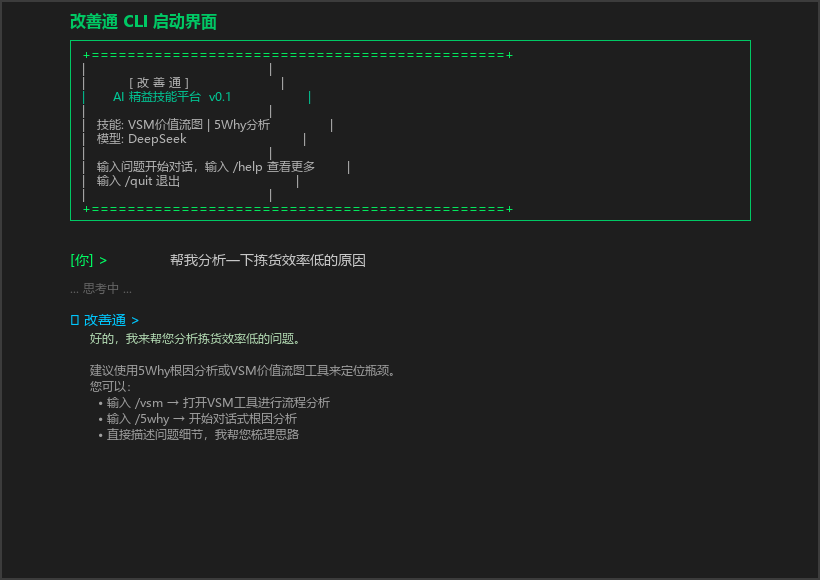
Building "GaiShanTong," a Lean Improvement AI Assistant on WorkBuddy, From Zero to Runnable in Just 2 Hours
The biggest signal in this case is not just "AI was used." It is that a very vertical professional tool was built in a way that looks usable in a real production setting.
The author says they have spent nearly 20 years in lean improvement work across:
- manufacturing
- third-party warehouse logistics
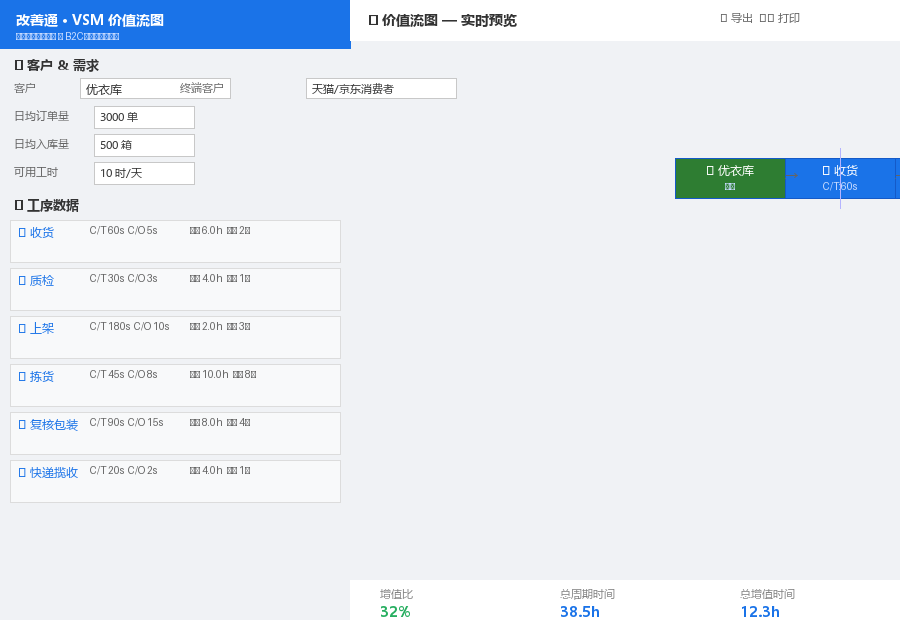
And what they built with WorkBuddy is not a generic chat helper. It is a warehouse-focused lean-improvement tool called 改善通 with two core capabilities:
VSMvalue-stream mapping5Whyroot-cause analysis
3.1 What Makes It Feel Real Is That the Warehouse Process Is Already Hard-Coded Into the Tool
In the public article, the VSM tool is not an abstract template. It is directly structured around warehouse logistics steps such as:
- receiving
- quality inspection
- putaway
- picking
- review and packing
- courier pickup
The input fields are also very specific rather than generic:
C/TC/O- headcount
- value-added time
The tool then generates a value-stream-map preview and automatically outputs:
- value-added ratio
- total cycle time
- bottleneck process
That is the point where this stops looking like "AI can draw a diagram" and starts looking like:
AI packaging warehouse-operations methodology into a shell that frontline teams can actually use.
3.2 A 2-Hour MVP Matters Here Because the Lesson Is "Make It Run First"
The public case also states a few details very plainly:
- the full idea-to-runnable process took only 2 hours
- the launch method was double-clicking a
.batfile - on
Windows, the author had to handle:- absolute
Pythonpaths - Chinese character encoding issues
API Keyconfiguration
- absolute
More importantly, the implementation approach is not flashy at all:
- let
WorkBuddygenerate the product concept document first - then write the
Pythonmain program - use keyword matching to trigger skills
- then build a separate interactive
HTMLpage forVSM
The author basically says the key out loud:
At the MVP stage, getting it running matters more than making it fancy.
That is especially true in logistics and supply chain, where teams often do not need a perfect platform first. They need to know:
- can the method be solidified at all
- will frontline staff use it
- can expert knowledge become a reusable entry point
Case 4: Weekly Reports, Inventory Statistics, and Industry Briefings Are Becoming Fixed Automation Flows
Another public case is more operations-heavy:
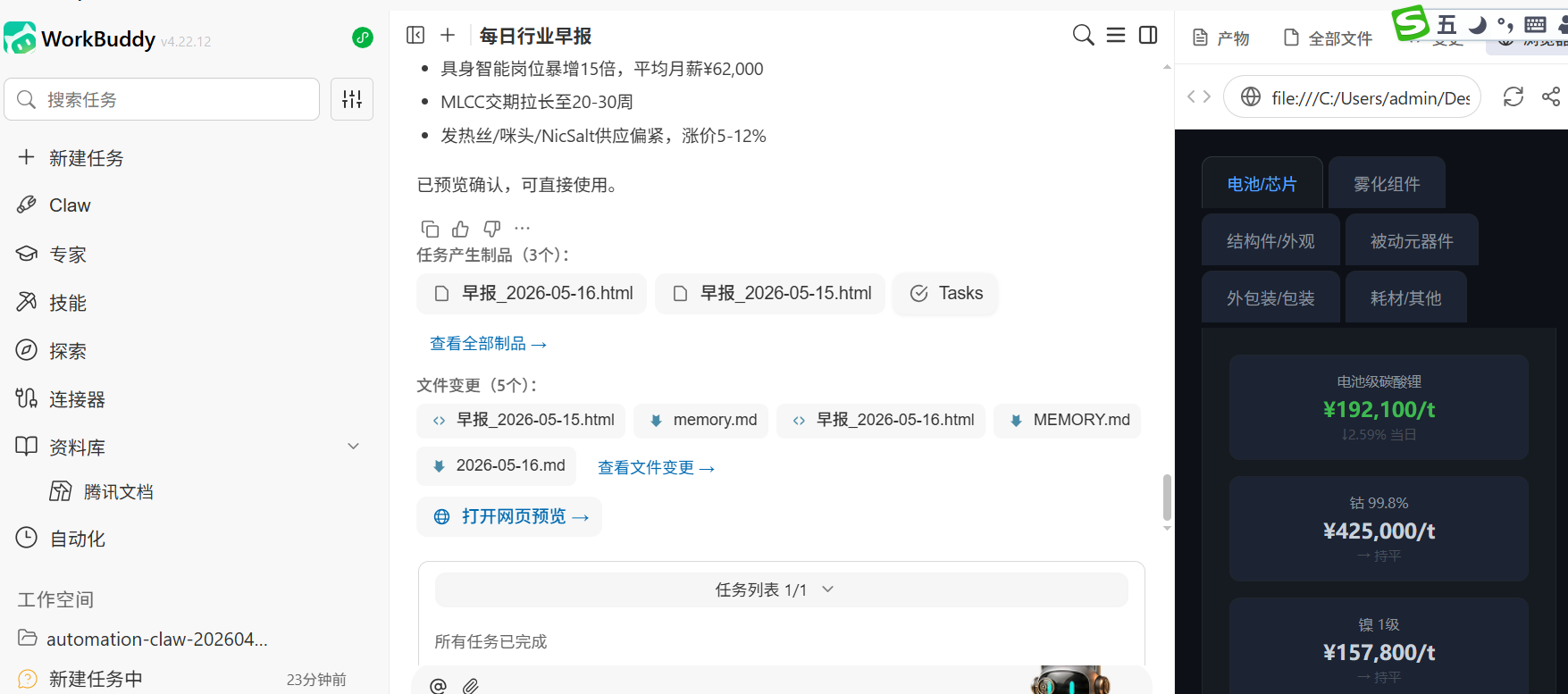
Building a Factory Operations Automation Workflow with WorkBuddy: From Weekly Reports to Inventory Data Processing
The title says factory operations, but many of the actual tasks map directly to supply chain, purchasing, and warehouse roles.
The public write-up highlights three especially representative automation scenarios:
- structured weekly report generation
- inventory data statistics and visualization
- an 8:30 a.m. daily industry-and-to-do briefing
4.1 Inventory Statistics: From 1 Hour Down to 5 Minutes Is Exactly the Kind of Work an Agent Should Eat First
The inventory example in the article is very concrete:
- first, normalize inventory and material data in a standard
Excelfile - fields include:
- material code
- name
- inbound quantity
- current inventory
- alert threshold
Then WorkBuddy is used to:
- summarize inbound quantity and current inventory by material category
- generate bar charts
- identify materials below alert threshold
- output replenishment-risk and priority recommendations
The key efficiency claim is simple and memorable:
- processing time dropped from 1 hour to 5 minutes
That is a classic supply chain data task. It is not technically flashy, but it is exactly the kind of work that burns time every week.
4.2 Daily Industry Briefings: Scheduled Supply Chain Updates and To-Dos
The same article also mentions a daily briefing generated at 8:30 a.m., including:
- manufacturing and supply-chain news
- condensed key points
- synchronized to-do items
- priority ranking
That means WorkBuddy in these roles is already moving from "help me once" toward:
fixed time, fixed inputs, fixed outputs, fixed rhythm.
That is very different from a one-off AI office demo.
Case 5: Even Logistics Training PPTs Are Being Compressed Into a Half-Day Task
The last piece that deserves a spot in this cluster is a WeChat-synced article:
Finish a Logistics AI Training PPT in Half a Day: My IMA + Doubao + WorkBuddy Toolkit (with Prompts)
This case matters because it is not only about executing business operations. It is about:
how logistics teams turn experience, plans, and industry knowledge into materials that are teachable, reusable, and ready to present.
From the public metadata and article path, a few details are visible:
- the post is marked as
articleSource: W, meaning a WeChat-synced article - the original source is the WeChat public account
豆豆1982 - the original-publication source information is preserved in the article path
The tool combination described in the piece is also very clear:
IMA: build the knowledge framework first- Doubao: generate the first
PPTdraft WorkBuddy: refine it again using practical implementation cases
The final result is:
- a logistics-industry
AI Agenttraining deck completed in half a day
This is not a direct execution case like customs review or inventory analysis, but it still shows something important:
WorkBuddy is starting to enter internal knowledge packaging, training output, and solution delivery.
That matters to supply chain teams too, because many organizations fail to scale not because nobody knows the work, but because:
- experience never gets codified
- nobody can explain the plan clearly
- onboarding new staff is too slow
- customer-facing presentation material is always late
What a Real Logistics and Supply Chain Production Environment Looks Like Across These Cases
If you put all of these public cases together, WorkBuddy in logistics and supply chain already shows some very clear shared traits:
- the inputs are not just chat
- customs declarations
- settlement sheets
Excel / CSV- inventory tables
- weekly or morning-brief materials stored in local folders
- the tasks are not one question and one answer, but continuous flows
- review
- verification
- aggregation
- alerts
- reporting
- follow-up
- the outputs are usually not a sentence, but operational artifacts
- risk assessments
- trend charts
- replenishment-priority suggestions
- weekly reports
- daily briefings
- small tools you can launch by double-clicking
- training
PPTs
That is why I think logistics and supply chain are one of the easiest places for WorkBuddy to show real value early.
This domain is rich in exactly the things agents can grab first:
- rules
- tables
- processes
- expert know-how
Which Teams Should Pilot This First
Good immediate fits
- teams with heavy import/export follow-up, customs review, or finance-reconciliation workloads
- operations or finance teams that do inventory, payment-cycle, and
SKUanalysis every week - improvement teams with explicit warehouse process-diagnosis needs
- purchasing, factory-operations, or supply-chain platform roles buried in documents and spreadsheets
- logistics teams that frequently need internal training, customer explanations, or solution-output materials
Teams That Can Wait and Watch
- teams with no stable workflow and only occasional chat needs
- teams that barely touch local files, reports, or professional rules
- organizations that still lack naming standards, folder standards, or reporting definitions
- teams that are not yet ready to define data boundaries and authorization boundaries for desktop agents
If You Want to Connect WorkBuddy-Like Logistics Flows to Custom Models, Where Is the Buying Value?
In logistics and supply chain, the real procurement question is usually not "which model sounds smartest?" It is more often:
- is the long workflow stable
- are file-heavy tasks affordable
- can different roles route to different models
- can multiple agents share one unified gateway
So if you are building for supply chain analysis, document review, or process automation, a unified model entry point is often more practical than betting everything on a single model.
Start here:
Final Take
If I had to summarize my view of the WorkBuddy logistics and supply chain cases in one sentence, it would be this:
The real value is not that "AI has entered logistics." It is that AI is starting to take over the most tedious, rule-heavy, and experience-heavy parts of supply chain work, and it is starting to produce outputs that can keep moving through the workflow.
Once that starts working smoothly, the first benefits teams usually feel are not a flashy demo, but three very practical gains:
- repetitive document and reporting work drops noticeably
- inventory, payment-cycle, and
SKUanalysis gets to action faster - frontline experience and training materials are easier to turn into reusable workflows
That is why the most important thing to watch in this WorkBuddy track is not whether it can chat. It is whether it is starting to become a real agent workspace for business flow.
Sources
- Building an "Import/Export Supply Chain AI Team" with WorkBuddy
- Finance BP in Practice: Using WorkBuddy for Payment-Cycle, Inventory-Turnover, and SKU Operating Analysis
- Building "GaiShanTong," a Lean Improvement AI Assistant on WorkBuddy, From Zero to Runnable in Just 2 Hours
- Building a Factory Operations Automation Workflow with WorkBuddy: From Weekly Reports to Inventory Data Processing
- Finish a Logistics AI Training PPT in Half a Day: My IMA + Doubao + WorkBuddy Toolkit (with Prompts)
- Tencent Cloud official X: Introducing Tencent WorkBuddy