Tencent WorkBuddy Life Services and AI Payment Case Study: KFC, WeChat Pay AI Card, and Meituan Show Why Agents Are Starting to Handle Real Consumer Payments
If you still think WorkBuddy is mainly a Tencent office agent, its recent expansion into life services, restaurant spend, and AI payment should make you look again.
This time I stitched together four public sources:
- Tencent Cloud Developer Community: WorkBuddy is testing AI payment. Buy Q Coins with one sentence. Maybe we will not need to open the app in the future
- Nanfang Metropolis Daily: WorkBuddy is testing WeChat AI payment and can buy Q Coins with one sentence
- Mobile Payment Network: WeChat Pay's AI card has arrived and is under internal testing
- Beijing Daily: WeChat Pay officially launched the AI card
After reading them together, my conclusion is direct:
The most important signal in WorkBuddy life services is not whether it can recommend lunch. It is that Tencent is starting to compress the full chain of request -> recommendation -> add to cart -> payment confirmation -> in-store redemption into an agent workstation.
That is a different category from generic AI shopping assistants or coupon finders, because it already touches:
- restaurant spending
- local services group buying
- AI payment
- payment limits and authorization
- conversational checkout flows
In other words, it is moving from "an agent that helps you work" toward:
an agent that can execute consumer purchases inside controlled permission boundaries
The short conclusion first
-
As of June 29, 2026, the clearest public
WorkBuddysignals in life services are concentrated in three lines:- a life-services zone and restaurant brand partnerships
- the WeChat Pay AI card
- Meituan Life Assistant and group-buy payment flows
-
Public reports already make this look much closer to a real production environment than to a concept demo:
WorkBuddyis being extended into workers' breakfast, lunch, afternoon tea, and everyday spending- KFC has been named as the first Western restaurant partner in the life-services section
- users can complete intent expression, recommendation, ordering, and payment inside
WorkBuddy - WeChat has added an AI card
- payment is designed around ring-fenced funds and per-transaction confirmation
WorkBuddy Mac 5.1.1has already been publicly shown supporting Meituan Life Assistant for group-buy purchase and in-store redemption
-
If you are building around:
- restaurant commerce
- local services
- group-buy experiences
- agent payment
- consumer AI agents
then this
WorkBuddycase is much more valuable than another article about "what AI can recommend."
Why life services are unusually well suited to early agent value
Many people assume life services mostly need:
- better recommendation systems
- cheaper traffic acquisition
- smoother payment tools
All of that matters, but the real pain is usually this:
- intent is immediate
- decisions are fragmented
- platforms are fragmented
- page switching is constant
- users drop off between search, comparison, purchase, and payment
So the annoying part of life services is not "there is no service." It is this:
Every step is manageable, but every step requires another app, another page, or another confirmation.
The WorkBuddy + AI payment + life-services zone direction starts to attack exactly that problem:
- collect intent in chat
- recommend products or services
- continue into cart creation
- connect the payment rail
- keep authorization and spending limits separate
That is why I think this is more important than simple AI shopping guidance.
It is starting to touch a real transaction close.
Signal 1: WorkBuddy is no longer only an office assistant. It is entering life services
Public coverage from Nanfang Metropolis Daily and Mobile Payment Network points to the same important signal:
At Tencent Cloud's AI industry application forum on June 5, 2026, WorkBuddy publicly introduced a new direction:
- its scope would no longer stop at work scenarios
- it would expand into life services
- it would cover workers' three daily meals, afternoon tea, and routine consumption
That sentence matters a lot.
If it were only an office agent, its boundaries would still be familiar:
- document drafting
- knowledge management
- workflow execution
But once it enters life services, it hits a completely different infrastructure stack:
- merchants
- group buying
- payment
- redemption
- consumer safety
That means Tencent is not only experimenting with "adding a lifestyle skill to an agent."
It is testing whether the agent can start touching transactions.
Case 1: KFC being named as the first partner is a bigger signal than it looks
The most attention-grabbing public life-services signal is this:
KFC will become the first Western restaurant partner in WorkBuddy's life-services section.
Why does that matter?
Because it means the story has already moved beyond "maybe we will connect restaurant scenarios one day." It names an actual brand partner.
The Nanfang Metropolis Daily piece describes the goal directly:
to explore a new dining experience for the AI agent era
Mobile Payment Network adds another important layer:
- KFC already has more than 10,000 stores nationwide
- that gives WorkBuddy's dining scenario a real commercial fulfillment base
That point matters in local services.
Many AI commerce demos fail not because the assistant cannot talk, but because:
- there is no real merchant supply
- store coverage is too thin
- fulfillment is not actually usable
If the first partner is a chain like KFC, this life-services line is at least not pure slideware.
Case 2: Buying Q Coins and ordering KFC delivery are no longer just information lookups
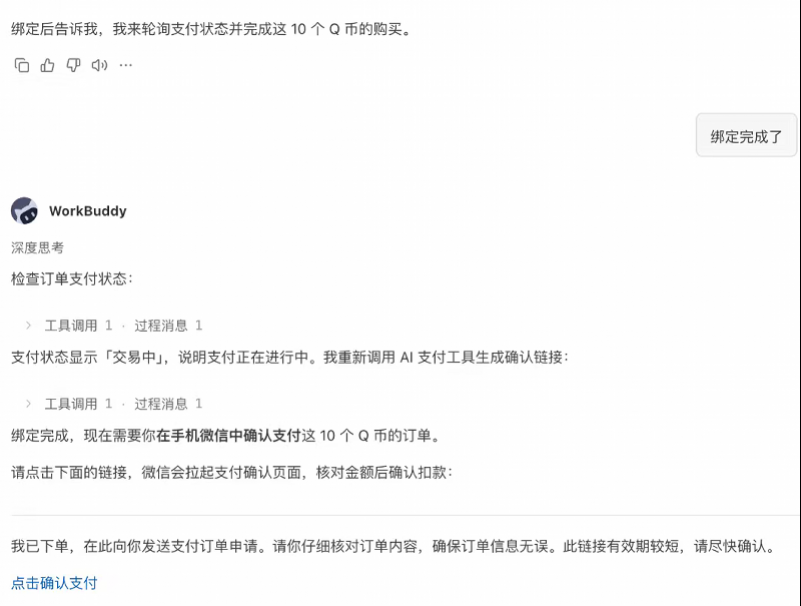
The most production-like part of the public material is not the brand name. It is the step-by-step conversation flow.
Nanfang Metropolis Daily gives a very explicit example:
- the user asks
WorkBuddyto buy Q Coins - the agent makes a recommendation
- it generates an order
- the user performs final confirmation and verification before payment
- the whole process does not require jumping to another platform
Mobile Payment Network quotes a more consumer-style internal example:
- "Help me order KFC delivery"
- the agent chooses the meal
- adds it to the cart
- then directly calls the WeChat Pay AI card to complete the payment
Both examples matter because they show the capability is no longer limited to:
- giving you a link
- giving you a recommendation
- showing a price
It is starting to connect these steps:
- receive a consumer intent
- search and recommend products or services
- create an order or cart
- initiate a payment flow
- wait for user confirmation
That is the key shift for me:
The agent is no longer only understanding consumption. It is starting to advance a purchase task.
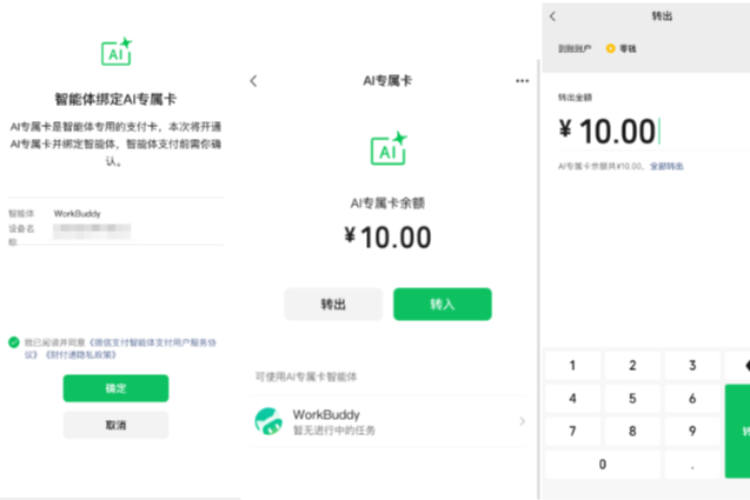
Case 3: The AI card is the piece that makes this feel like production
If recommendation, ordering, and cart creation are the front-stage experience, the thing that makes this look like a real production design is:
the WeChat Pay AI card
Across the public descriptions from Nanfang Metropolis Daily, Mobile Payment Network, and Beijing Daily, the AI card includes several features that look much closer to serious payment infrastructure:
- a separate card is added inside WeChat balance
- it is isolated from the main account
- users can transfer funds in and out
- agent spending is limited to the card balance
- every payment still requires final user confirmation
- the design follows dedicated funds and confirmation on every transaction
Why is that important?
Because every AI payment product runs into the same question:
How do users feel safe letting an agent spend money?
The answer here is not "trust the model."
It is:
- limit the amount
- isolate the balance
- preserve confirmation
That is a much more production-minded approach than "connect the payment first and worry later."
Case 4: Meituan Life Assistant is where the local-services loop becomes more real
Public material referenced by Beijing Daily and related reporting also points to a capability that looks even more like a local-services closed loop than simple food delivery:
Meituan Life Assistant
The public description says:
- users can call Meituan Life Assistant from the
WorkBuddyexpert page - they can express what they want to eat or what they want to do in conversation
- they can use the WeChat Pay AI card to buy group-buy offers
- then redeem them in store
Two details are especially worth remembering here:
1. It is no longer only about food delivery. It is about local services group buying
The wording "what to eat" and "what to do" suggests the target is not only one meal order, but a broader bucket of:
- dining
- group buying
- local services spending
2. The version and entry point are already public
Public coverage explicitly says:
- the capability can be experienced in
WorkBuddy Mac 5.1.1
That matters because version-level evidence is usually much more useful than a vague roadmap.
When you combine these public examples, the production picture looks like this
If you put these reports together, the life-services environment around WorkBuddy already shows several signals that look very production-like:
- a clear scenario, not vague consumer talk
- a named partner brand, not a fictional merchant
- a clear payment infrastructure layer, not recommendation only
- a clear security and authorization mechanism, not default full-autonomy charging
- a public version entry point, not an internal-only vision
- a clear local-services use case, not only virtual goods
That makes it look much more like a real agent commerce workflow:
- the user states intent in chat
- the agent recommends and filters
- the agent creates an order or cart
- the AI card is invoked
- the user confirms payment
- the purchase completes or the offer is redeemed in store
If you are building in life services, payments, or consumer agents, you will recognize the difference quickly:
This is no longer only a conversational shopping assistant. It is a purchase execution entry point with payment guardrails.
But I would not oversell it as "AI can now buy anything"
In one sentence:
This life-services line is worth studying, but seeing "AI payment" should not make you imagine that WorkBuddy can already replace every app or every commerce flow.
My three biggest reservations are still these:
1. Public wording still says "early testing" and "internal testing"
Both Nanfang Metropolis Daily and Mobile Payment Network note that the WeChat Pay plus WorkBuddy AI payment capability is still in early internal testing at Tencent.
That means the direction is real, but it is not the same as broad, mature, open availability.
2. The AI card design itself admits that payment has to stay conservative
The whole design around dedicated funds and confirmation on every transaction shows that Tencent is not treating this as a full-autonomy spending system.
That is not a weakness. It is a sign that:
The more real payment becomes, the less likely it is to be fully unbounded.
3. The hard part of life-services agents is not only the model. It is fulfillment and permissions
The real difficulties are still:
- whether merchants integrate
- how payment is controlled
- how group-buy redemption works
- how version rollout is staged
- whether users are willing to hand purchase actions to an agent
So this line deserves careful study, but it should not be misread as "payment is connected, therefore local services are solved."
How I would test this before integrating it into a product
- First separate recommendation from purchase execution.
- If payment is involved, test spending isolation, confirmation flow, and interruption handling first.
- Test restaurant delivery, group-buy offers, and virtual goods as separate tracks instead of one giant "AI life assistant" bucket.
- Watch three metrics closely: jump count, payment confirmation success rate, and redemption or fulfillment completion.
- If you are comparing different agents, models, or payment rails, include integration friction and security review cost in the economics.
For overseas buyers, the commercial path behind the agent stack can matter almost as much as the demo itself. Some teams prefer working through a Hong Kong-based company and a more unified procurement, billing, and integration surface when comparing China-linked model or agent routes. That can reduce operational friction, but it is still something to verify against the live route status rather than assume from a case study alone.
If you are now comparing WorkBuddy, Marvis, or other AI agent and model routes, a simple place to start is:
My final take
If I had to summarize this WorkBuddy life-services case in one sentence, it would be this:
The most important thing here is not that Tencent WorkBuddy can recommend lunch. It is that it is starting to push restaurant spend, local services, and payment permissions into an actual agent workstation.
That is far more meaningful than adding one more AI shopping Q and A layer.
Because once an agent can, inside controlled boundaries:
- receive the need
- recommend the options
- push the order
- initiate the payment
- hand the final confirmation back to the user
then it is no longer only an office assistant.
It is moving toward a real consumer transaction entry point.
FAQ
Which scenarios are the main focus of WorkBuddy's life-services capability right now?
Based on the public material, the main scenarios are:
- restaurant spending
- local services group buying
- virtual goods purchases
- AI payment flows
What exactly is the AI card?
It is a separate payment card capability that WeChat Pay designed for AI agent payment scenarios. Public descriptions show that it is isolated from the main account, supports user-controlled top-up and transfer-out, and still requires final confirmation on every payment.
Why is the KFC partnership signal important?
Because it shows that WorkBuddy's life-services section is not only a future plan. It already has a concrete restaurant brand and a large nationwide store network behind the scenario, which looks much more like a real commercial environment.
What can Meituan Life Assistant already do?
According to the public material, users can call Meituan Life Assistant from WorkBuddy's expert page, use conversation to select a local-services group-buy offer, complete the purchase, and redeem it in store. Public reporting also says Mac 5.1.1 already supports this capability.
Where should I start if I want to compare WorkBuddy or other agent routes in more detail?
Start with these three pages:
References
- Tencent Cloud Developer Community: WorkBuddy is testing AI payment. Buy Q Coins with one sentence. Maybe we will not need to open the app in the future
- Nanfang Metropolis Daily: WorkBuddy is testing WeChat AI payment and can buy Q Coins with one sentence
- Mobile Payment Network: WeChat Pay's AI card has arrived and is under internal testing
- Beijing Daily: WeChat Pay officially launched the AI card