Tencent WorkBuddy Public Service Case Study: Government AI Assistant, Digital Counter, and Housing Fund AI Workflows
If you still think WorkBuddy is mainly a desktop productivity assistant, you are probably missing the more interesting part of the story.
I went back through several public materials directly tied to government service, citizen guidance, housing fund digital counters (in China's housing provident fund system), and internal public-sector productivity. After reading them side by side, my view is pretty clear:
Tencent's broader AI office and agent route around WorkBuddy is no longer just about helping staff write reports. It is starting to move into front-line public service workflows.
What matters here is not whether AI can answer questions. The real question is whether it can:
- turn natural-language citizen requests into executable service flows
- connect lookup, extraction, estimation, signing, and process handoff in one chain
- support both external citizens and internal staff
- upgrade public service from "available online" to "easy to use, fast to use, and possible to complete while chatting"
If that direction keeps working, the payoff is bigger than office efficiency.
It changes the structure of the citizen service experience itself.
The short conclusion first
-
As of June 29, 2026, the most representative public-facing examples tied to Tencent's WorkBuddy-related government and public service route can already be grouped into three fairly clear tracks:
- Internal productivity for staff: using
WorkBuddy / LightClawfor report generation, meeting-note capture, and office or R&D efficiency - Citizen service guidance: exemplified by Shenzhen Bao'an's
Xiaobao Tongxue, which turns city-service guidance into voice input and one-click handling - Housing fund "chat while filing" workflows: exemplified by the Handan housing fund digital counter, which pushes natural-language dialogue directly into service execution
- Internal productivity for staff: using
-
The strongest signal is not "it can chat." It is that public materials already show concrete production-style details such as:
- a WeChat mini program entry point
- natural-language conversation driving the workflow
48high-frequency service items being connected600+city-service items covered- a single service trip cut from
15minutes to3minutes 2,475consultations handled in the first week82%automatic answer accuracy- more than
600,000annual housing fund withdrawal service visits
-
If you care about:
- public service digitization
- citizen-facing AI assistants
- linking internal staff efficiency with external service delivery
- whether AI can really run in process-heavy environments
then this route is more informative than a generic office AI demo.
One clarification first: this is not just "put WorkBuddy into a mini program"
The easiest mistake here is to describe the picture like this:
- WorkBuddy handles office productivity
- a government mini program handles public service
- both happen to use Tencent AI somewhere in the stack
That is too shallow.
Based on the public materials taken together, the more accurate reading is this:
WorkBuddy is the office-side entry point within Tencent's larger AI office and agent route, while citizen guidance and digital counters are the public-service extension of that same capability path.
So the value is not a single isolated tool. It is the fact that the same route is stretching across:
- the internal side: reports, notes, staff productivity, office assistance
- the external side: citizen guidance, Q&A, service handling, natural-language interaction
If those two sides really connect, that looks much more like a full public-sector agent system.
Case 1: public-sector buyers do not just want a chatbot. They want a stack that is both localizable and cloud-native
In the public article about Tencent Cloud + AI full-stack capabilities for digital government, Tencent describes several tensions in public-sector digitization very directly:
- agencies need localized deployment for security and compliance
- they also need internet-grade concurrency and availability
- they care about domestic and controllable technology stacks
- they still need systems that are actually usable by business teams
Inside that article, Tencent explicitly names a government AI toolchain that includes:
WorkBuddy: Tencent's low-barrier AI office assistantLightClaw: a cloud environment for one-click AI deploymentADP 3.0: support forLLM + RAG,Workflow, andMulti-Agent
That matters because it shows the public-sector decision is not simply "Should we buy a smarter Q&A bot?"
It is really:
How do we connect office work, development work, and citizen-facing service flows into one shared AI foundation?
That is why I do not think this route should be evaluated only through the front-end chat experience. It makes more sense to look at it across three layers:
- internal office assistance
- workflow and development orchestration
- external public-service access points
Case 2: Shenzhen Bao'an's "Xiaobao Tongxue" suggests citizen guidance is already past the proof-of-concept stage
The same public material highlights another case that deserves attention:
Shenzhen Bao'an District's Xiaobao Tongxue
According to the public description:
- it is the intelligent guidance assistant inside the
Bao i Qimini program - it is meant for smart city service guidance and proactive citizen engagement
- it covers
600+city-service items - it supports voice input
- it supports one-click handling
- it can guide users through more complex matters such as high-level talent subsidies and food-operation permits
Why does this matter?
Because this is not just another FAQ bot. It looks more like:
a public-facing service desk for specific government matters.
In citizen service, the hardest part is often not "finding an answer." It is:
- not knowing which service window to use
- not knowing whether you qualify
- not knowing which button or next step actually matters
- not knowing which documents to prepare
If intelligent guidance tools like Xiaobao Tongxue can absorb that friction early, the value is not only lower call-center load. It is that many processes that used to depend on manual hand-holding can start being resolved online much earlier.
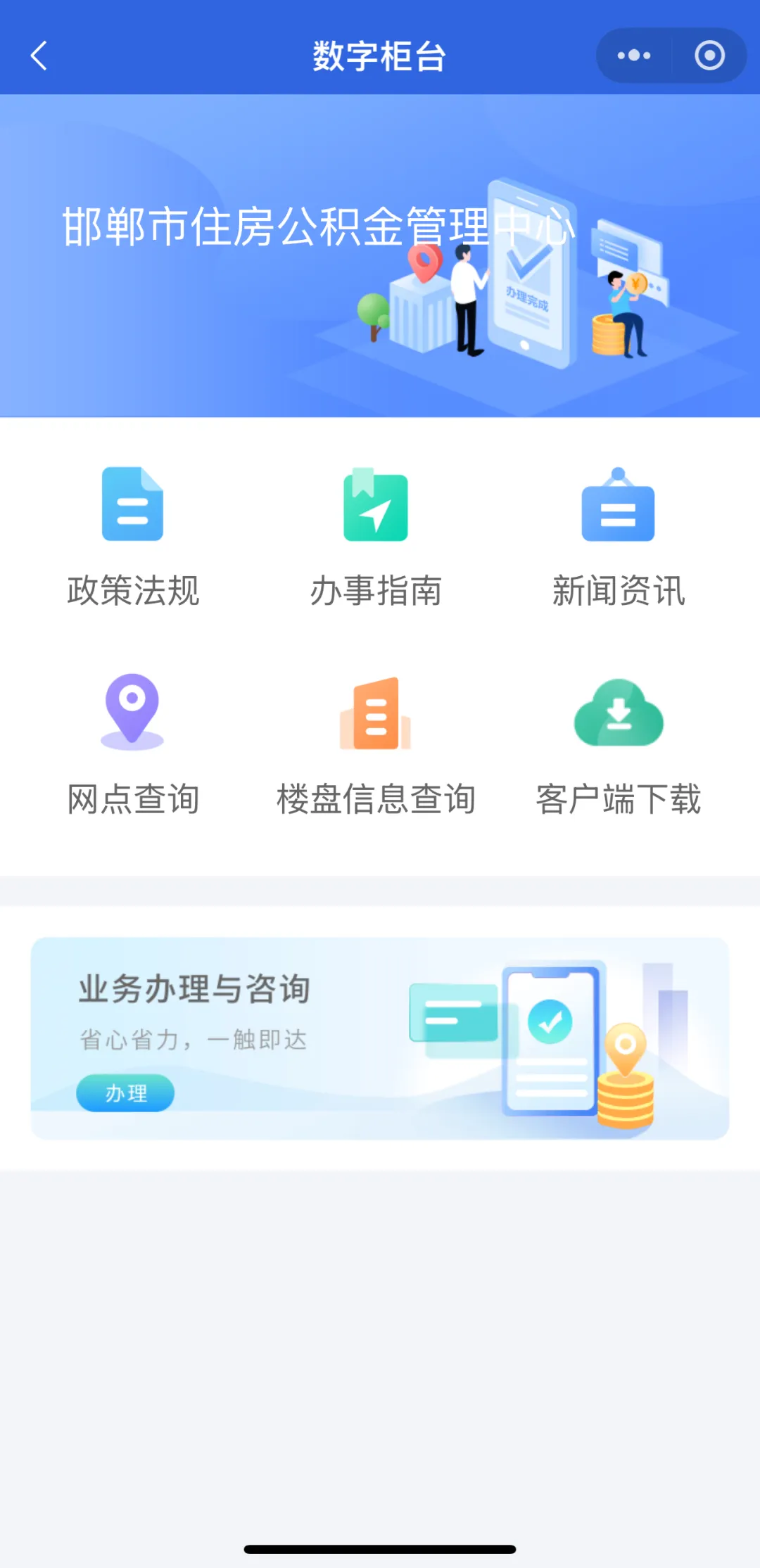
Case 3: Handan's housing fund digital counter is the more important step, because it pushes the dialogue into the transaction itself
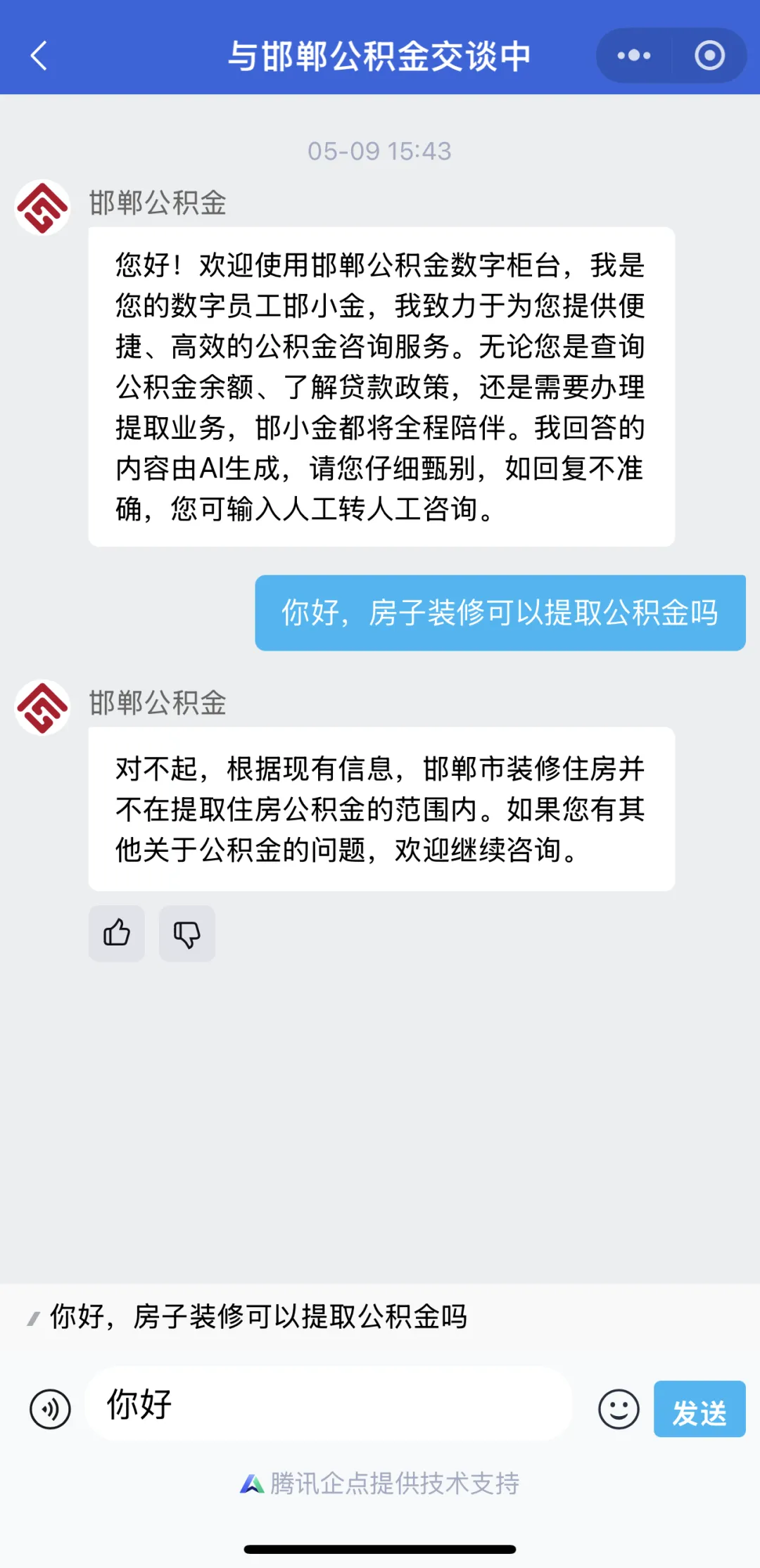
If intelligent guidance helps people find the path, the Handan housing fund digital counter for China's housing provident fund service takes the more important next step:
it lets the conversation become part of the actual service-handling process.
In Tencent Cloud Developer Community's public write-up on the Handan launch, the details already read like a real production deployment:
- a WeChat mini program entry point
- described as the country's first housing fund withdrawal digital counter that lets users "chat while filing"
- the user starts with natural-language requests
- dialect speech can also be recognized
- the system uses a large model to understand intent
- a workflow then automatically triggers:
- identity verification
- housing fund system data access
- agreement signing
- business-process handoff
In other words, this is not "ask a question, then click away to another service form."
It is:
the chat itself becoming part of the transaction path.
That is a meaningful shift in public service because the biggest time drain is often not the approval decision itself. It is everything around it:
- form filling
- repeated explanation
- back-and-forth confirmation
- figuring out the next entry point
If natural-language interaction can absorb part of that friction up front, the service experience changes quite a bit.
The public numbers are already enough to show this is not a slide-deck demo
The Handan case becomes much more persuasive once you look at the public metrics:
2,475consultations handled in the first week after launch82%automatic answer accuracy- for the retirement withdrawal case:
- formerly
15minutes - now
3minutes - more than
80%faster
- formerly
48high-frequency housing fund services are being connected step by step- more than
600,000annual service visits for housing fund withdrawal processing
Those numbers do not mean every city will get the same result. But they do mean one important thing:
this is no longer a PPT-phase experiment. It has started carrying real service volume.
For me, the detail that matters most is the 48 high-frequency items. A lot of so-called government AI projects never move beyond one or two showcase scenarios. Once high-frequency matters start getting connected in batches, the system looks much closer to a sustainable operating model.
Case 4: the same route serves staff internally through WorkBuddy and citizens externally through a digital counter
Another public write-up on Tencent's "cloud foundation + large model" housing fund system transformation makes a very valuable point.
It does not describe the housing fund scenario as only an external citizen-service project. It also explicitly mentions:
- internal office-efficiency replacement
- smart office assistants such as
WorkBuddy / CodeBuddy - one-click generation of different types of analysis reports
- structured capture of multimodal meeting data
That tells us Tencent's public-sector AI route is not being framed as:
- one stack for the front office
- another stack for the back office
- and yet another stack for general office work
It looks more like this:
- external side: digital counter, citizen guidance, "chat while filing"
- internal side: office assistant, report generation, meeting-note capture, process support
That is the part I find most strategically interesting about the WorkBuddy route. If you only improve the external side, the organization itself may not become much more efficient. If you only improve the internal side, the citizen experience still barely changes. The more useful route is the one that tries to connect both.
What these public cases suggest a real production environment looks like
When you stitch the public materials together, Tencent's WorkBuddy-related public-service and government agent path already shows several concrete production signals:
- there is an internal productivity assistant, not only an external Q&A bot
- there is workflow orchestration, not only open-ended model chat
- there are WeChat mini program and mobile entry points, not only web demos
- there is voice input and dialect recognition, not only clean typed text
- there are real actions such as query, withdrawal, loan estimation, and signing
- there is expansion across high-frequency service items, not just one demo matter
- there are measurable metrics, not just abstract positioning
That is why I read this as:
an AI workflow starting to move into front-line citizen service, not just an internal office helper inside a government unit.
Which public-service teams should study this route most closely
I think this route is especially relevant for:
- housing fund, social-service, and citizen-service agencies that handle large numbers of repeated matters
- departments trying to move offline consultation and form-heavy handoff into online entry points earlier
- government teams that already have mini programs, apps, or official service accounts, but still offer a weak interaction experience
- digital teams that want to improve both internal staff efficiency and external citizen experience
- government cloud and industry cloud teams that need local compliance but also large-scale online service capacity
If your environment does not really involve:
- high-volume public consultation
- high-frequency service execution
- linked internal and external workflows
- mini program or mobile entry points
then the value of this route will feel less immediate.
If you want to evaluate it yourself, test it this way
Do not start by asking, "Can the AI chat?"
Start with real public-service workflows instead:
- Pick
3to5of your highest-frequency service items and test whether the system can connect consultation, eligibility judgment, the service entry point, and the next step in one chain. - Test "guidance" and "execution" as two separate layers. Do not hide them inside one marketing slogan.
- Check whether it can handle voice input and non-standard expression. In citizen service, that matters a lot.
- Run a second pass on the internal WorkBuddy side: do report generation, meeting-note capture, and matter summarization actually remove manual work?
- Only then calculate ROI, focusing on:
- per-case handling time
- automatic answer accuracy
- diversion rate away from manual counters
- coverage of high-frequency matters
If you are also comparing unified model access and buying paths, the practical starting points are:
Final take
If I had to summarize my view of these WorkBuddy public service cases in one sentence, it would be this:
What matters most is not that government teams are "using AI too." It is that Tencent has already combined an office assistant, a citizen guidance assistant, and a "chat while filing" digital counter into something that increasingly looks like a real public-service workflow.
If that route keeps maturing, the change will not only show up as faster answers. It will show up as:
- fewer citizens getting lost at the service entry point
- shorter handling time for high-frequency matters
- less pressure on manual service counters
- faster internal handling of reports and meeting notes
- front-office and back-office work finally being linked by the same agent capability layer
That is why I think the WorkBuddy route is starting to matter at the public-service front line.
References
- Tencent Cloud + AI full-stack capabilities supporting integrated innovation and efficiency gains in digital government
- Tencent "cloud foundation + AI large model" reconstruction of housing fund core systems and closed-loop operations
- A government AI that lets people get things done while chatting lands in Handan
- Tencent Cloud enterprise agent deployment: from scenario pilots to scaled adoption