Tencent WorkBuddy for WeChat Official Accounts: How Media Teams, Creators, and Solo Businesses Use AI Agents for Content Automation
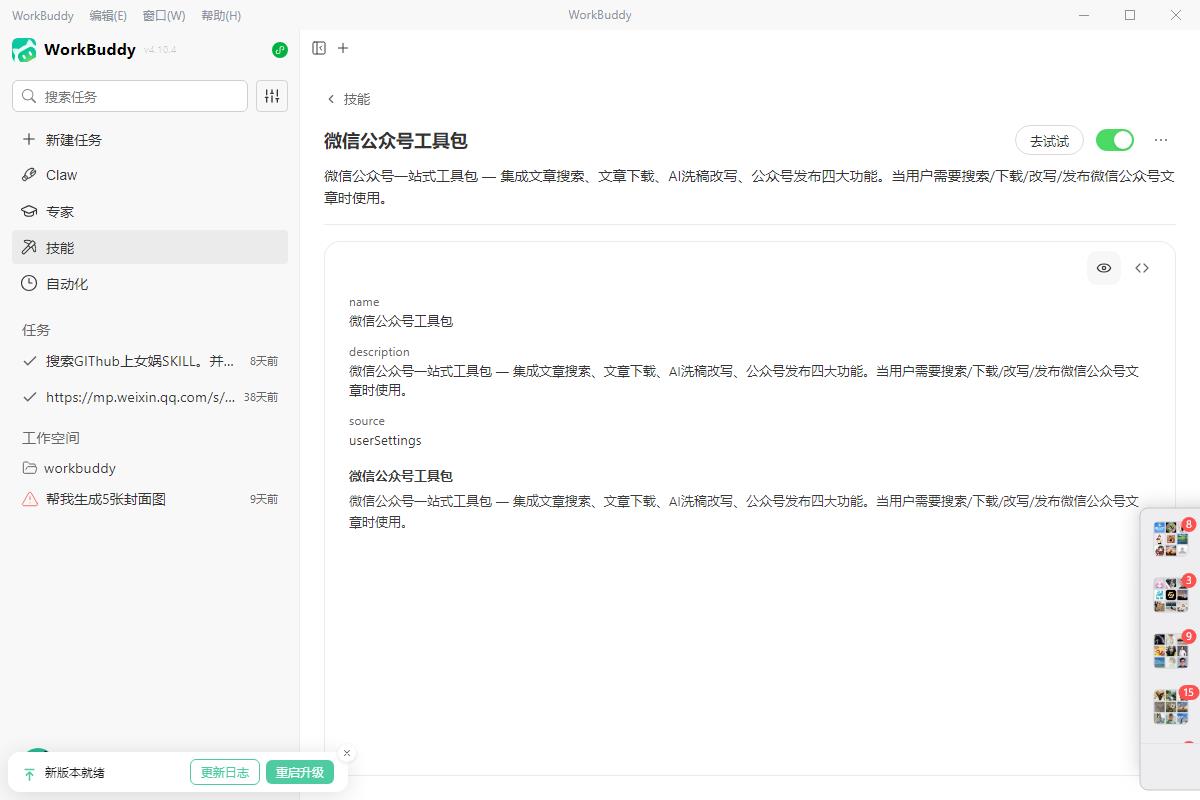
If you think WorkBuddy is just another AI chat tool from Tencent, you are missing the bigger picture.
I specifically looked at the media, creator, and WeChat Official Account operations angle this time, and what stands out in the public material is that the product is already moving beyond "let AI help write a paragraph." It is starting to cover the entire content pipeline: topic discovery, research collection, rewriting, layout, image support, and publishing.
More importantly, several public posts on Tencent Cloud Developer Community already spell out the scenarios, Skill names, task chains, and even some concrete efficiency claims. If you care about content workflows, AI-powered editorial systems, or WeChat publishing automation, those case studies are much more useful than a generic product page.
The Short Verdict
- As of June 29, 2026, public materials show at least four fairly concrete content-industry use cases for
WorkBuddy:- Information processing and report generation for media organizations
- Topic planning and content production for solo businesses and creator teams
- End-to-end automation for WeChat Official Accounts
- Dedicated Skill orchestration for WeChat article writing
- The most valuable part is not that "it can write," but that it turns general-purpose models into repeatable content workflows.
- If you run a WeChat account portfolio, an industry intelligence workflow, a content operations platform, a research desk, or a brand content team,
WorkBuddyis much more relevant than a standard chat-based AI tool.
What It Is Actually Trying to Replace in Content Work
Most chat AI tools usually solve tasks like:
- Give me a title
- Polish this paragraph
- Summarize this article
The public WorkBuddy examples are clearly aiming at something larger. It looks more like Tencent wants to cover this full chain:
- Watch trends and collect source material
- Break down competitor articles and reusable structures
- Generate drafts and platform-specific versions
- Format the output into HTML ready for WeChat Official Accounts
- Push the final article into the publishing backend through Skills or release actions
In other words, its role in content teams is closer to:
an AI editorial workspace with Skills
rather than
a model window that only chats and writes on demand
Case 1: Media and Cultural Organizations, With a Public Claim of 75x Higher Efficiency
The most striking public case I found is this Tencent Cloud Developer Community article:
AI Agent Improves Efficiency in the Media Industry: Tencent Cloud WorkBuddy Delivers 75x Faster Information Processing
What makes that piece valuable is not just the headline. It places WorkBuddy inside a very familiar and very painful industry problem set:
- Information overload
- Heavy policy and trend tracking work
- Slow report production
- Long content review chains
According to the public article, the solution is built on the OpenClaw architecture and emphasizes:
- Multi-agent collaboration
- Expandable expert Skills
- Web search and source collection
- Voice capabilities and structured processing
- Enterprise-grade security protection
More importantly, it does not just say "AI was used." It translates the value into business outcomes:
- 75x faster policy analysis
- 50%+ improvement in report generation efficiency
- Automation beginning to cover hot-topic discovery, content creation, and review
That public positioning says at least one important thing:
In content-heavy industries, what makes WorkBuddy persuasive first is not inspiration. It is the ability to ingest, break down, and organize information at scale.
If your team already works on:
- Media monitoring
- Research briefings
- Policy tracking
- Industry intelligence
- Brand content planning
the value of this direction is pretty easy to see.
Case 2: Solo Businesses and Creators, From Working Alone to "Managing an AI Team"
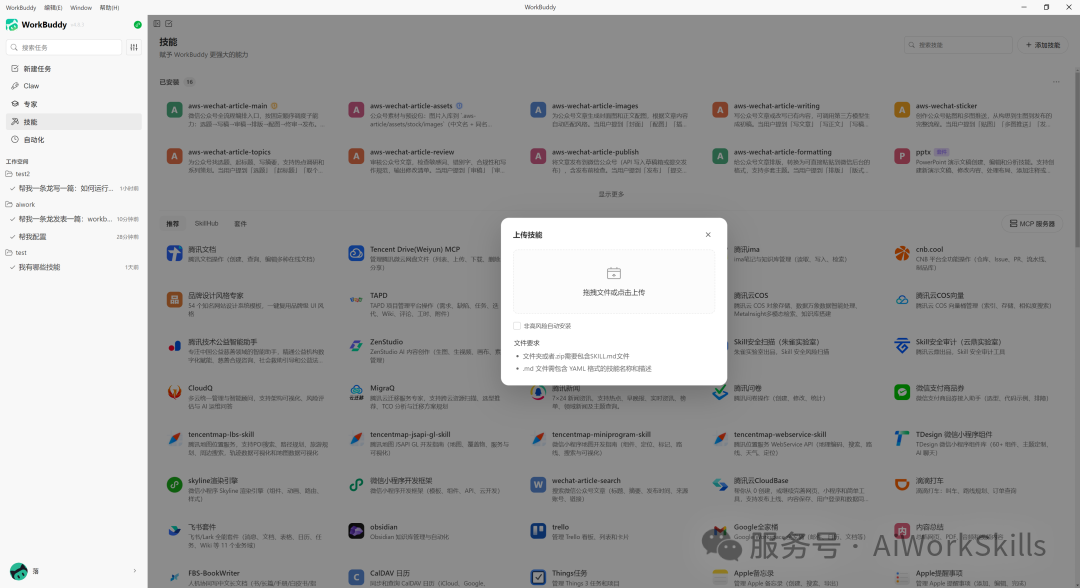
Another very down-to-earth public case is:
90% of One-Person Companies Burn Out. WorkBuddy Helped Me Go From One Person to a Team
Why does this belong in an SEO-focused article? Because it captures the most real problems many content entrepreneurs face right now:
- Topic competition keeps getting tougher
- AI-generated content is becoming more homogeneous
- Recommendation traffic is unstable
- One person has to write, format, publish, and think about strategy at the same time
The article describes WorkBuddy very directly:
you are not just talking to one AI, you are assigning work to an AI team.
The public workflow it describes includes:
- AI tracking trending topics
- AI breaking down content structures
- AI handling layout and cover preparation
- Humans keeping their time for direction, performance review, and strategy changes
It even gives an easy-to-share time comparison:
- Before: 8 hours to produce one article, with the creator drained by the end of the day
- Now: 2 hours to finish one article, leaving 6 hours for direction and data review
This kind of case will not represent every team, but it does reflect a real change in production mindset:
AI is not there to replace your voice. It is there to remove the repetitive labor around content production.
Case 3: End-to-End Automation for WeChat Official Accounts, With the Workflow Publicly Explained
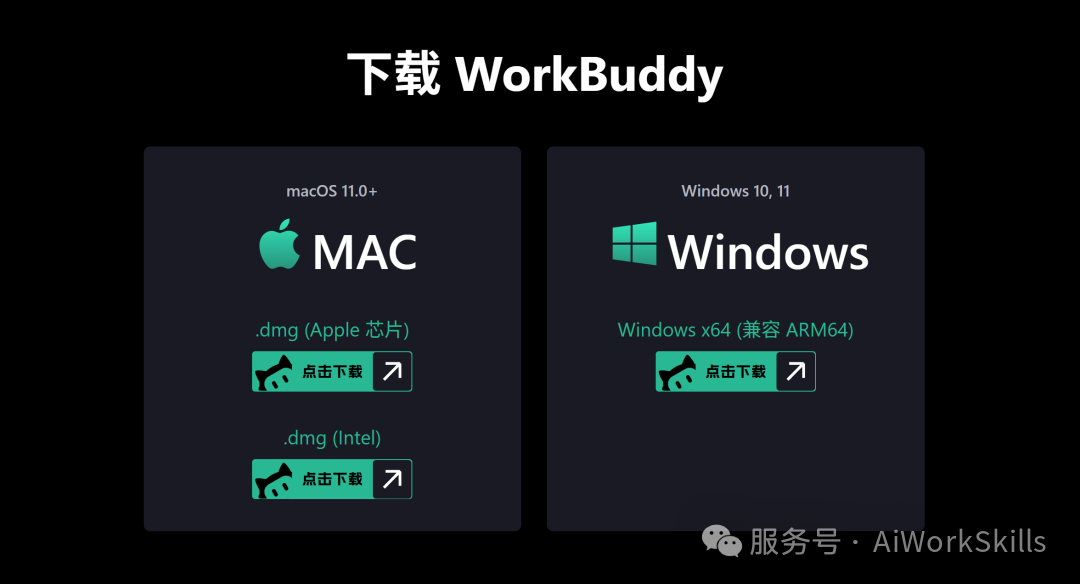
If you care more about practical WeChat publishing operations, Tencent Cloud Developer Community also has a more tutorial-like public article:
How to Use AI Work Skills in WorkBuddy to Automatically Operate a WeChat Official Account
The article makes one thing very clear:
AI Work Skills are not a new model. They are a set of professional workflow Skill packages attached to WorkBuddy.
What does that mean for WeChat Official Account operations?
- You do not have to start from a blank prompt every time
- You can turn "topic selection -> drafting -> review -> layout -> image support -> publishing" into a fixed process
The public article frames the production setup in a very practical way:
- A full WeChat Official Account workflow can be completed in 30 minutes
- It supports configuration for account persona, content direction, and publishing channels
- You install the Skill first, then execute the task inside WorkBuddy
At that point, the problem is no longer just "can it write an article?" It becomes something closer to:
installing a reusable production line for a content team
If you operate multiple accounts, multiple recurring columns, or multiple platforms, that model matters much more than one-off copy quality.
Case 4: A WeChat Writing Skill Stack Broken Down Into Search, Rewriting, Formatting, and Publishing
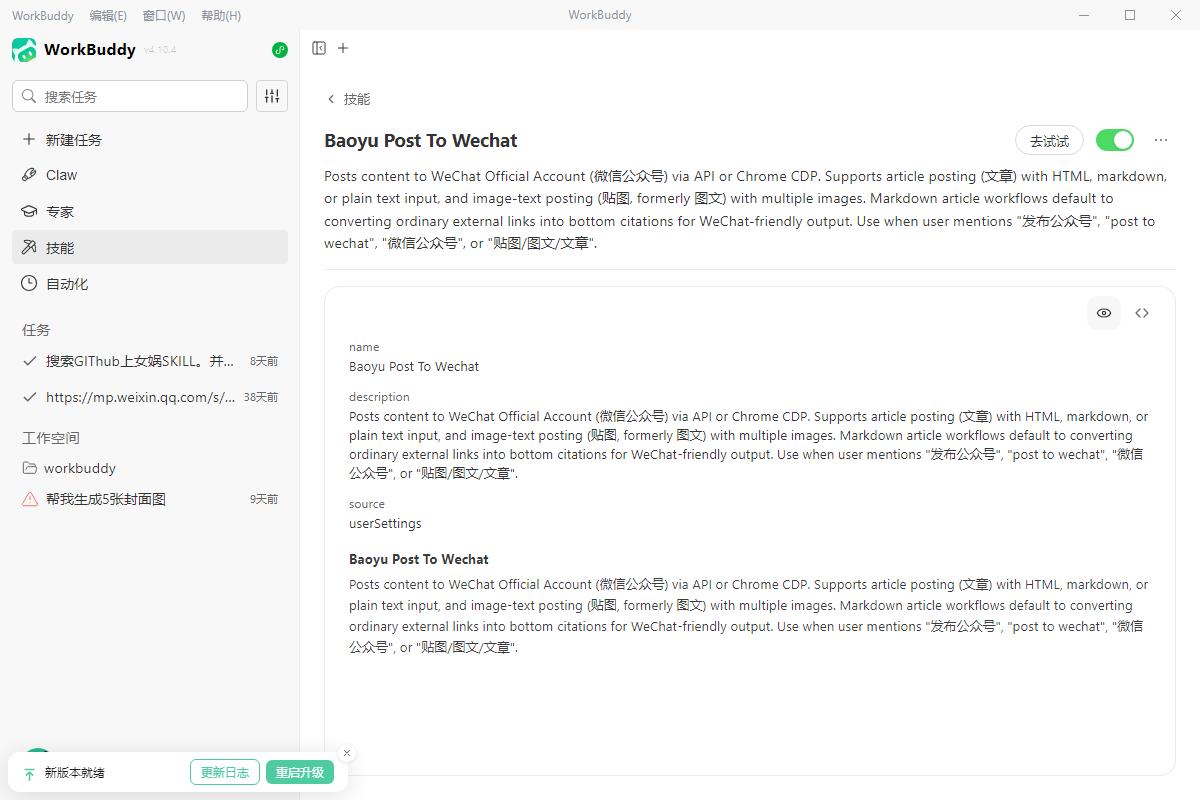
There is also a more hands-on public article:
WorkBuddy in Practice: Automatically Writing Articles for WeChat Official Accounts
Its biggest value is that it openly lays out a concrete content production Skill stack. The public article mentions these core Skills:
wechat-toolkitbaoyu-post-to-wechatwechat-article-writerhumanizer-zhbaoyu-markdown-to-html
Put those names together and the real workflow is easy to read:
wechat-toolkithandles search, download, analysis, and rewritingwechat-article-writercreates a first draft tailored to WeChat article tonehumanizer-zhreduces obvious AI-style phrasingbaoyu-markdown-to-htmlhandles formattingbaoyu-post-to-wechatpublishes directly to the WeChat Official Account backend
Why does this chain matter? Because it shows that in this direction, WorkBuddy is not simply "throw everything at one large model." Instead, it works like this:
WorkBuddy handles orchestration, while Skills handle specialized steps.
That matters more in real production than a narrow benchmark about which model sounds more human, because once teams actually go live, they care about questions like:
- Can the workflow be reused?
- Can another teammate keep it running?
- Can it reduce manual switching between tools?
- Can a new hire still produce output by following the same process?
What These Public Cases Suggest About the Real Production Environment
If you put these public articles together, the production environment WorkBuddy is moving toward in content teams seems to have a few shared traits:
- A desktop workspace acts as the task hub
- A set of installable, switchable, reusable Skills sits behind it
- The content process is multi-step, not a single-turn chat exchange
- Inputs are not only prompts, but also articles, links, screenshots, and documents
- Outputs are not just answers, but drafts, HTML, publishable content, and research deliverables
That is why I see it less as a "content writing model" and more as a content agent platform.
Which Teams Should Test It First
Teams That Should Try It Now
- Teams running WeChat account portfolios, creator account portfolios, or brand content operations
- Media or research teams that continuously produce industry intelligence, policy tracking, and trend reviews
- Solo businesses and small content teams
- Content workflow teams that need to connect Markdown, HTML, and the WeChat Official Account backend
Teams That Can Wait and Watch
- Teams that only publish once in a while and do not have a fixed process
- Teams without multi-account, multi-column, or multi-platform needs
- Teams that do not want to maintain Skills, workflows, or content standards
- Teams that only want a general chat AI instead of an operations workspace
If You Want to Plug Similar Workflows Into Custom Models, Where the Buying Value Sits
For many teams, the real question is not only whether the workflow can run end to end, but also:
- Whether costs stay controllable at scale
- Whether you can switch to backup routing when one model becomes unstable
- Whether multiple editors or multiple agents can share the same unified key and billing layer
So if you are building a content automation workflow, a unified model gateway is often more valuable than any single model.
You can continue from these internal pages:
My Final Take
If I had to summarize this batch of WorkBuddy content-industry cases in one sentence, it would be this:
The most important signal is not that "AI can write WeChat articles." It is that Tencent is starting to consolidate a messy set of content tasks into Skills, workflows, and agent-based execution.
For media teams, creators, and WeChat publishing teams, the real dividing line is not whether an article sounds human. It is whether:
- Trend tracking and source processing become materially faster
- Fixed columns and fixed workflows become reusable
- Publishing can move from manual copy-and-paste to an actual workflow
At least based on the public material available today, WorkBuddy already looks like more than a proof of concept on this path. It is beginning to show a reusable, deployable, repeatable way of working.
References
- Tencent launches an efficiency agent toolkit to create AI productivity entry points for diverse users
- AI Agent Improves Efficiency in the Media Industry: Tencent Cloud WorkBuddy Delivers 75x Faster Information Processing
- 90% of One-Person Companies Burn Out. WorkBuddy Helped Me Go From One Person to a Team
- How to Use AI Work Skills in WorkBuddy to Automatically Operate a WeChat Official Account
- WorkBuddy in Practice: Automatically Writing Articles for WeChat Official Accounts