Tencent WorkBuddy Ecommerce Use Cases: Why Shopify Data Sync, Multi-Channel Order Automation, and ERP Integration Are Moving to AI Agents
If you think the value of WorkBuddy in ecommerce is just "helping an operator write a couple of promo lines" or "building a customer-service FAQ bot," that is only the shallowest layer.
I went through several public pieces focused specifically on cross-border ecommerce data management, Shopify order sync, multi-channel buyer message alerts, and ERP API integration. After reading them, my conclusion was pretty clear:
The most important thing about WorkBuddy in ecommerce is not that it chats better. It is that it is starting to enter the workflows that actually affect daily operations: orders, ads, messages, inventory, and ERP.
And for ecommerce teams, the heaviest work is often not "not knowing how to operate the business." It is:
- Too many platforms to switch between
- Inconsistent order and refund definitions
- Ad spend and sales revenue sitting in different currencies
- Message alerts, order summaries, and inventory stats repeating every day
- ERP integrations that take too long and break whenever an interface changes
That is exactly why I think ecommerce is one of the easiest places for AI Agents like WorkBuddy to prove real value first.
The Short Version
- As of June 29, 2026, the most convincing public
WorkBuddydeployments in ecommerce cluster around three areas:- Cross-border ecommerce data systems and Shopify auto-sync
- Multi-channel order and buyer-message automation
- Internal ERP API integration and reusable skill-based workflows
- Based on public material from Tencent Cloud Developer Community, these cases are no longer "let's casually try AI." They already show fairly concrete:
- Platform environments
- Data structures
- API and token mechanisms
- Automation task setup
- And efficiency gains that can be checked against actual business work
- If you work in cross-border ecommerce, marketplace operations, order and inventory operations, or ERP coordination, these examples are much more useful than a generic AI office demo.
Why Ecommerce Is So Easy to Win Over With Workflow-Driven AI
What really wears ecommerce teams down is usually not product selection or media buying. It is:
- Too many fragmented platforms
- Too much scattered data
- Too many inconsistent definitions
- Too many repetitive actions every day
- Too many disconnected systems
In other words, the most annoying part of ecommerce is usually not "understanding the business." It is:
The chain from messages, orders, ads, and inventory to ERP, reporting, and sync backfills is simply too long.
And the clearest thing in the public WorkBuddy examples is that it is not being used like an isolated chat box. It is moving into layers such as:
- API integration
- Data synchronization
- Multi-currency handling
- Message alerts
- Automated summaries
- Reusable skills
- ERP integration
That makes it look much more like:
An ecommerce operations automation hub
rather than:
A model window that only answers questions
Case 1: A Cross-Border Ecommerce Data System Is More Than "Building a Dashboard"
The first public piece that feels closest to a real ecommerce production environment is this Tencent Cloud Developer Community article:
A Beginner Built a Data Management System with Tencent's "Xia"
What makes it valuable is that it does not describe an abstract requirement. It lays out a very concrete cross-border ecommerce setup:
- Operating two standalone stores in Thailand and Vietnam
- Watching two Shopify admin backends every day
- Tracking three ad platforms at the same time
- Repeatedly copying spreadsheet data during monthly reconciliation
The article says the author's original need was actually pretty simple:
- Put sales data from the two stores together
- Make it editable
- Visualize it
- And reconcile accounts under one consistent definition
But what WorkBuddy ended up delivering was not just a spreadsheet. It was a working internal system:
- Backend built with the Python standard library
- Frontend delivered as an HTML interface
- Charts rendered with Chart.js
- A first usable version running in less than one day
- Available locally at
http://localhost:8080
These details matter, because they show that WorkBuddy in this case was not just "suggesting features." It was handling:
- Local runtime setup
- Data structures
- Dashboard pages
- API sync logic
- Currency-definition design
That is already much closer to a real lightweight operations system than a one-round AI chat.
Case 2: The Real Difficulty Is Not Pulling Orders, But Reconciling the Numbers
The most interesting part of this public case is not "it connected to the Shopify API." It is that it surfaced several very real cross-border ecommerce problems.
1. Rebuilding Multi-Currency Logic
The first issue the author hit was messy exchange-rate logic:
- Sales revenue came in Thai baht and Vietnamese dong
- Ad spend came in US dollars
- Final reporting still had to roll up into RMB
If the definition is wrong, the ROI view is meaningless.
The solution described in the article looks very much like a real production design:
- Store sales revenue in the original currency
- Thai store in
THB - Vietnam store in
VND
- Thai store in
- Store ad spend in
USD - Use USD as the unified ROI baseline
- Convert into the display currency only at the final presentation layer
This is not "AI helping you do one formula." It is:
AI starting to participate in metric-definition design.
2. Shopify Sync and Refund Attribution
The article also mentions a very typical ecommerce problem:
- Shopify was pulling order data automatically
- But the synced amount was off by more than a hundred yuan compared with the backend
The root cause turned out not to be a broken API. It was:
- The daily sync only pulled orders created that day
- But a refund for an order created yesterday happened today
- That refund was never counted in the daily result
The logic WorkBuddy adjusted to was:
- Look back across the previous 7 days of orders on every sync
- Attribute refunds by the actual refund date
That is why I think this case is especially valuable. In a real production environment, the hardest problem is almost never "can you call the API?" It is:
After you connect the API, can your business definitions stay accurate over time?
3. Tokens Expiring Every 24 Hours
Shopify access tokens expiring daily is another very real online-operations problem.
The article describes the fix like this:
- Check token validity at startup
- Refresh proactively 5 minutes before expiration
- Automatically re-auth on
401
That means WorkBuddy in this case was not just "writing a few scripts." It was handling:
- Scheduling
- Authentication
- API fault tolerance
- Auto-recovery
Those are system-maintenance concerns, not copywriting tasks.
Case 3: The Public Screenshots Already Look Like a Real Ecommerce Operations Backend
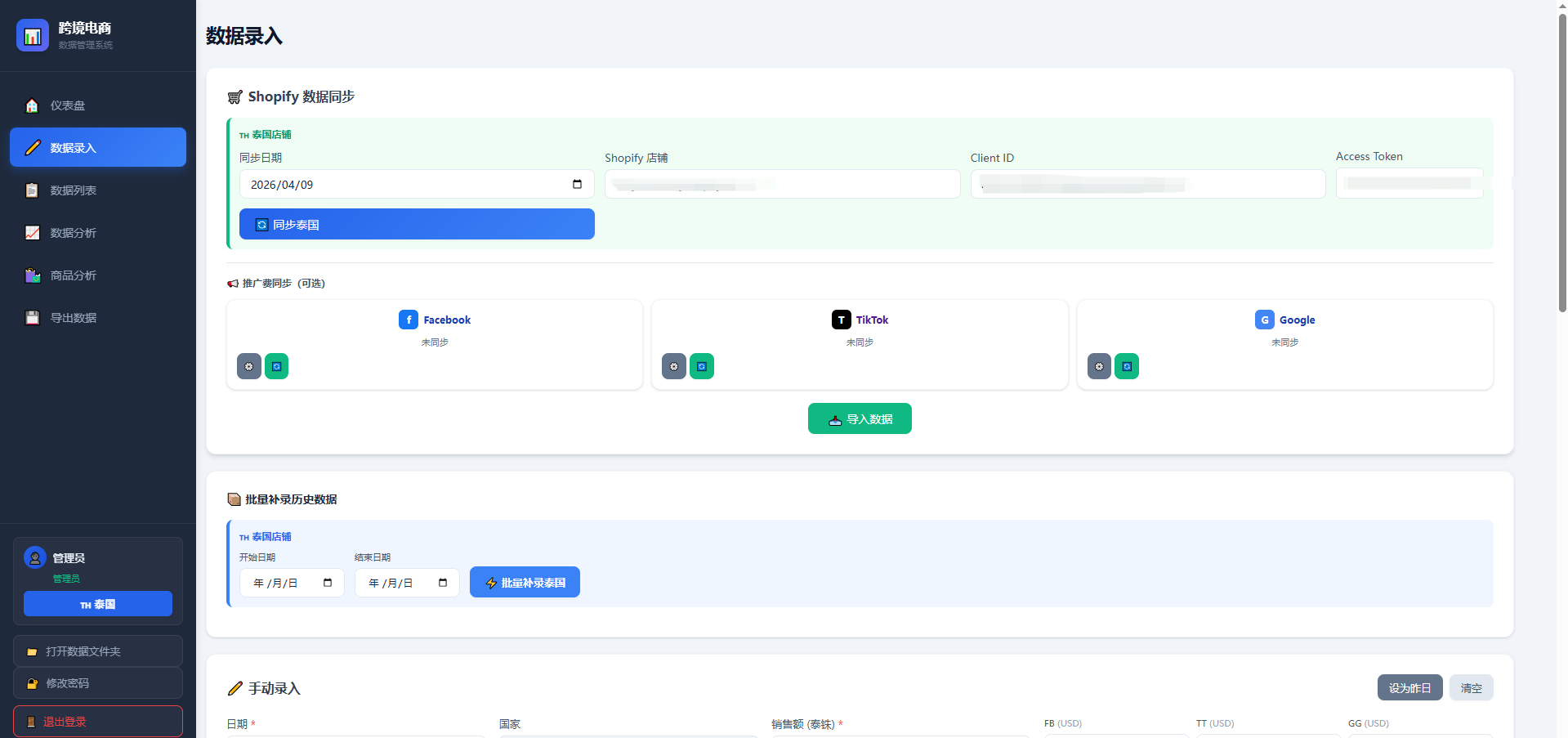
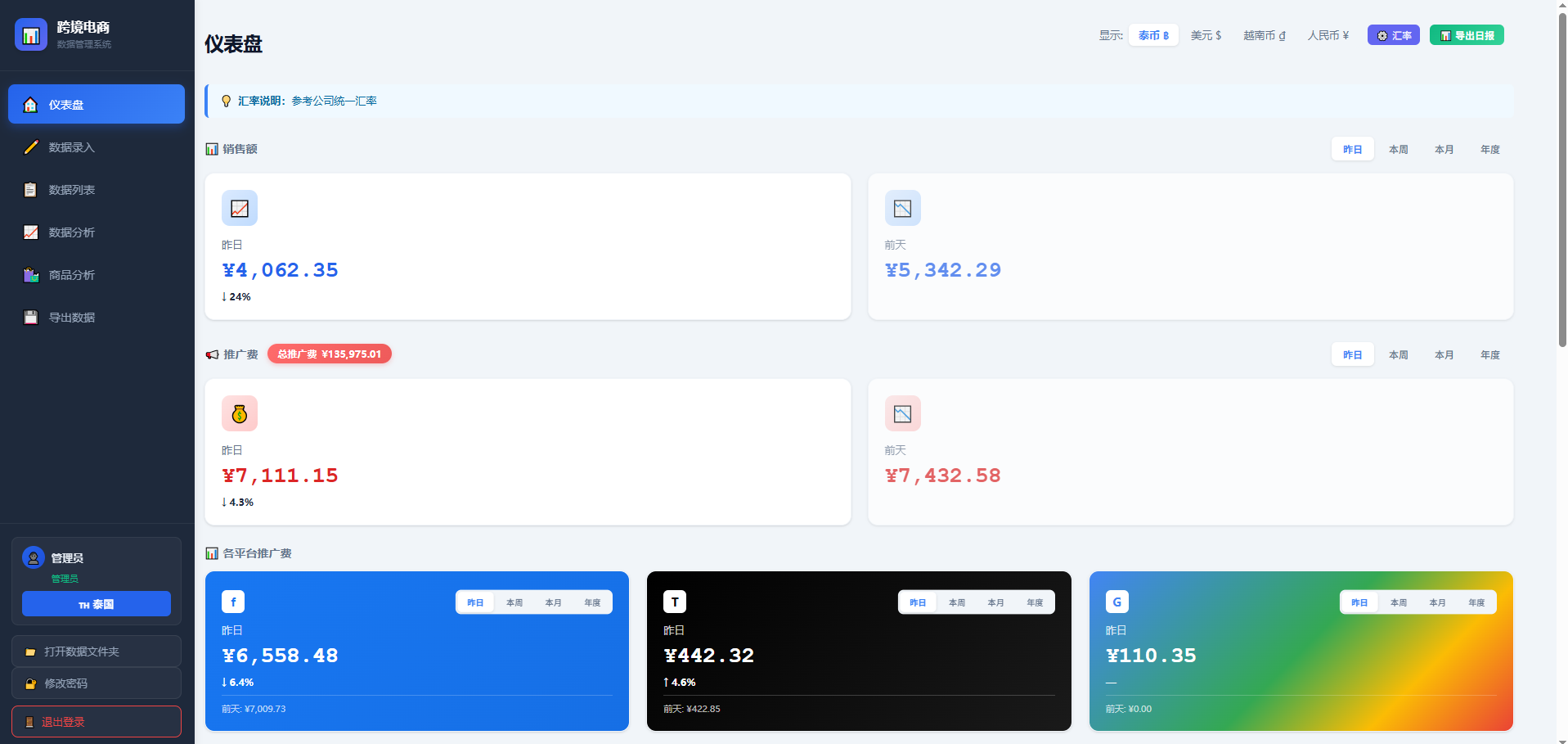
Another big plus in that cross-border ecommerce article is that it leaves behind fairly complete backend screenshots.
From the public screenshots alone, you can already see several production-environment signals:
- A full left-side navigation:
- Dashboard
- Data Entry
- Data List
- Data Analysis
- Product Analysis
- Export Data
- A visible Shopify data sync module
- A clearly labeled sync target for the Thailand store
- Explicit fields for:
Client IDAccess Token- Facebook / TikTok / Google ad sync
- Single-day sync
- Historical batch backfill
That means it is not a static page pretending to be "extensible." It is already entering a very typical ecommerce workflow:
- Store-level integrations
- Ad-platform integrations
- Historical data backfills
- Auth and credential fields
And another public screenshot shows even more:
- Switchable display currencies:
- Thai baht
- US dollar
- Vietnamese dong
- RMB
- Ad spend split by:
- TikTok
- Exportable reports
- Time-range views for yesterday / this week / this month / yearly
At that point, it is no longer just "pulling some numbers together." It is:
Moving toward a shared backend that operations, paid acquisition, and finance can all use for reporting and reconciliation.
Case 4: Multi-Channel Message Alerts and Order Statistics Are the Fastest Way to Save Human Time
The second public piece that fits naturally into an ecommerce article family is:
Ecommerce Seller Test: Using WorkBuddy to Automate Multi-Platform Orders and Messages Doubled Efficiency
This one matters because it is not about cross-border standalone stores. It is about another very typical China marketplace environment:
- Taobao
- Pinduoduo
- Douyin
- Xianyu
The article describes the pain points very directly:
- Buyer messages had to be checked across multiple backends
- Order sync and inventory statistics were still manual every day
- Repetitive relisting and price changes were mechanical and tiring
- Operators often worked until late at night
It highlights two very practical automation scenarios:
1. Unified Alerts for Multi-Platform Buyer Messages
The core logic is simple:
- Sync buyer messages from different platforms
- Push them into WeChat or DingTalk
- Stop manually refreshing multiple dashboards
The article gives a clear business outcome:
- Response rate improved from 90% to 100%
2. Automated Order Statistics
The workflow is also very explicit:
- Export orders from multiple platforms
- Aggregate them automatically into an online spreadsheet
- Auto-calculate total orders, revenue, and average order value
- Run every day after midnight
The article gives the efficiency claim as:
- Saving at least 1 hour of manual reporting time every day
That is extremely direct value for ecommerce teams, because what many teams lack is not "analysis skill." It is:
Removing the repetitive daily work from human hands.
Case 5: ERP Integration Is the Hardest Bone to Chew for Many Ecommerce Operations Teams
The third public piece that absolutely belongs in this topic cluster is:
WorkBuddy Connects to an Internal Enterprise ERP System
This one leans more technical, but it is especially important for ecommerce companies. Once a business moves from "running a single store" to "coordinating across teams," the hardest part is usually not the dashboard anymore. It is:
- Orders need to flow into ERP
- Inventory needs to be queried from ERP
- Customer data needs to connect with ERP
- System upgrades force interface rework
The article describes traditional ERP integration pain pretty bluntly:
- Manually reading API docs
- Hand-writing adapter code
- Testing interfaces by hand
- Mapping database tables manually
- Maintaining everything again after system upgrades
The route WorkBuddy demonstrates in this article is a different model:
- Give it the API documentation URL directly
- Let it understand the authentication flow on its own
- Discover interface structures by itself
- Test interfaces by itself
- Then package the reusable capability into a Skill
The article even says that after learning the system, it can report back to the user with capabilities such as:
- Query customer information
- Create orders
- Check inventory
That point matters a lot, because it suggests that WorkBuddy in enterprise settings is not just "helping write code." It is:
Pushing the learning, validation, and reuse of ERP integration toward an Agent-based workflow.
For ecommerce operations teams, that kind of capability is highly valuable. A lot of business coordination gets stuck not because the team lacks ideas, but because:
ERP integration is slow, heavy, and dependent on a small number of technical people.
Case 6: The WorkBuddy Client Screenshot Also Shows It Starting to Take On Operations Checks
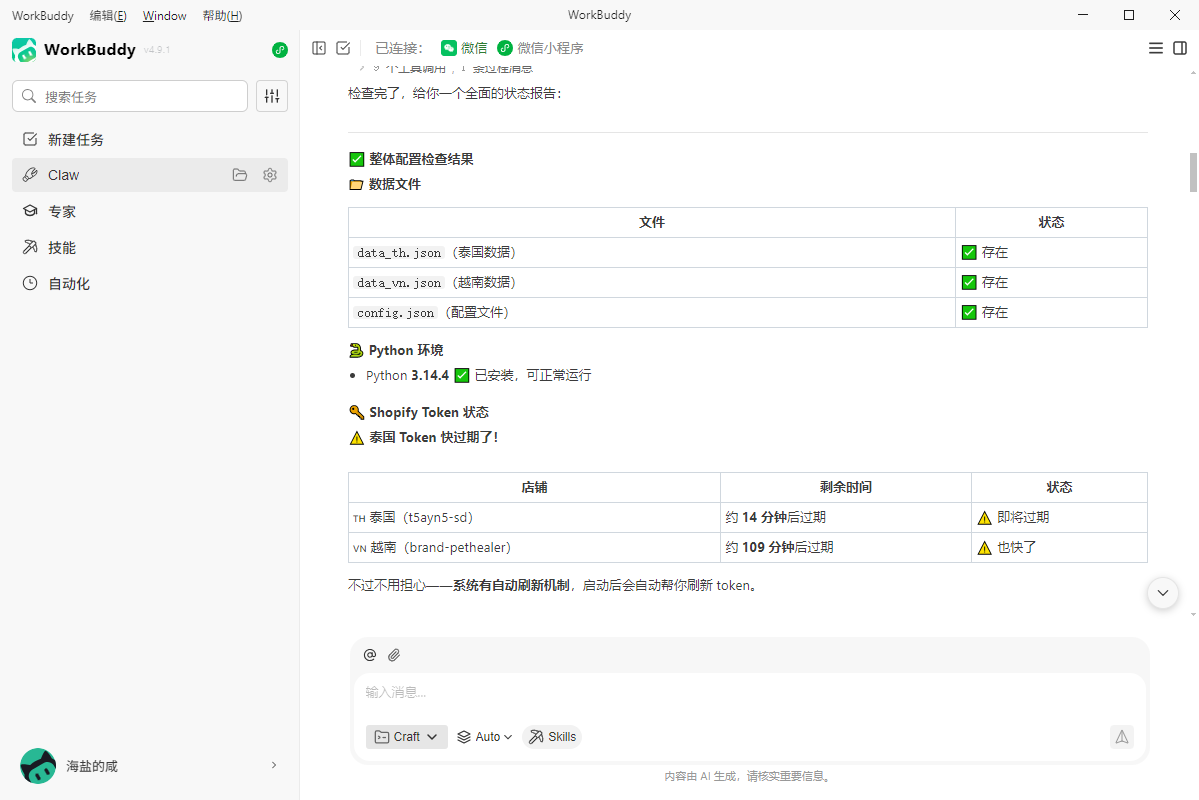
There is another screenshot in the cross-border ecommerce case that I think is especially important.
From the screenshot, you can directly see:
WorkBuddyconnected to:- WeChat Mini Program
- It checks:
- Data-file status
- Python environment
- Shopify token status
- It also shows:
- Thailand store token expires in about 14 minutes
- Vietnam store token expires in about 109 minutes
Why does this image matter? Because it shows that in this case, WorkBuddy is not just "generating a system." It is already taking on:
- Environment checks
- Token-state inspection
- Data-file integrity checks
Those are operations and system-inspection tasks.
And those tasks matter a lot in ecommerce, because what often makes an internal backend feel "unstable" is not the core logic. It is:
- Tokens expiring
- Data files going missing
- A silent sync step breaking somewhere
If an Agent is already surfacing those states clearly and reporting them back, then its role starts to look much more like:
An ecommerce workstation that helps monitor the system with you
What These Public Cases Say About Real Ecommerce Production Environments
If you stitch these public pieces together, the production environment for WorkBuddy in ecommerce already shows some clear patterns:
- Real platforms, not abstract tasks
Shopify- Taobao
- Pinduoduo
- Douyin
- Xianyu
- Real acquisition channels, not blank demo data
- TikTok
- Real currency and reporting-definition problems, not idealized examples
THBVNDUSDCNY
- Real system issues, not just "write some code"
- Cross-day refunds
- Token expiration
- Historical backfills
- Data-correction fixes
- Real organizational coordination, not just personal productivity
- ERP integration
- Reusable skills
- Automated summaries
- Reporting output
That is why I think it looks more like:
A digital operations backend plus an Agent automation layer
rather than:
A standalone AI utility
Which Ecommerce Teams Should Test It First
Best Fit to Try Now
- Teams running cross-border standalone stores or multi-store operations
- Seller teams handling orders and buyer messages across multiple platforms
- Teams constantly fighting over ad spend, revenue, and ROI definitions
- Mid- and back-office teams that already have ERP but find integration and maintenance too heavy
- Operations teams that want to start with small systems or automation scripts before attempting anything larger
Better to Wait
- Very small teams with no stable, repeated workflow and everything handled ad hoc
- Teams with no meaningful platform data and no willingness to clean up their business definitions
- Teams that only want a chat assistant and have no plan to connect AI into the business workflow
How I Would Test It Yourself
- Pick one painful, high-frequency workflow first. Do not start by trying to rebuild the entire stack.
- In ecommerce, the best first cuts are usually:
- Shopify sync and refund attribution
- Multi-platform message alerts
- Automated order summaries
- Report generation
- Do not only ask "can it run?" Focus on:
- Whether the data definitions stay stable
- Whether tokens and sync jobs recover automatically
- Whether historical backfills and refund corrections are reliable
- Whether the reports and backend are something the business team will actually use
- If you already operate across multiple systems, it is also worth comparing:
- Which scenarios fit a workstation-style Agent like
WorkBuddy - Which scenarios are still better handled through your own direct API orchestration
- Which scenarios fit a workstation-style Agent like
If what you care about more right now is: how to connect Tencent models, GLM, Kimi, DeepSeek, StepFun, and other models into your own Agent workflows under one roof, you can start here:
My Final Take
If I had to summarize my view of WorkBuddy ecommerce use cases in one sentence, it would be this:
The most important thing is not whether AI can save ecommerce teams a little time. It is that WorkBuddy is already moving into the places that actually determine whether the business runs smoothly: Shopify data sync, multi-channel message alerts, cross-currency reconciliation, and ERP integration.
That matters much more than "can it help write better copy." Because the hardest part of ecommerce has never been one good operating suggestion. It is:
Gradually bringing scattered platforms, scattered data, and scattered systems into one workflow that can keep running.
If WorkBuddy can genuinely run in those places, then its significance for ecommerce is not "a small efficiency boost." It is:
Starting to move an operations backend that used to rely on human patchwork into an AI workstation that can automate, inspect, and reuse the workflow.