Tencent WorkBuddy in the Game Industry: Why AI Agents Are Taking Over Mini-Game Prototypes, Cocos Development, and COS Asset Management
If you still think of WorkBuddy as "an AI chat tool made by Tencent," you are probably missing the real story in the game industry.
I went back through several public articles directly tied to mini games, game prototypes, Cocos development, and COS asset management. After reading them closely, my conclusion is pretty direct:
The most important thing to watch about WorkBuddy in the game industry is not whether it can write a few lines of code. It is that it has already started entering real development workflows, prototyping workflows, and asset workflows.
And when you put these public cases side by side, you realize it is no longer dealing with lightweight "write me a demo" tasks. It is already touching:
- WeChat mini-game planning and engineering execution
- Rapid
WebGameprototype validation Cocos Creatormigration and asset reuse- Game asset management, preview, and signed delivery inside COS
At that point, it is no longer just a product that "talks through ideas with you." It looks much more like:
An AI Agent that is growing into a real game production workspace.
The short conclusion first
- As of June 29, 2026, the most convincing public
WorkBuddyuse cases in the game industry fall into three areas:- Mini-game planning and code collaboration
- Prototype building in hours and Cocos migration
- Automation for game assets and resource management
- Based on public Tencent Cloud Developer Community write-ups, these cases are not just proof that it "can do something." They already include fairly concrete environments, technical stacks, and efficiency numbers.
- If you are working on mini games, indie games, small-team prototype validation, or game development support tooling, the
WorkBuddytrack is much more useful as a reference than a generic AI coding demo.
Why the game industry may be especially well suited to show value early
A lot of people assume game development mainly needs "smarter models," "stronger coding ability," or "better artistic taste."
Those things matter, of course. But in real production environments, what slows teams down is usually not a lack of brilliant ideas. It is things like:
- Too many design documents, with revisions moving too slowly
- Prototype trial-and-error being too expensive
- Switching and migrating technical stacks being too heavy
- Asset management being too fragmented
- Small teams getting consumed by low-value operational work
In other words, the most painful part of game development is often not "we do not know how to do it."
It is that you know what needs to be done, but every step is scattered, slow, and easy to redo.
That is exactly where WorkBuddy has started to show up:
- It takes in the requirements and planning first
- Then helps you build the prototype
- Then connects to engineering and migration work
- Then absorbs the asset pipeline along the way
That is why I think its value in the game industry is more practical than many models that are only good at one-off answers.
Case 1: The WeChat mini game Code Name: Journey to the West used it to speed up the full workflow under Cocos Creator 3.x
The first public article worth reading closely is this Tencent Cloud Developer Community post:
A Practical Sharing Session on Using WorkBuddy to Improve Efficiency in Game Development
The most important thing about this piece is not the vague claim that "efficiency improved." It is that the production environment is described very clearly. The public article explicitly says the author was:
- A data analyst in the game industry who also builds demos
- Working in
Cocos Creator 3.x - Building the WeChat mini game Code Name: Journey to the West
That already looks much closer to a real production setup, because it is not discussing a tool in the abstract. It is describing collaboration inside a specific mini-game project.
Even more importantly, the article gives a striking set of efficiency numbers:
- 27 professional design documents completed in 2 days
- The traditional approach would take about 1 to 2 months
- Code-fixing efficiency improved by 20 to 30 times
- Resource-processing speed improved by 20 to 30 times
- The full project cycle dropped from 6 to 8 weeks to 3 to 4 days
Of course, those numbers come from a public case study, so they are not automatically universal. But they still show one important thing:
In this case, WorkBuddy was not helping at just one point. It was taking on the planning, code, and asset tracks together.
That matters a lot for mini-game teams, because the most common problem in mini-game projects is usually not a lack of direction. It is:
- Requirements changing frequently
- Very fast iteration cycles
- Not enough people to split work cleanly
- Planning, engineering, and assets constantly blocking one another
If an Agent can organize those three tracks earlier, the impact on a small team will feel more obvious than any benchmark score.
Case 2: WebGame prototypes are already getting compressed to the hour level, from idea to playable version
The second public article feels even more relevant for prototype-heavy teams:
AI-Driven Mini-Game Development: From Idea to Playable Prototype in Just Hours
The key point here is not "another game demo was built." It is that the article describes prototype validation in a way that feels very close to a real workflow.
The technical path in the public article is very clear:
- Generate a design document from natural language
- Build an interactive prototype using
WebGame (HTML5 + Canvas/WebGL) - Run it as a single file
- Apply changes in seconds
- Experience it directly in the browser
Why is this especially suitable for mini-game and indie teams? Because it avoids several of the most common problems in a traditional prototype stage:
- Environment setup takes too long up front
- Requirement changes are too slow
- Engine-side trial and error is too expensive
- Art and gameplay are hard to validate together
The most memorable example in the article is the actual project Virus Storm. Based on the public description, WorkBuddy handled:
- The full path from design document generation to a runnable
WebGame - A planning package that included worldbuilding, level design, and the numeric balance system
- A later migration of the
WebGameprototype into theCocosengine throughCodeBuddy - More than 90% reuse of core assets
That means it is not just "build a throwaway prototype first." It is trying to avoid wasting the early prototype work.
The article also mentions two signals that matter a lot in real teams:
- Full-process prototype development efficiency for Virus Storm improved by more than 90%
- Some projects are already reaching a point where one person can complete the full loop from idea to playable prototype in a single day
That matters a lot for mini-game teams, because the biggest fear in prototyping is usually not a lack of ideas. It is this:
There are too many ideas, but no validation method that is cheap enough and fast enough.
If the WorkBuddy + WebGame + CodeBuddy chain runs smoothly, its biggest value to a game team is not just "it helps write code." It is that it helps you fail more cheaply and find the directions worth funding more quickly.
Case 3: COS game asset management is already far beyond just "uploading files"
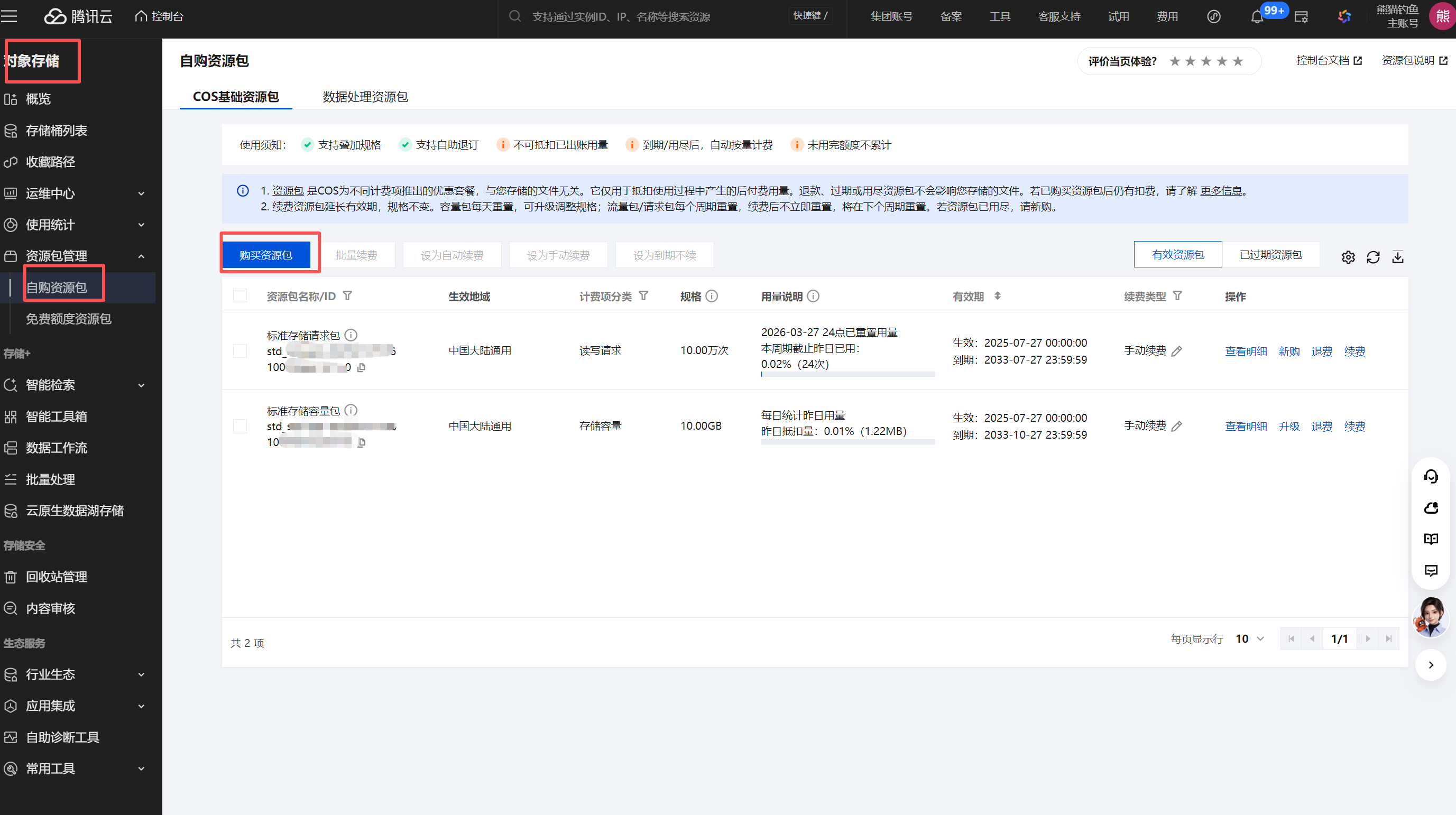
If the first two cases lean more toward planning and engineering, the third one is much more about the messy operational work inside production environments:
Tencent Cloud COS × WorkBuddy X skill: Automating Asset Management for My Game Project "Lobster"
What makes this article especially valuable is that it breaks down a workflow many teams assume must be handled manually into something that can be automated.
The public write-up gives a very concrete stack:
- Tencent Cloud COS
- Cloud Infinite CI
- WorkBuddy AI Agent
- OpenClaw S1 standard
The author summarizes the result in one line:
A zero-manual, second-level-response, natural-language-driven game asset management pipeline.
Based on the public description, this asset workflow is no longer just about "storing files." It is handling:
- File uploads
- Folder management
- Watermark generation
- Thumbnail generation
- Signed URL generation
- Asset preview and distribution
The article also gives one very clear efficiency claim:
- 90% reduction in manual operation time
Why does this kind of work matter so much? Because many game teams are slowed down less by gameplay design and more by asset circulation itself:
- UI, character art, and backgrounds are scattered across different directories
- Previewing assets is inconvenient
- Sharing large images is inconvenient
- Link permission control is annoying
- Every handoff to planning, engineering, outsourcing, or QA requires extra work
If WorkBuddy can already connect those actions with natural language, then its meaning for game teams is not "it is better at chatting."
It is starting to take over repetitive labor in asset collaboration.
Case 4: The public screenshots already look like real production environments, not just concept demos
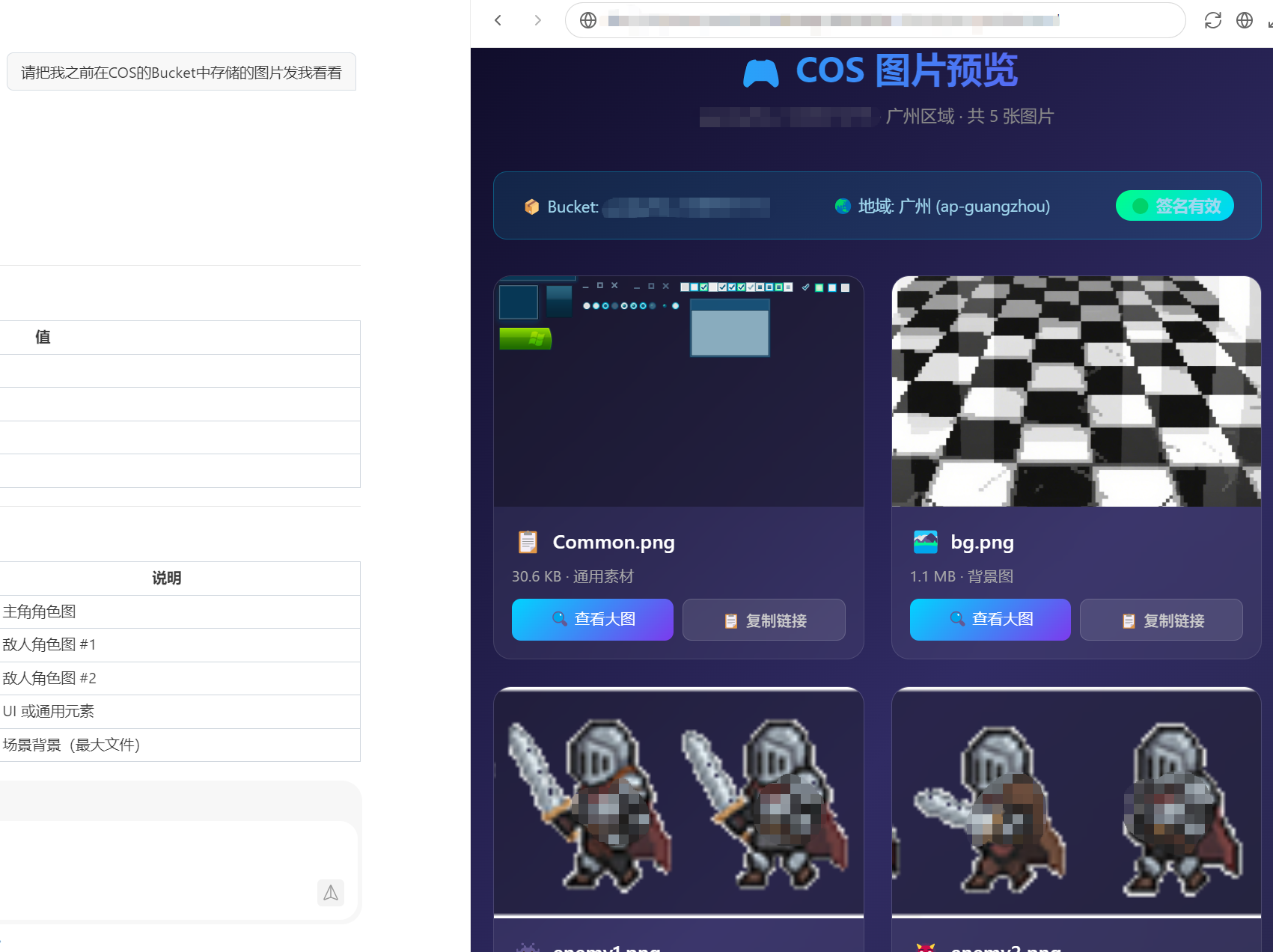
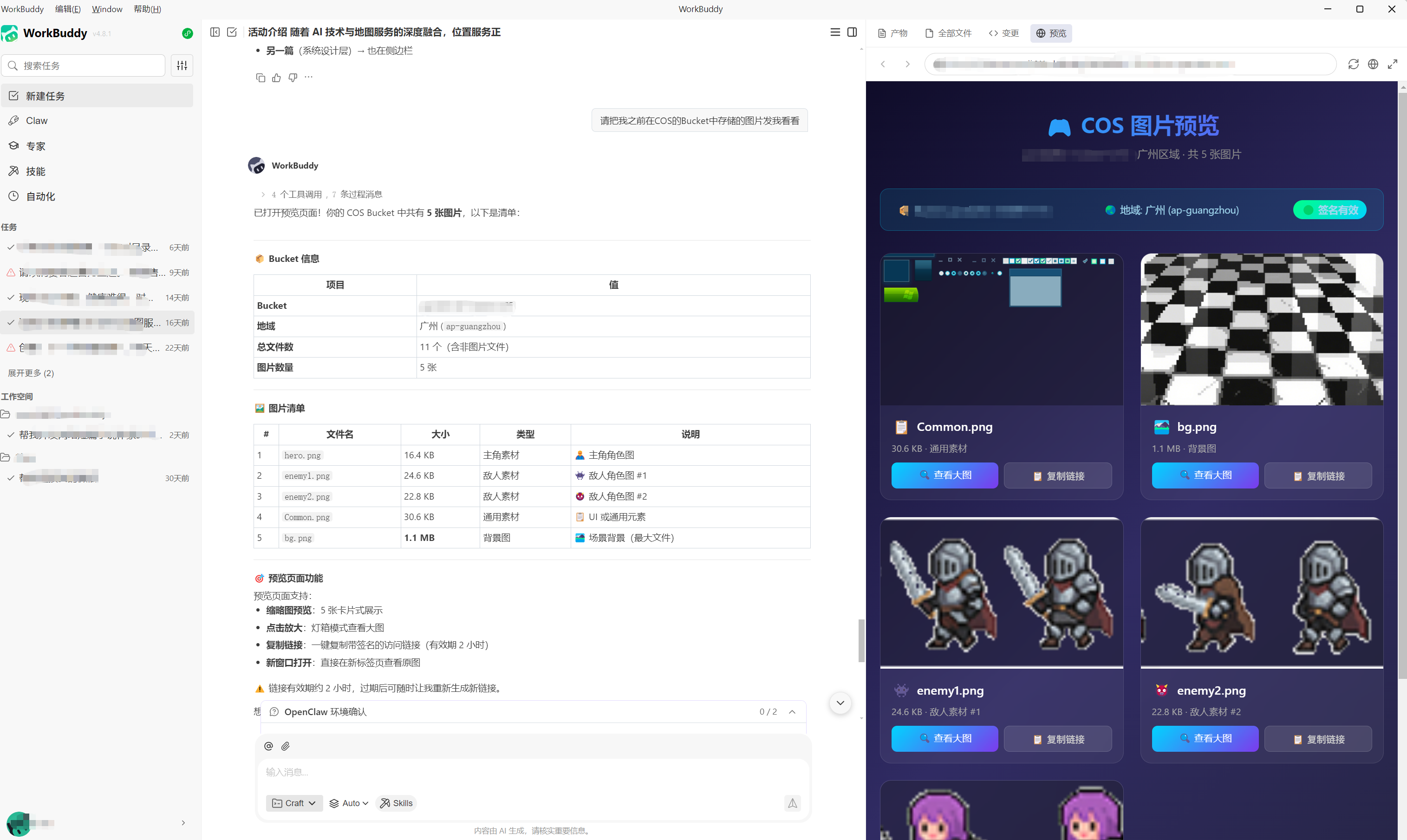
What makes this track especially interesting to me is not just how the articles describe it. The public screenshots themselves already look a lot like real environments.
From the screenshot in the asset-management article, you can directly see several things:
WorkBuddyfirst reads the asset list inside the bucket- The preview pane on the right directly shows asset cards and a large-image entry point
- Each asset item includes the filename, size, type, and description
- The page even shows access-control information such as signature valid
The screenshot even includes very typical game asset naming patterns, such as:
hero.pngenemy1.pngenemy2.pngCommon.pngbg.png
That tells us it is not speaking abstractly about "supporting asset management." It is already very close to the file organization patterns common in game projects.
And this interface also reveals something very practical:
In these scenarios, WorkBuddy is not just calling a model. It is connecting a desktop workspace, cloud storage, preview pages, and a Skill-driven workflow.
That is more valuable than showing an API scorecard by itself, because what teams actually care about is:
- Can project members use it directly?
- Can we cut down on tool switching?
- Can we compress asset collaboration into one workspace?
One level higher: Tencent's public positioning already treats the game industry as a priority scenario
Beyond the case-by-case hands-on articles above, the Tencent Cloud Developer Community also published a more high-level piece:
Tencent Cloud AI Agent Practices in the Game Industry: From Development Efficiency to Scaled User-Acquisition Growth
The importance of this article is that it shows Tencent is not treating the game industry as a one-off demo. It is treating it as a priority industry for scaled deployment.
Signals mentioned in the public article include:
- Asset production capacity improved by 10 times
- User-acquisition ROI improved by 6.2%
- Development efficiency improved by 50%
Those numbers no longer cover only "development" itself. They are starting to converge across:
- Development efficiency
- Asset operations
- Security and collaboration
- Growth-side media buying
That also explains why I see WorkBuddy in the game industry not as a point tool, but more like:
An Agent workspace that is gradually connecting R&D, prototyping, assets, and operations.
What these public cases suggest about real production environments in the game industry
When you put these public articles together, several common patterns show up in how WorkBuddy is already being used in game production:
- There is a specific project, not a blank chat session
- There is a clear technical stack, such as
Cocos Creator 3.x,WebGame, andHTML5 + Canvas/WebGL - There are concrete outputs, not just answers, including design docs, prototypes, asset lists, preview pages, and signed links
- There is a clear cloud resource environment, such as
COSandCloud Infinite CI - There is a concrete collaboration goal, not just one person having a smoother experience, but reducing repeated team rework
That is why I think the best use for it right now is not passive concept-watching. It is this:
Small teams, mini-game teams, prototype teams, and game development support teams using it for real trial-and-error work.
Which game teams should try it first right now
Teams that should try it immediately
- Teams building WeChat mini games, H5 mini games, or indie game prototypes
- Small teams that need to validate gameplay and balancing directions quickly
- Teams using
Cocos,WebGame, or browser-based prototype stacks - Project groups with especially chaotic asset management, preview, and distribution workflows
Teams that can wait and watch
- Teams that already have a very mature internal toolchain and do not want to switch workspaces soon
- Teams that rarely do fast prototype iteration
- Projects with almost no asset-collaboration pressure, very small scope, and very short workflows
- Teams that care more about top-tier visual art quality than solving workflow efficiency first
If you want to test it yourself, this is how I would test it
- Start with a real mini-game or prototype project. Do not begin from a blank prompt.
- Split the evaluation into three separate task groups:
- Planning and requirement organization
- Prototype building and migration
- Asset management and distribution
- Do not only ask "can it do it?" Focus on:
- The number of rework cycles
- The time from requirement to usable output
- Asset reuse rate
- Whether asset-collaboration costs drop in an obvious way
- If you already run multi-model or multi-Agent workflows, it is also worth comparing:
- Which tasks fit a workspace-style product like
WorkBuddy - Which tasks are still better handled through direct APIs and your own orchestration
- Which tasks fit a workspace-style product like
If what you care about more right now is how to unify Tencent-family models, GLM, Kimi, DeepSeek, StepFun, and similar routes inside your own Agent workflow, you can start here:
My final take
If I had to summarize my view of WorkBuddy game industry use cases in one sentence, it would be this:
What matters most is not that "Tencent also made an AI." It is that the product has already started entering the places that really consume team energy: mini-game planning, hour-level prototyping, Cocos migration, and COS-based asset collaboration.
At this stage, it is obviously not a "one-click from idea to launch" system. But the public cases are already enough to show:
- It can handle engineering workflows
- It can handle prototype workflows
- It can handle asset workflows
- And it has already left fairly concrete traces of real production environments
For the game industry, that matters more than a polished model launch. Because what really changes efficiency is usually not how smart the model sounds. It is this:
Has it started taking over the work your team has to repeat every week, even though nobody actually wants to do it?
References
- A Practical Sharing Session on Using WorkBuddy to Improve Efficiency in Game Development
- AI-Driven Mini-Game Development: From Idea to Playable Prototype in Just Hours
- Tencent Cloud COS × WorkBuddy X skill: Automating Asset Management for My Game Project "Lobster"
- Tencent Cloud AI Agent Practices in the Game Industry: From Development Efficiency to Scaled User-Acquisition Growth