Tencent WorkBuddy Smart Home Retail Case Study: Why AI Agents Are Moving into Pre-Sales Plans, Sales Quotes, and After-Sales Tickets
If you think WorkBuddy is only useful in smart home retail for writing a few pieces of marketing copy or replying to basic customer-service questions, you are only seeing the shallowest layer of what it can do.
This time I dug into a public article focused directly on end-to-end automation in smart home retail. After reading it, my conclusion was pretty clear:
The most interesting thing about WorkBuddy here is not chat. It is that it is starting to enter real business workflows spanning pre-sales, marketing, sales, after-sales, and the systems that connect them.
And in smart home retail, the heaviest work is usually not "can we sell," but:
- fragmented requirement intake
- slow proposal output
- painful quote calculation
- long after-sales ticket chains
- expensive coordination across multiple systems
That is exactly why I think this industry is a very good fit for a workstation-style AI agent like WorkBuddy to create real value first.
The short conclusion first
- As of June 29, 2026, the most convincing public
WorkBuddyuse cases in smart home retail are concentrated in three areas:- pre-sales requirement intake, solution generation, and sales quote automation
- batch marketing content production and multi-platform distribution
- intelligent after-sales ticket dispatching and cross-system coordination
- Based on public Tencent Cloud Developer Community material, these cases have already moved beyond "using AI for a few small features" and now show clear signs of:
- closed-loop business workflows
- distinct role responsibilities
CRM/ quoting system / ticketing system /BIdashboard integration- real-time
ERP / CRMlookup - mobile task triggering through WeCom / DingTalk
- If your team operates in smart home retail, offline stores, project-based sales, or installation plus after-sales coordination, these examples are much more valuable than generic AI office demos.
Why smart home retail is such a good fit for process-driven AI
What makes smart home retail hard is usually not one isolated task, but the full chain:
- the path from consultation to after-sales service is long
- each role owns only one slice, so information breaks easily
- proposals, quotes, procurement, acceptance, installation, and training all require cross-team coordination
- marketing and sales are not separate systems in practice and often have to move in parallel
In other words, the real pain is not a lack of business capability. The real pain is this:
From the moment a lead comes in to planning, quoting, signing, installation, repair, and follow-up, the entire chain often runs on manual handoffs.
And the most obvious pattern in the public WorkBuddy case is that it is not acting like a standalone chat box. It is moving into steps like:
- information gathering
- solution generation
- quote calculation
- batch content creation
- after-sales ticket handling
- cross-system coordination
That makes it look much more like:
an automation hub for smart home retail
instead of:
a model window that only answers questions
The public diagrams show that this business chain has already been broken into a full workflow
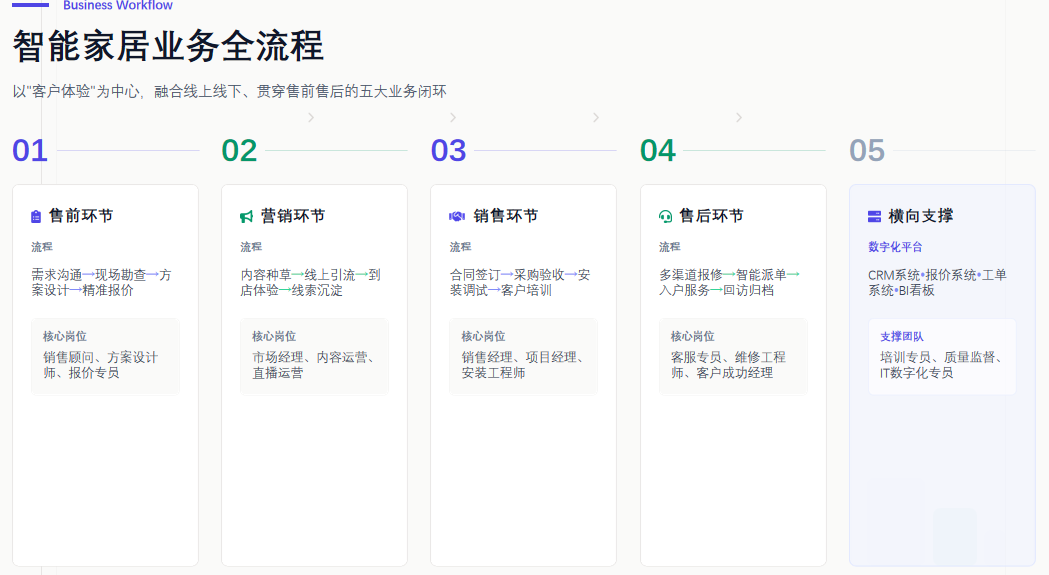
One of the most valuable things in this public article is how completely it breaks the workflow down. It already looks much closer to a real production setup than to a demo.
The diagram splits the smart home retail process into five sections:
- Pre-sales
- requirement communication
- on-site assessment
- solution design
- precise pricing
- Marketing
- awareness content
- online lead generation
- in-store experience
- lead capture
- Sales
- contract signing
- procurement and acceptance
- installation and commissioning
- customer training
- After-sales
- multi-channel repair requests
- intelligent dispatch
- on-site service
- follow-up and archiving
- Horizontal support
CRMsystem- quoting system
- ticketing system
BIdashboard
That tells us this is not a single-point "AI can improve efficiency" demo. It is already trying to cover an environment where all five lines run together:
- pre-sales
- marketing
- sales
- after-sales
- data and systems support
Case 1: The most valuable part is not writing proposals, but swallowing the messy work before the quote
The first line worth pulling into a dedicated SEO article is sales quote automation.
The public write-up describes the traditional pain points very directly:
- requirement intake often misses information
- solution drawings take time and get revised repeatedly
- quote calculation requires manual inventory and cost checks
- cross-team internal approvals leave customers waiting
What WorkBuddy automates is not just "calculate the quote." It takes over the whole stretch before the quote:
- information gathering
- automatically researches competitors and market data online
- organizes the findings into a structured report
- solution generation
- works from the customer requirements list
- automatically uses
PPTtemplates to generate a proposal
- quote calculation
- connects to
ERP / CRM - checks real-time inventory and cost
- generates standardized quotation sheets
- connects to
- workflow coordination
- supports remote task triggering via WeCom / DingTalk
- enables mobile work
That is why I think this case matters. The real quoting problem is never just "do we have the right Excel formula." It is this:
Can the information, proposal, inventory, cost, and approvals before the quote be connected into one chain?
Case 2: Smart home marketing is not about writing one post, but running a continuous content pipeline
The second line from the same public article that is highly worth turning into SEO content is AI-driven marketing content generation.
This part reads much more like the kind of content factory a real business team would care about, not "let the AI casually write a few lines of copy."
The article breaks marketing automation into three modules:
1. Market research and topic planning
- automated hot-topic tracking
- scheduled online research into smart home technology trends
- intelligent competitor monitoring
- automatic collection of competitor pricing, selling points, and user reviews
- generation of a daily industry trend report
2. Batch creation for multiple content platforms
- multi-agent coordination
- one-click generation of differentiated copy for different platforms
- automated formatting
MarkdowntoHTMLconversion- support for WeChat Official Accounts, Xiaohongshu, Zhihu, and WeChat Channels
3. Personalized marketing and user interaction
- generates personalized recommendation copy based on user behavior data
- integrates automated replies in WeCom
- pulls product material from the knowledge base to create tailored responses
This shows that in this industry WorkBuddy is not only touching "content." It is moving across the whole chain of:
- research
- topic selection
- writing
- formatting
- distribution
- replies
Case 3: What makes it feel like production is not the diagrams, but the fact that roles and systems are already written into it
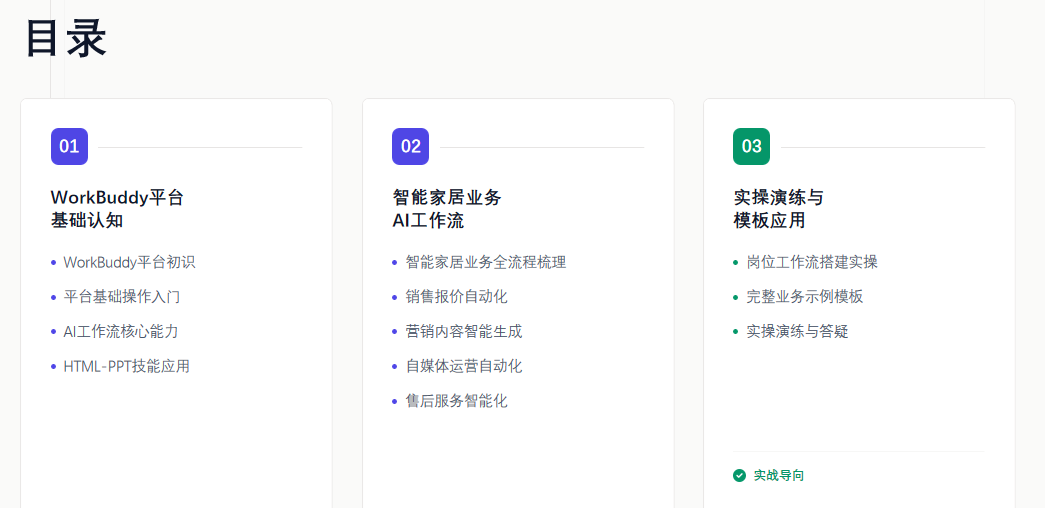
One reason I rate this article highly is that it does not only list features. It directly names the roles, systems, and ways of working involved.
From the screenshots and the main text, you can see:
- core roles
- sales consultant
- solution designer
- quoting specialist
- marketing manager
- content operations specialist
- customer-service specialist
- maintenance engineer
- customer success manager
- cross-functional roles
- training specialist
- quality supervisor
- IT and digital operations specialist
- horizontal systems
CRM- quoting system
- ticketing system
BIdashboard
That means the article is not abstractly saying "some AI can improve some step." It is describing this instead:
how different roles can actually use the same workstation together.
And that is one of the hardest steps in real industry rollouts.
Case 4: The value of the after-sales line is not just dispatching, but turning service from reactive work into a managed process
The third line in the public write-up that deserves attention is intelligent after-sales service.
It is not describing a simple FAQ bot. It describes a full after-sales chain:
- multi-channel repair intake
- intelligent dispatching
- on-site service
- follow-up and archiving
And in the role template examples, it even gives natural-language triggers such as:
- "Handle the new after-sales ticket"
That means WorkBuddy is not just replying to customers in this scenario. It is already moving into a service chain like:
- parsing repair information
- matching against a knowledge base
- generating resolution plans
- dispatching tickets
This matters a lot in smart home retail because after-sales is usually not a side process. It is:
a key driver of repeat purchases, reputation, referrals, and project profitability.
Case 5: Based on the public material, this industry is best approached by templating role-based tasks first
Another practical reason this article stands out is that it proposes a very clear rollout method. It does not jump straight to full end-to-end transformation. Instead, it starts with:
- defining the core tasks for each role
- identifying automation opportunities
- designing executable workflows
- splitting the task into
WorkBuddysteps
It even gives role-template examples:
- sales consultant
- "Generate a quote for a smart lighting solution"
- content operations specialist
- "Monitor hot topics and generate today's Xiaohongshu post"
- customer-service specialist
- "Handle the new after-sales ticket"
This looks much closer to the right path for real enterprise adoption. In many teams, what actually gets traction is not a giant all-in-one platform first, but this:
bring the most repeatable, easiest-to-template role actions into the agent first.
What these public cases tell me about smart home retail production environments
When you break this public article apart, the production environments around WorkBuddy in smart home retail already show a few common traits:
- there are real closed-loop workflows, not isolated tasks
- pre-sales
- marketing
- sales
- after-sales
- there are real supporting systems, not just text generation
CRM- quoting system
- ticketing system
BIdashboardERP / CRM
- there is real data and real external connectivity, not empty templates
- competitor pricing
- market data
- inventory
- cost
- user behavior data
- there are real actions, not just answers
- solution generation
- quote generation
- batch content creation
- remote triggering through WeCom / DingTalk
- ticket dispatching
That is why I think it behaves more like:
an agent workstation for stores and project-based retail
instead of:
a generic chat AI
Which teams should test this first
Teams that should try it now
- smart home retail teams and project-based sales teams
- organizations with complete proposal, quoting, installation, and after-sales chains
- teams that already have
CRM / ERP / ticketingsystems but still suffer from heavy coordination costs - retail teams that handle both content marketing and lead operations themselves
- companies that want to start AI adoption from role-based templates
Teams that can wait
- small teams with no stable process and everything handled ad hoc
- teams with no real data or systems in place and no standardized role actions yet
- teams that only want lightweight Q&A and do not plan to connect AI into business workflows
If you want to test this yourself, here is how I would do it
- Start with one high-frequency, highly standardized step. Do not try to connect the entire company on day one.
- In this industry, the best starting points are usually:
- sales quote automation
- pre-sales solution generation
- batch marketing content creation
- after-sales ticket dispatching
- Do not only ask whether it can generate output. Focus on:
- whether less information gets missed
- whether quoting standards stay consistent
- whether people need to switch systems less often
- whether after-sales response time gets shorter
- If your company is already investing in digital transformation, compare:
- which scenarios fit a workstation-style agent like
WorkBuddy - which scenarios are still better handled through internal system orchestration
- which scenarios fit a workstation-style agent like
If what you care about more right now is how to unify Tencent-family models, GLM, Kimi, DeepSeek, StepFun, and similar models inside your own agent workflow, you can start here:
My final take
If I had to summarize my view of the WorkBuddy smart home retail case in one sentence, it would be this:
What matters most is not whether AI can save a store a bit of time. It is that it is already entering the places that really determine whether the business runs smoothly: pre-sales plans, sales quotes, marketing content, after-sales tickets, and horizontal system coordination.
That matters far more than whether it can write copy. Because the hardest part of project-based retail has never been one piece of sales talk. It has always been this:
bringing scattered roles, scattered systems, and scattered processes into a single workflow that can keep running.
If WorkBuddy really starts working in these places, then its importance to this industry is not "a little more efficiency." It is this:
moving a business chain that used to depend on constant manual handoffs into an AI workstation that can be scheduled, reused, and extended.