Tencent Hunyuan Hy3 Review: 295B MoE, 256K Context, Stronger Agent Capabilities, and Real Product Integration

If you are searching for Tencent Hunyuan Hy3, you probably are not looking for just another model launch summary.
What you really want to know is:
- whether
Hy3is already a serious foundation model for coding and agent workflows - whether it behaves more like a general chat model or a practical productivity model
- whether it belongs in the same evaluation pool as
GLM,DeepSeek, andQwen
I reviewed Tencent's official July 6, 2026 Hy3 release note, the Tencent Hy3 GitHub repository, and the Hugging Face model card together. The conclusion is fairly straightforward:
What matters about Hy3 is not just that Tencent released a formal Hunyuan 3 model. It is that Tencent is now presenting model capability, real product feedback, agent usefulness, and API availability as one integrated story.
Quick verdict
- As of July 8, 2026,
Hy3is one of Tencent Hunyuan's most important official text-model releases. - In Tencent's own framing,
Hy3is not just a chat model. It is clearly oriented toward:- complex reasoning
- code generation
- agent tasks
- long-context use
- enterprise productivity scenarios
- Architecturally,
Hy3is aMoEmodel with:- 295B total parameters
- 21B active parameters
- 3.8B MTP layer parameters
- 256K context length
- In product deployment,
Hy3has already been integrated into:WorkBuddy/CodeBuddyYuanbaoMarvisima
- On the access side, Tencent has already stated that:
- the API is available on Tencent Cloud TokenHub
- multiple overseas third-party developer platforms will integrate Hy3 progressively
If you are a developer, an API integrator, or someone routing across multiple Chinese models, Hy3 is already at the stage where it deserves real testing.
Why this is more than a routine model upgrade
Tencent first released Hy3 preview on April 23, 2026. What launched on July 6, 2026 is the official Hy3 release.
That matters because this is not just a renamed preview. Two things stand out:
- Tencent explicitly says the official release further improves stability and cost efficiency
- the model has now been shaped by feedback from 50+ products and large-scale internal real-world usage
That puts Hy3 in a different category from models that still mostly live in benchmark decks.
Tencent's story here is much more practical:
- it has been used in real products
- it has seen daily end-user feedback
- it has seen internal business feedback
- it already has an API delivery path
That means Hy3 is no longer just about whether the model can do something. It is increasingly about whether it can do it reliably enough to ship.
The parameter story is not about being the biggest
Tencent's official specifications are fairly clear:
- 295B total parameters
- 21B active parameters
- 3.8B MTP layer parameters
- 256K context length
- MoE architecture
The most important point here is not raw total size, but this:
21B active parameters strongly suggests that Tencent is optimizing for capability-per-inference-cost, not just bragging rights on total parameter count.
In other words, Tencent is not selling Hy3 as the biggest model. It is selling it as:
a very strong model at its effective size, with performance that can rival flagship open-source models that are two to five times larger.
That is a very practical selling point for teams that actually care about production cost.
The most important thing about Hy3 is Agent and productivity usefulness
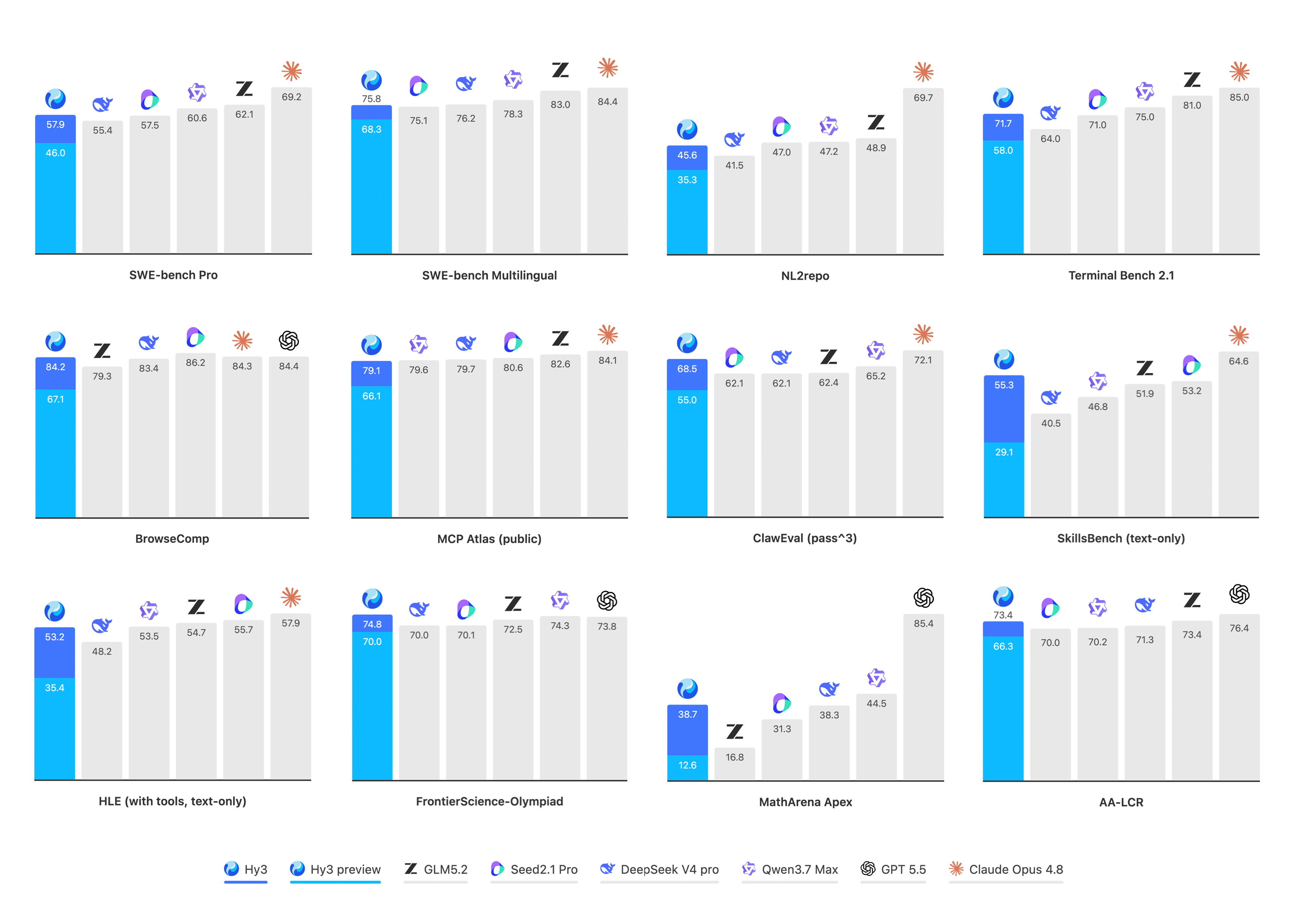
Both the official release note and the model card keep emphasizing one direction:
Hy3 improved especially strongly in agent, coding, and productivity tasks.
Tencent explicitly highlights progress in:
- software development
- office productivity
- financial modeling
- frontend design
- game production
That tells you Hy3 is not meant to be just another chat responder. It is aimed more at:
- task execution
- tool orchestration
- workflow coordination
- productivity delivery
That is why I would categorize Hy3 as much more of an agentic coding and productivity model than a general chat-first model.
Real product integration matters more than benchmark screenshots
Many model launches are overloaded with scores. Hy3 is more interesting because it is already embedded inside Tencent's own high-frequency products.
1. WorkBuddy and CodeBuddy
Tencent says WorkBuddy and related office-agent products already have real demand for:
- automated script generation
- workflow orchestration
- complex task handling
Tencent also says that since preview launched, the number of users actively selecting Hy3 preview inside WorkBuddy grew sixfold.
That is an important signal. It means Hy3 is not just "plugged into a product." It is actually being chosen by users.
2. Yuanbao Agent
Tencent also says that with Hy3's stronger agent capability, Yuanbao now offers a free Agent function.
Users can describe a task and have the system generate:
PowerPointWordExcelPDFHTML
That is already a productivity-delivery workflow, not just a conversation loop.
3. Marvis and ima
Hy3 also strengthens:
Marvis Agentfor file editing and generation, file management, diagnostics, and computer operationsimafor knowledge-base Q&A, long-form writing, and structured proposal generation
Taken together, that makes one thing very clear:
Hy3 is becoming one of the main foundation models behind Tencent's internal agent and productivity ecosystem.
How to read the benchmarks
Tencent's repository and model card provide a large benchmark appendix. The most valuable thing is not whether every single number is number-one. It is the capability shape the numbers reveal.
You see tasks such as:
SWE-bench ProSWE-bench MultilingualTerminal Bench 2.1BrowseCompMCP AtlasClawEvalFrontierScience-Olympiad
That list alone tells you a lot.
1. Coding and agent tasks are a core battlefield
If the strongest emphasis is on:
SWE-benchTerminal BenchClawEval
then this is obviously not a model optimized mainly for casual creative writing.
It is a model Tencent wants to prove in:
developer environments, tool use, and real agent execution.
2. It is also extending into search, tools, and scientific reasoning
Tasks like BrowseComp, MCP Atlas, and FrontierScience-Olympiad show that Hy3 is not only pushing on code.
It is also moving into:
- search
- retrieval
- tool use
- harder reasoning workflows
That makes it more suitable for complex productivity systems, not just single-turn chat.
What is the most practical value for developers and enterprises
If we strip away the launch language, I think Hy3's most practical value is here:
1. It gives teams another serious Chinese-model route for agent workloads
If your stack is already comparing:
GLMQwenDeepSeek
then Hy3 absolutely belongs in the same test pool.
Tencent's own positioning already makes clear that this is not a sidecar model. It is intended to be:
a strong, cost-efficient option for agents and productivity tasks at scale.
2. Tencent's product ecosystem gives it unusually rich real-world feedback
This matters a lot.
Many models can demo well, but the real problems are:
- drift on long tasks
- weak reliability in multi-step execution
- poor stability in workflow use
Hy3's advantage is that it is already being exercised through Tencent's own:
- office agent products
- knowledge workflows
- file workflows
- WeChat customer-service scenarios
- gaming assistants
That kind of feedback loop is hard to fake.
3. The API path is already real
For integrators, one of the most annoying situations is not a weak model. It is:
- no usable API
- unclear access path
- weak ecosystem readiness
Hy3 is already past that stage in Tencent's own public communication:
TokenHubAPI is live- overseas third-party developer platforms are expected to add it
That means this is not just an internal Tencent model anymore. It is moving into a broader access layer.
If you want to evaluate Hy3 now, what should you test first
If you are about to add Hy3 into your model-evaluation pool, I would prioritize these task categories:
- Code and repository tasks
- multi-file edits
- code explanation
- script generation
- CI/CD helper tasks
- Agent execution chains
- tool use
- task planning
- file generation
- office automation
- Long-context tasks
- long document structuring
- proposal synthesis
- knowledge-base Q&A
- multi-turn context retention
If you want to start from unified access, pricing comparison, and integration patterns, these pages are the most practical entry points:
Final take
If I had to compress my view of Tencent Hunyuan Hy3 into one sentence, it would be this:
The most important thing about Hy3 is not that Tencent launched another large model. It is that Hy3 is becoming a real production-oriented foundation model inside Tencent's agent and productivity ecosystem.
Is it automatically the best model in the world? I would not write that.
Has it clearly reached the stage where developers and enterprises should test it seriously? Yes.
Especially if you care about:
- agents
- coding
- office automation
- long context
- Chinese-model API routing
Hy3 is no longer a model you can ignore.
FAQ
When was Tencent Hy3 officially released?
The official release date was July 6, 2026. Before that, Hy3 preview launched on April 23, 2026.
What are Hy3's core specs?
According to the official model card, Hy3 is a MoE model with 295B total parameters, 21B active parameters, 3.8B MTP layer parameters, and 256K context length.
Is Hy3 more of a chat model or more of an agent and coding model?
Based on Tencent's public framing, it is much more oriented toward reasoning, code generation, agent execution, tool use, and productivity tasks than simple chat.
Is the Hy3 API already available?
Tencent explicitly states that Hy3 API is already live on Tencent Cloud TokenHub, with overseas third-party developer platforms expected to integrate it progressively.