Seed2.1 Review: Is This Chinese Agent, Coding, and Multimodal Model Worth Testing?
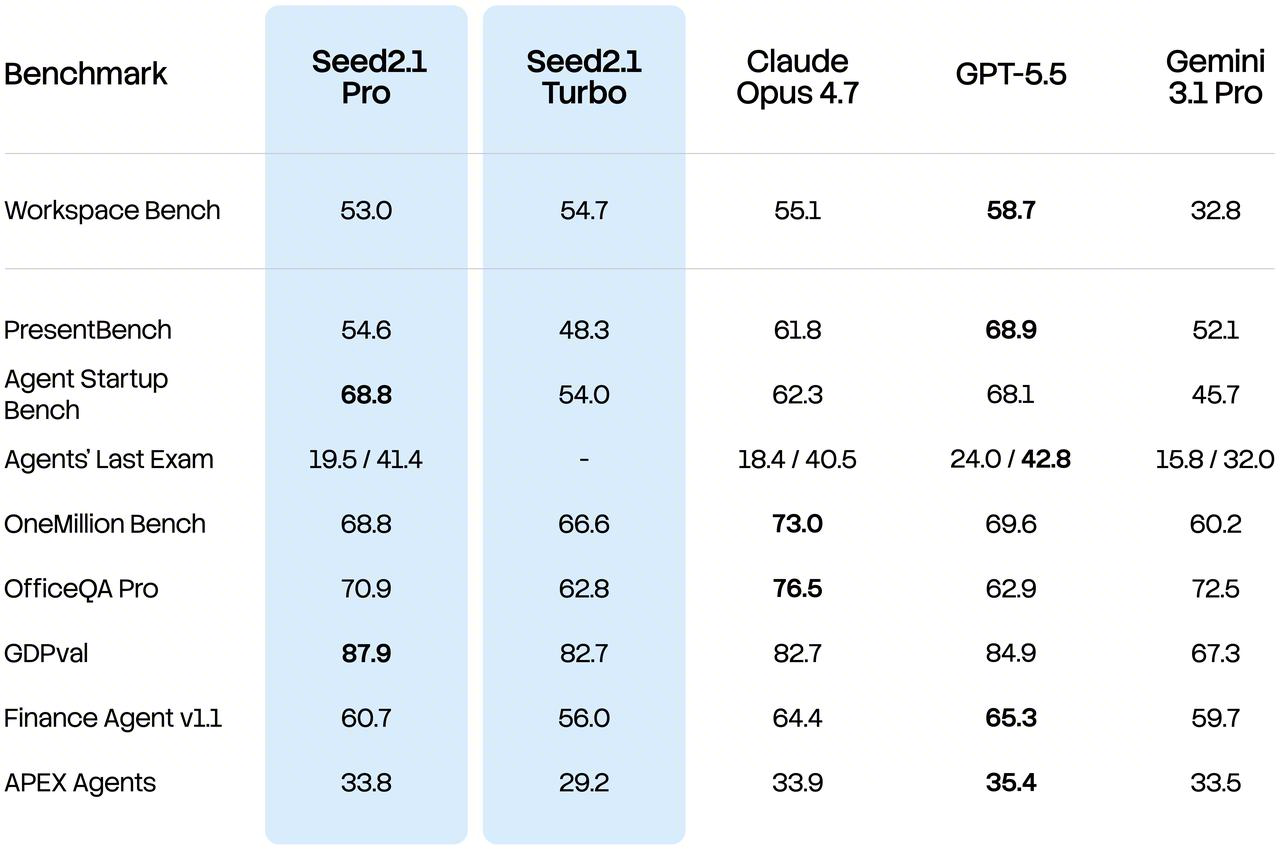
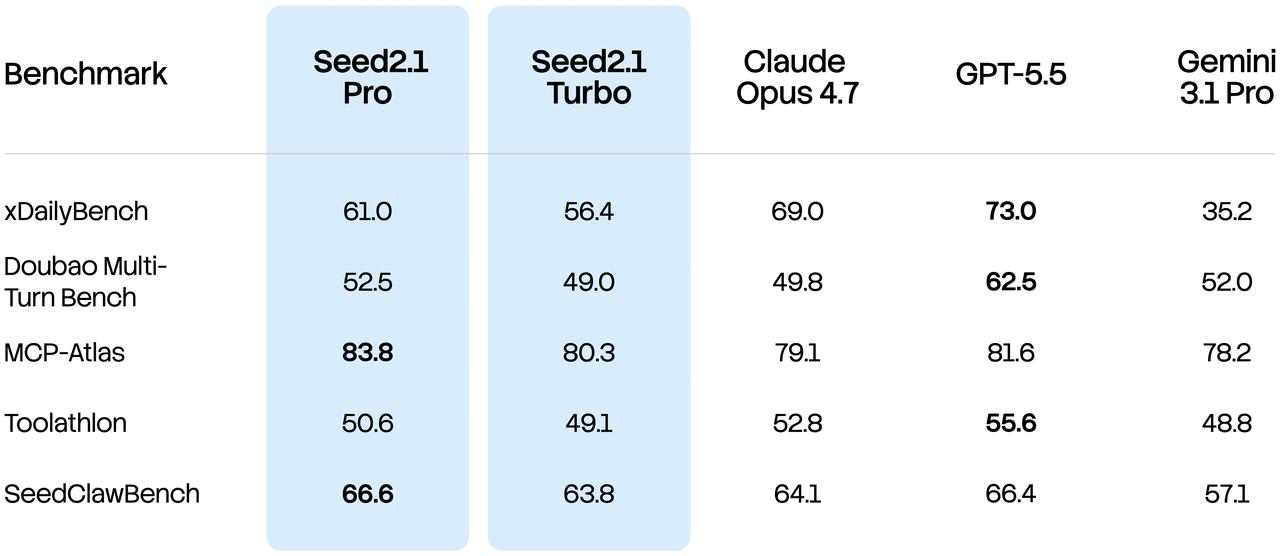
Seed2.1 was officially released by ByteDance Seed on June 23, 2026. The launch positioned Seed2.1 Pro and Seed2.1 Turbo as models built for real productivity work: agent execution, end-to-end coding, multimodal understanding, and long-context task delivery.
This review is based on ByteDance Seed's official project page and launch materials, but translated into a buyer-side question. For overseas buyers, the more useful question is not whether the launch sounds ambitious. It is this: does Seed2.1 deserve a place in a real evaluation cycle for agent workflows, repo-scale coding, and multimodal automation?
My short verdict is simple: if your team is evaluating agent workflows, coding agents, multimodal automation, or Chinese model procurement, Seed2.1 belongs on the shortlist.
TL;DR
Seed2.1was officially released on June 23, 2026.- The lineup centers on Seed2.1 Pro and Seed2.1 Turbo.
- The strongest official positioning is around agents, coding, GUI or computer-use style tasks, multimodal understanding, and long-context execution.
- The benchmark claims are promising, but they are still primarily vendor-published results until you validate them on your own tasks.
- For global buyers, the more useful commercial question is how to compare Seed-style routes with other Chinese model families through a simpler billing and onboarding path.
- This page is a review, not a live inventory promise. Current route availability, pricing, and account access should follow the live pricing, buy, and tutorials pages.
What Seed2.1 actually is
From ByteDance Seed's official project page and launch blog, Seed2.1 is not framed as a lightweight chat-model refresh. It is presented as a productivity-oriented model family designed for:
- more reliable general agent execution,
- stronger end-to-end software engineering delivery,
- better multimodal reasoning and video understanding,
- improved long-context task handling.
That distinction matters. A lot of model launches sound impressive if you only look at one benchmark or one short demo. Seed2.1 is more interesting if you care about whether a model can keep moving toward a task goal across multiple steps, tools, files, and interfaces.
The 4 things that matter most
1. Seed2.1 looks like a workflow model, not just a prettier chat model
The official materials keep coming back to the same idea: task completion matters more than one-turn polish.
Examples mentioned by the vendor include:
- project planning,
- file processing,
- tool use,
- lesson-plan and PPT generation,
- spreadsheet analysis,
- report generation.
That is the right framing for buyers who are not shopping for casual chat, but for work completion.
2. The coding story is about repository-scale delivery
ByteDance positions Seed2.1 around full software delivery, not only snippet generation. The emphasis is on:
- requirement understanding,
- implementation,
- bug fixing,
- environment setup,
- result verification.
That makes it more relevant for coding agents, repo maintenance, internal developer tools, and multi-file engineering tasks than for simple "write me a helper function" usage.
3. The agent angle is one of the strongest reasons to test it
The official release highlights performance in agent-style and computer-use benchmarks, including task environments that require more than pure text reasoning.
If your product needs a model that can:
- read instructions,
- decide what tool to call,
- continue after partial progress,
- work across browser, document, and code contexts,
then Seed2.1 is a better fit than a model chosen only for generic chat quality.
4. Multimodal ability matters because it expands automation use cases
The more interesting multimodal value is not "the model can describe an image." It is whether the model can turn visual input into usable work output.
That can matter for:
- screenshot-to-code workflows,
- document and chart understanding,
- form extraction,
- video understanding,
- design-to-implementation tasks,
- GUI-driven automation.
For buyers building real products, that is much more commercially relevant than a few isolated benchmark wins.
Which official signals are most worth tracking
If you want to use this review as a buying filter, I would prioritize three groups of official signals. They are not independent proof, but they do show where ByteDance believes Seed2.1 is strongest.
General agent and high-value task signals
- GDPVal: the launch materials say
Seed2.1 Proreached the top score on this benchmark. - Workspace Bench
- Agent Startup Bench
- Agents' Last Exam (ALE): described as first-tier in the official materials.
Those are closer to the question that matters for buyers: can the model actually help complete real work.
Coding and software engineering signals
- ProgramBench
- NL2Repo-Bench
- Code Arena: Frontend: ByteDance says
Seed2.1 Previewreached 1539 and ranked No. 8, with top-10 placement in 5 of 7 frontend subcategories.
The launch blog also highlights an anonymous developer crowd test on real repository tasks where Seed2.1 Pro posted a 59.1% win rate against Claude Opus 4.6. That is still a vendor-published comparison, but it is much more decision-useful than a single static coding question.
Multimodal, long-context, and video-understanding signals
- CharXiv-RQ
- MeasureBench
- ERQA
- MMLongBench-128K
- VideoMME
- TVBench
- TOMATO
Those benchmark names matter because they point to the exact use cases Seed2.1 is trying to win: long documents, structured visuals, interface-heavy tasks, and long-video workflows.
What I would not over-assume
Reddit-style honesty: Seed2.1 looks strong, but I would not market it to myself as a magic all-purpose replacement without testing it first.
Three caution points matter:
1. Most headline numbers still come from official materials
Claims such as top scores, first-tier placement, or strong head-to-head win rates are useful signals, but they are still primarily vendor-published. Treat them as inputs for evaluation, not as the final answer.
2. Strong workflow models are not automatically the cheapest option for every task
If your workload is mostly:
- short prompts,
- light drafting,
- simple extraction,
- basic chat,
then the best buying decision may come down to total token cost, routing simplicity, and latency rather than maximum task-completion strength.
3. Procurement matters as much as model quality
For many overseas teams, the blocker is not benchmark quality. It is procurement friction:
- separate vendor accounts,
- separate balances,
- regional onboarding complexity,
- inconsistent API surfaces,
- harder model-to-model comparison.
That is exactly why teams often look for a Hong Kong-based gateway instead of evaluating every Chinese model family through a separate commercial path.
A practical note on access for overseas teams
When buyers search for Seed2.1 API, they are often trying to solve procurement and comparison problems as much as model quality questions:
- a simpler way to test Chinese models,
- a cleaner overseas billing path,
- easier comparison across multiple model families,
- less friction when switching between routes.
llm-agent.cc is the Hong Kong-based company behind this site. We help overseas customers evaluate and access Chinese mainland model APIs through a simpler commercial path when that is operationally easier, not as a guarantee that every route is always live for every account tier.
Who should test Seed2.1 now
Good candidates
- teams building agent products,
- coding-agent teams working on real repositories,
- AI office or research workflow builders,
- multimodal automation products,
- buyers comparing Chinese model routes for production use.
Teams that can wait
- teams that only need lightweight chat,
- buyers optimizing only for the cheapest short-call route,
- teams with no real agent or coding workloads yet,
- teams that are not prepared to evaluate task completion with real internal data.
How I would evaluate it before buying at scale
- Pick
3to5real tasks from your own workflow. - Measure completion rate, rework, elapsed time, and token usage.
- Include multi-step tasks, not only single-turn prompts.
- Test it against at least two other routes, not in isolation.
- Separate "good benchmark story" from "good production economics."
For coding agents, use real repository tasks. For multimodal workflows, use your real screenshots, PDFs, forms, or video snippets. For procurement, compare not only per-token pricing, but also account overhead, billing path, and operational complexity.
Check the live pages before making a buying decision
If you want to compare Seed2.1 or related Chinese model routes through llm-agent.cc, use these live pages first:
Current route availability, pricing, and account access can change. Follow those pages for live status instead of reading this review as a guarantee that Seed2.1 is already available on every route or plan.
Final take
If I had to summarize this Seed2.1 review in one line, it would be this:
Seed2.1 looks like a serious productivity model for agent, coding, and multimodal workflows, and it is especially worth testing if your team is already comparing Chinese model routes for real production use.
The model itself is only one part of the decision. The other part is procurement and routing:
- how easily can your team access it,
- how quickly can you compare it with other Chinese models,
- how much operational overhead comes with the buying path,
- and whether the total workflow cost is actually competitive.
That is why this is not only a model-evaluation topic. For many global teams, it is also a buying-architecture topic.
FAQ
When was Seed2.1 released?
According to ByteDance Seed's official launch materials, Seed2.1 was officially released on June 23, 2026.
What versions are included in the Seed2.1 release?
The official project page lists Seed2.1 Pro and Seed2.1 Turbo.
Is Seed2.1 worth testing for coding agents?
Yes, if your evaluation is focused on:
- multi-step engineering tasks,
- repository-aware coding work,
- multimodal workflows,
- agent execution instead of plain chat quality.
Why would an overseas team use a Hong Kong gateway instead of buying model access one vendor at a time?
Because some teams prefer a simpler overseas onboarding and billing path when comparing Chinese model families. But live route availability, pricing, and account access should still be confirmed on the Pricing, Buy API access, and integration tutorials pages.
Where should I start if I want to compare Chinese model routes commercially?
Use: